

A high-performance exhaust system like the Project Faster Inc. Liberator is nothing more than an expensive ornament if your engine's fuel map remains calibrated for factory restrictions. You likely recognise that premium bolt-on components only reach their engineering potential when the air-to-fuel ratio is precisely managed. It is common to feel concerned that a lean-running engine following an exhaust upgrade might lead to permanent internal damage or a corrupted ECU. This guide demonstrates how to integrate Dynojet tuning technology with elite mechanical hardware to realise the full power and stability of your motorcycle.
We will examine the selection of the correct Power Vision 4 hardware, the importance of cloud-tune availability for 2024 through 2026 models, and how digital calibration secures the mechanical integrity of your build. By aligning software precision with high-strength components like a Mako swing arm, you ensure that every bit of torque translates into forward momentum without compromising reliability. Discover the technical pathway to crisp throttle response and increased horsepower through professional-grade calibration.
Key Takeaways
- Understand the evolution from carbureted jet kits to sophisticated EFI flash tuning for superior engine management and reliability.
- Learn why a Dyno Jet Power Vision 4 is the necessary partner for high-flow components like the PF Liberator High-HP Exhaust.
- Explore the engineering relationship between mechanical rigidity and digital power delivery to ensure your build remains stable under high-torque loads.
- Master the technical process of flashing a Harley-Davidson ECU to eliminate throttle lag and protect against damaging lean-running conditions.
- Realize the performance advantages of a build where every mechanical upgrade is supported by validated digital calibration.
Understanding the Dynojet Ecosystem: Beyond Simple Fuel Mapping
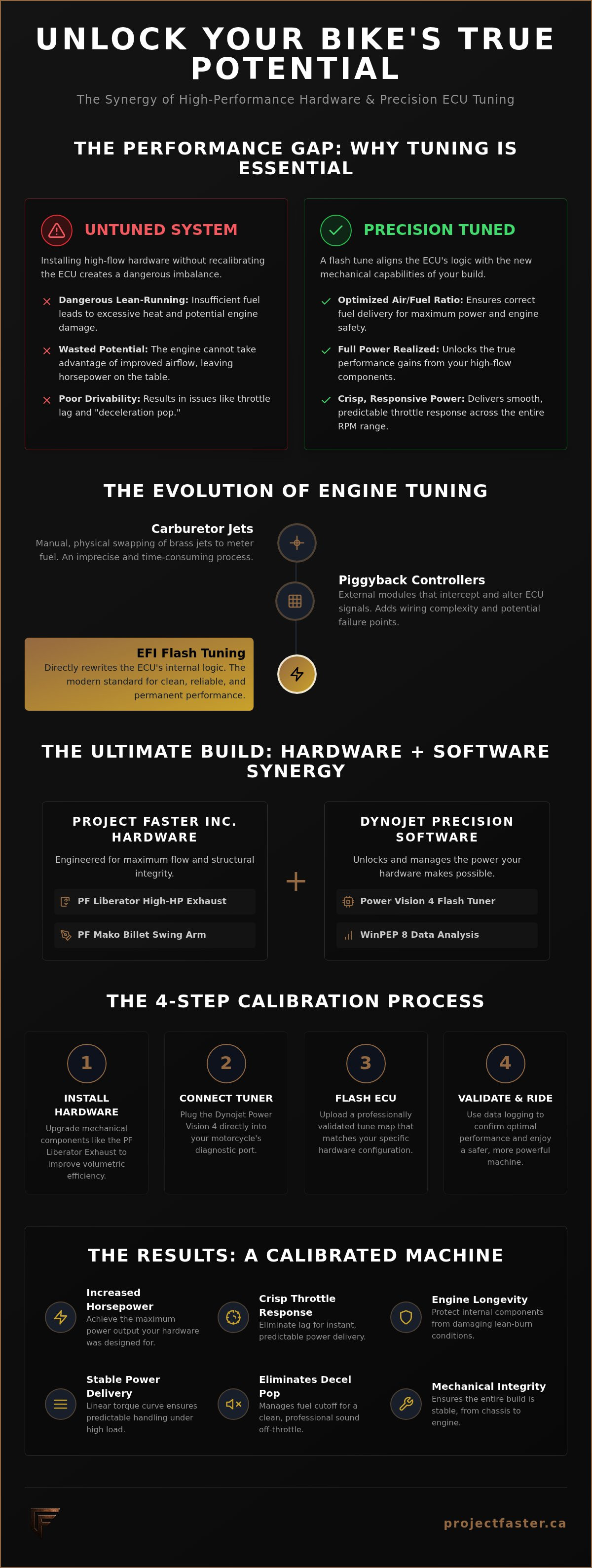
Performance is a calculation of physics and chemistry. For decades, riders used physical brass jets to meter fuel. Today, the Dyno Jet ecosystem has evolved into a sophisticated digital management suite. It is no longer about "tricking" a sensor with a cheap plug-in module. Instead, it is about comprehensive engine tuning that recalibrates how the motorcycle processes air and fuel at every RPM and throttle position.
Your Engine Control Unit (ECU) is a rigid logic board. When you install high-performance hardware like the PF Liberator High-HP Exhaust, you fundamentally shift the engine's volumetric efficiency. The ECU does not know you have improved the flow; it continues to deliver fuel based on factory-restricted parameters. You must teach the brain to recognize these new mechanical limits to prevent lean-burn scenarios that compromise engine longevity. Professional builders rely on data logging to bridge this gap, ensuring that the theoretical power on a spec sheet translates into real-world stability.
Flash Tuning vs. Piggyback Controllers
Modern V-Twin builds prioritize the invisible nature of flash tuning. Devices like the Power Vision 4 rewrite the internal tables of the ECU, creating a permanent and clean installation. Unlike piggyback controllers such as the Power Commander 6, which intercept signals between the ECU and the injectors, a flash tune changes the baseline logic. This results in a more stable, reliable system with fewer failure points in the wiring harness. For those seeking elite-level builds, the ability to flash the ECU directly is the only way to maintain a streamlined, factory-finish look without redundant hardware.
The Role of WinPEP 8 in Performance Analysis
Hardware is only as effective as the data supporting it. The Power Core Software Suite, which includes WinPEP 8, received its latest update on June 15, 2026, reinforcing its status as the industry standard for data analysis. This software allows technicians to move beyond guesswork. By utilizing the WinPEP 8 Data Center, builders visualize power curves and identify flat spots in torque delivery. This connection between technical data and the "seat-of-the-pants" feel is what separates a generic map from a precision-calibrated machine. Data logging ensures that performance gains are documented and repeatable, providing a level of mechanical integrity that aesthetic upgrades cannot match.
Why High-Performance Hardware Requires Precision Tuning
High-performance hardware is a mechanical liability without accurate digital calibration. When you install the PF Liberator High-HP Exhaust, you fundamentally increase the engine's ability to move air. This massive shift in volumetric efficiency requires a corresponding increase in fuel delivery. Without a Dyno Jet flash tune, the engine operates in a dangerous lean-burn state. This condition generates excessive cylinder head temperatures that can fatigue internal components and lead to catastrophic failure. Tuning is the safeguard that ensures your hardware investment actually delivers on its promise of power.
Calibrating for the PF Liberator Exhaust
The PF Liberator is engineered for high-velocity flow and reduced backpressure. While this is essential for top-tier horsepower gains, it often causes the factory ECU to struggle with maintaining a stable idle. A precise map adjustment eliminates the "deceleration pop" common in uncalibrated builds by managing fuel cutoff during off-throttle events. Proper calibration also aligns the torque curve with the exhaust’s resonant frequency. This ensures that the power delivery is linear and predictable across the entire RPM range. Riders should also stay informed regarding EPA enforcement on aftermarket parts to understand the regulatory landscape surrounding these modifications.
Chassis Rigidity and Power Management
Mechanical strength is only effective when power delivery is predictable. A rigid chassis, anchored by the PF Mako Billet Swing Arm, eliminates the structural flex found in OEM components. This lack of "give" means every engine pulse is transmitted directly to the rear tire through the 7075 aluminum structure. If the throttle response is erratic or "twitchy," the motorcycle becomes difficult to control under hard acceleration. Utilizing Dyno Jet technology to refine throttle progressivity allows the Vector Billet Swing Arm to manage increased torque without breaking traction prematurely. This synergy between software and hardware creates a machine that is both faster and more stable. If you are planning a high-output build, you can speak with our engineering team to ensure your components are perfectly synchronized.
Comparing Dynojet Solutions: Power Vision 4 vs. Legacy Systems
Tuning technology has transitioned from bulky handheld hardware to streamlined digital interfaces that reside in your pocket. The Dyno Jet Power Vision series represents this evolution, moving from the original PV1 and PV2 units to the current app-based architecture. This shift reflects the increased complexity of modern V-Twin communication protocols. Whether your motorcycle utilizes the older J1850 protocol or the modern CAN-bus system, the hardware must provide a stable, high-speed connection. This ensures that data packet integrity remains uncompromised during the critical moments of an ECU flash.
Power Vision 4: The App-Driven Future
The Power Vision 4 is the current standard for riders who demand efficiency and smartphone integration. By utilizing a high-speed Bluetooth interface, the PV4 allows you to view real-time engine data directly on your mobile device, eliminating the need for extra clutter on the handlebars. One of its primary advantages is the accessibility of "cloud-tunes." For 2024 through 2026 Harley-Davidson models, Dynojet has expanded its cloud-tune database, allowing riders to download and flash validated maps in minutes. This ecosystem also simplifies management for those with multiple motorcycles, as you can handle several vehicle licenses within a single app interface.
Power Vision 3: The Hard-Wired Professional Choice
While the PV4 offers convenience, many professional builders still rely on the Power Vision 3 for its dedicated hardware and wired reliability. The PV3 features a rugged, high-contrast screen designed to withstand the high-vibration environment of a performance V-Twin. Builders often prefer the PV3 for permanent handlebar mounting, providing a constant stream of critical data like cylinder head temperature and air-fuel ratios without relying on a phone's battery or a wireless connection. It remains a precise tool for those who prefer a tactile, physical interface over a touchscreen application.
Choosing between these systems depends on your specific performance goals and how you intend to monitor your machine. A cloud-tune is an excellent starting point for Stage 1 upgrades, but a custom dyno-tune remains the gold standard for high-horsepower builds involving components like the PF Liberator exhaust. Regardless of the hardware choice, the goal is to provide the ECU with the data it needs to manage the increased volumetric efficiency of your build. If you're unsure which tuner best supports your mechanical upgrades, contact our technical team for a professional recommendation.
Maximizing V-Twin Output: The Calibration and Flash Process
Precision tuning is the final layer of a performance build, but its success depends entirely on the mechanical integrity of the motorcycle. A digital map cannot fix a physical air leak or a failing battery. Before you connect your Dyno Jet hardware, you must verify that the engine is a sealed, stable environment. If the physical components aren't secure, the data collected by the sensors will be compromised, leading to a calibration that is fundamentally flawed. Flashing the ECU is the process of rewriting the engine's "operating system" to recognize the increased volumetric efficiency of your upgrades.
The Pre-Tuning Mechanical Checklist
Mechanical failures often masquerade as tuning issues. You must ensure that all titanium bolt kits and critical fasteners are torqued to exact engineering specifications to prevent vibration-induced air leaks. Intake leaks are particularly destructive; they introduce unmetered air that leans out the mixture and confuses the O2 sensors. Additionally, battery health is paramount. If the voltage drops below a specific threshold during the flash process, you risk a communication timeout that can corrupt the ECU. Always connect a high-quality battery tender before initiating a map write to maintain a steady 12.6 volts or higher.
The actual flashing process involves selecting a base map that most closely matches your hardware, such as the PF Liberator exhaust and a high-flow intake. The Power Vision system automatically saves a copy of your original factory calibration before any changes are made. This "Return to Stock" safety net is vital. It allows you to revert the motorcycle to its OEM state at any time, ensuring that your factory baseline is never permanently lost during the tuning process.
Refining the Map with Target Tune
A base map is a starting point, but real-world variables like Canadian fuel quality and varying altitudes require fine-tuning. Integrating wideband O2 sensors through a Target Tune module allows the system to monitor the exhaust gas in real-time with far greater accuracy than factory narrowband sensors. This technology enables the ECU to operate in a "Closed Loop" state across a wider range of the power band. By constantly adjusting fuel trims, the system achieves the perfect stoichiometric ratio for both peak power and engine longevity. This ensures the engine doesn't run too hot during summer tours or too rich at higher elevations. If you require assistance selecting the correct calibration for your specific hardware combination, contact our engineering department for technical support.
Engineering the Ultimate Build with Project Faster and Dynojet
Performance is a holistic pursuit. A high-output engine managed by Dyno Jet calibration requires a chassis capable of translating that energy into forward momentum without deflection. Project Faster components, such as the PF Mako Billet Swing Arm, provide the engineer-certified rigidity necessary to handle the increased torque loads. When you reduce unsprung weight through the use of 7075 aluminum and titanium bolt kits, you fundamentally lower the motorcycle's centre of gravity. This mechanical efficiency, paired with a refined fuel map, creates a machine that is more stable and responsive at high speeds. It's the cumulative effect of these precision-engineered layers that defines an elite build.
Closing the loop on a project means moving from the first billet cut to the final digital flash. Every mechanical upgrade should be supported by a corresponding software adjustment to ensure the system operates within its designed thermal and structural limits. By focusing on the physics of performance rather than aesthetic trends, you build a motorcycle that delivers real-world results. This approach eliminates mechanical weaknesses and ensures that your hardware and software are never working against each other.
The Synergy of Billet and Bluetooth
The relationship between hardware and software is best exemplified by the balance of "going power" and "stopping power." As you increase horsepower through digital tuning, the demand on your braking system and chassis stability intensifies. The PF Vector 108mm Radial Mount Brake Arm is designed to provide the uncompromising stiffness required to manage the aggressive deceleration of a tuned V-Twin. Achieving elite-level performance means your build must be balanced. A bike that accelerates like a rocket but flexes under braking is an incomplete engineering project. Excellence requires viewing the motorcycle as a single, integrated unit where billet strength and Bluetooth-enabled calibration work in perfect harmony.
Next Steps for Your Performance Project
Selecting the right combination of hardware and software depends on your specific performance objectives. Whether you are building a long-distance tourer that needs smooth, reliable power or a high-HP street machine, component compatibility is the key to longevity. You shouldn't guess which maps or parts fit your vision. Consulting with experts ensures that your investment results in a cohesive, reliable machine rather than a collection of conflicting parts. If you're ready to push the limit, contact the Project Faster engineering team to start your build. We provide the technical expertise to ensure your mechanical upgrades and Dyno Jet tuning are perfectly synchronized for the road ahead.
Mastering the Synergy of Mechanical and Digital Engineering
Achieving elite motorcycle performance requires more than just bolting on premium parts. It demands a holistic approach where precision 7075 billet aluminum construction and high-HP PF Liberator exhaust systems are supported by accurate digital mapping. By utilizing Dyno Jet technology, you ensure that every mechanical upgrade operates within its optimal thermal and structural parameters. This synchronization eliminates the risk of lean-burn conditions while maximizing the stability and power delivery of your machine.
The transition from factory restrictions to a fully calibrated build is the final step in realizing your motorcycle's true potential. Whether you are installing engineer-certified Mako swing arms or refining your throttle response via the Power Vision 4, the goal remains uncompromising reliability and functional superiority. Don't leave your performance to chance by running uncalibrated hardware. Start your high-performance build by contacting Project Faster today and align your machine with the highest standards of modern engineering. Your path to a faster, more stable ride begins with professional calibration.
Frequently Asked Questions
Will a Dynojet Power Vision void my motorcycle warranty in Canada?
Manufacturers in Canada can deny powertrain warranty coverage if an ECU modification is linked to a mechanical failure. While provincial consumer protection acts exist, Canada lacks a direct federal equivalent to certain international warranty laws. Dealership diagnostic tools can often detect that the ECU has been flashed, even if the factory tune is restored. You should consult your local dealer regarding their specific policy on performance tuning before proceeding.
Can I use a Power Vision 4 on more than one motorcycle?
Yes, provided you purchase additional vehicle licenses. A single Dyno Jet Power Vision 4 device can manage multiple motorcycles, but each unique VIN requires its own paid license to unlock the flashing capabilities. This allows builders to use one interface for an entire fleet while maintaining individual tune files for each bike. It is a cost-effective solution for households or shops managing several high-performance projects simultaneously.
Do I need a professional dyno tune if I use a pre-loaded Dynojet map?
Not necessarily for basic Stage 1 builds, but it is recommended for high-output projects. Pre-loaded "cloud-tunes" are engineered as safe, effective baselines for common hardware combinations. However, a professional dyno tune provides the final 5 to 10 percent of optimization by accounting for specific mechanical variances and local environmental conditions. For builds featuring the PF Liberator exhaust, a custom tune ensures maximum volumetric efficiency and engine longevity.
What is the difference between a Power Commander and a Power Vision?
The primary difference is how they interact with the motorcycle's electronics. A Power Commander is a physical piggyback module that intercepts signals, while a Power Vision is a flash tuner that permanently rewrites the ECU's internal logic. Flash tuning is preferred for modern builds because it removes the need for additional hardware and provides more comprehensive control over the engine's operating parameters such as ignition timing and rev limits.
How does altitude in the Canadian Rockies affect my Dynojet tune?
High altitude in regions like the Canadian Rockies reduces air density, which can lead to a rich-running condition. While factory sensors provide basic compensation, a Dyno Jet calibration ensures that target air-fuel ratios remain precise during significant elevation shifts. This optimization prevents the power loss and erratic throttle response often felt when riding through mountain passes in Alberta or British Columbia with higher-flowing components.
Can I revert my bike to the factory settings after using a Dynojet tuner?
Yes, the Power Vision automatically saves your original factory calibration before the first flash. This "Return to Stock" feature allows you to restore the OEM settings at any time. It is a critical safeguard for riders who may need to reset their motorcycle for emissions testing or before selling the vehicle. This ensures that your factory baseline is never permanently lost during the performance tuning process.
Is the Power Vision 4 compatible with both Android and iOS devices?
Yes, the Power Vision 4 utilizes a Bluetooth interface compatible with both Android and iOS smartphones. The dedicated app provides a seamless user experience for downloading tunes, viewing live engine data, and managing vehicle licenses. This cross-platform support ensures that most modern mobile devices can serve as the primary tuning interface. The app is updated regularly to support the latest operating system versions and hardware configurations.
Do I need to leave the Dynojet hardware plugged into the bike while riding?
No, the hardware only needs to be connected during the flashing process or when using the real-time data display. Once the new map is written to the ECU, the device can be removed. Many riders choose to leave it disconnected to maintain a clean, factory look, only reconnecting it for diagnostic checks or further calibration. This flexibility is a major advantage over older piggyback systems that required permanent installation.