

A high-performance V-Twin is only as capable as the logic controlling its combustion cycle, which is why the Thundermax system is a foundational requirement for serious builds. You've likely felt the frustration of a jagged throttle response or excessive engine heat after bolting on a high-flow exhaust like the PF Liberator. It's common to realize that factory lean air-fuel ratios simply cannot handle the physics of increased airflow, leaving your bike feeling unrefined despite the expensive hardware upgrades. Precision tuning is the mechanical glue that binds high-performance components into a cohesive, reliable power plant.
The Thundermax ECM solves these engineering gaps by replacing the stock unit with a system that prioritizes real-world data over static maps. This guide explains how the unit utilizes 18mm wide-band oxygen sensors to deliver a smooth, powerful powerband and lower operating temperatures. You will discover why synchronizing this advanced software with a rigid chassis, such as a Mako swing arm, is the only way to achieve mechanical excellence. We will examine the 2026 model compatibility and the auto-tuning features that ensure your bike adapts to future hardware changes without requiring a new dyno session for every modification.
Key Takeaways
- Learn why the Thundermax standalone ECM provides superior control over factory "piggyback" systems by managing every aspect of engine logic.
- Understand the engineering shift from narrowband to wideband O2 sensors, allowing for real-time fuel map adjustments based on actual exhaust gas samples.
- Discover the importance of pairing software-driven torque increases with a rigid chassis, such as the Mako billet swing arm, to ensure maximum power transfer.
- Identify how optimizing air-fuel ratios reduces cylinder head temperatures and prevents premature component wear caused by factory lean settings.
- Master the fundamentals of physical installation and professional optimization to ensure your V-Twin remains reliable across all Canadian riding conditions.
Understanding the ThunderMax ECM: The Brain of V-Twin Performance
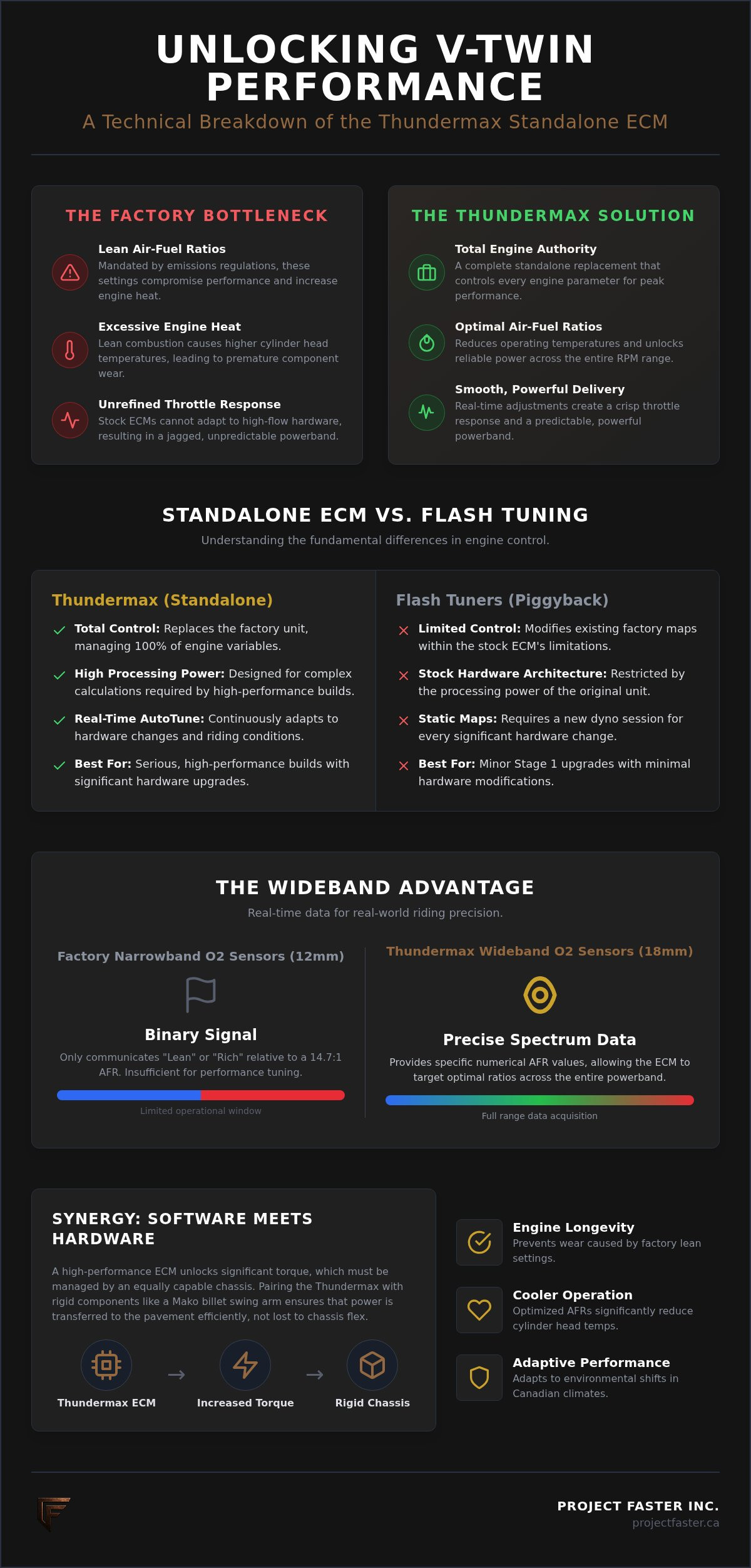
The Electronic Control Module (ECM) is the most critical hardware component for engine management. Unlike common tuners that merely modify factory tables, the Thundermax is a complete standalone replacement. It assumes total authority over the engine's operation, including precise control over ignition timing, fuel delivery, and idle speed. By removing the factory unit, riders eliminate the rigid lean parameters mandated by emissions regulations. These factory settings often compromise engine longevity and performance to meet standard compliance. A performance build requires a brain that prioritizes power and cooling over generic efficiency.
Standalone ECM vs. Flash Tuning
Flash tuners work by "re-mapping" the existing factory software. While effective for minor stage one upgrades, they're fundamentally limited by the stock hardware architecture. A standalone ECM operates with a higher degree of processing power and provides 100% control over every engine variable. This level of autonomy is essential for high-performance builds. When you install high-output hardware like the PF Liberator exhaust, factory logic often fails to compensate for the drastic change in airflow. A dedicated module ensures the fuel curve matches the mechanical reality of the build. This increased torque necessitates a rigid foundation, making components like the Mako billet swing arm a necessary companion to the software upgrade.
The Evolution of EFI in Harley-Davidson
The introduction of Electronic Fuel Injection in V-Twin engines marked a shift from mechanical simplicity to digital precision. Early systems were rudimentary and offered limited adjustment, often struggling with heat management in heavy touring models. Modern engineering has evolved to allow for much more granular control of air-fuel ratios. By 2026, the technology has reached a point where user-accessible platforms manage complex variables like knock control and real-time oxygen sensing. The release of the Thundermax 309-606 for 2026 Softail models demonstrates a commitment to keeping pace with Harley-Davidson's latest powertrain developments. This evolution allows riders to realize the full potential of their mechanical investments through a professional, engineering-first perspective.
The AutoTune Advantage: Wideband Precision for Real-World Riding
The transition from factory narrowband sensors to wideband technology represents a fundamental shift in engine management. Most stock Harley-Davidson models utilize 12mm narrowband oxygen sensors designed primarily for emissions compliance. These sensors operate within a very narrow window; they essentially function as a binary switch that tells the ECM whether the air-fuel mixture is above or below the stoichiometric ratio of 14.7:1. For a high-performance build, this data is insufficient. The Thundermax system replaces these limitations with 18mm wideband sensors that provide a complete spectrum of data, allowing the ECM to target specific air-fuel ratios across the entire powerband.
Wideband O2 Sensors Explained
The technical superiority of 18mm sensors lies in their ability to sample a larger volume of exhaust gas with extreme precision. While narrowband sensors only communicate "lean" or "rich," wideband units provide a specific numerical value. This real-time feedback allows the system to adjust fuel delivery instantly, resulting in a crisper throttle response and more aggressive acceleration. Understanding How Fuel Injector Systems Work reveals that accuracy is the only way to achieve mechanical efficiency. Wideband sensors serve as the primary data source for calculating the volumetric efficiency of the engine in real-time.
Adapting to Environmental Variables
Canadian riders face unique challenges due to diverse geography and rapid temperature shifts. A bike tuned at lower altitudes will naturally run differently when climbing through higher mountain passes or navigating varied terrain. Air density decreases at higher altitudes, which can lead to a rich condition and sluggish performance if the ECM cannot adapt. The Thundermax closed-loop system monitors these environmental variables and adjusts the fuel map while you ride. This constant optimization prevents engine pinging and detonation, which are common risks when factory-set lean parameters meet high-load situations.
By utilizing this self-correcting logic, the system eliminates the need for expensive dyno sessions every time you swap a component or change your riding environment. If you are planning a cross-country tour or a major engine upgrade, you can consult with our engineering team to ensure your hardware is ready for this level of precision. This automated adaptability ensures that your mechanical investment remains protected regardless of the Canadian climate.
Synergizing Software with High-Performance Hardware
Focusing solely on the digital side of performance is a common mechanical oversight. When a Thundermax unit optimizes fuel delivery and ignition timing, the resulting increase in torque places immense stress on the motorcycle's frame and drivetrain. A powerful engine is useless if the chassis cannot translate that energy into forward motion. We view the ECM as one half of a performance equation that requires high-grade hardware to complete. Structural integrity becomes the limiting factor once the engine is operating at its peak volumetric efficiency.
High-horsepower components like the PF Liberator exhaust system create the airflow necessary for significant gains, but they rely entirely on the precision of the fuel map to prevent lean-burn damage. Once the software and exhaust are synchronized, the next bottleneck is often the factory swing arm. Replacing a stock unit with a Mako billet swing arm ensures that the increased power doesn't result in rear-end instability or "bagger wobble" during aggressive acceleration. This synergy between software and hardware is what defines a professional build.
Power Delivery and Chassis Rigidity
Engineers often discuss "chassis flex," which occurs when the frame twists under high-load conditions. Stock stamped-steel swing arms are prone to this deformation, especially when a tuned engine delivers a sharp torque curve. The Vector billet swing arm provides the lateral stiffness required to keep the rear wheel tracked perfectly. Upgrading your suspension and swing arm alongside your ECM is not just about handling. It's about ensuring every bit of torque you've unlocked actually reaches the pavement without being lost to mechanical deflection.
The Role of Precision Fasteners
Structural integrity extends down to the smallest components. High-stress environments created by performance tuning generate increased vibration and heat. Using titanium bolt kits offers a dual advantage for the serious builder. Titanium provides a superior strength-to-weight ratio compared to OEM steel, ensuring fasteners don't stretch or fail under load. Additionally, reducing unsprung weight complements the improved throttle response of the Thundermax system. When the engine reacts faster, the chassis must be light and rigid enough to respond in kind. Every mechanical link must be as precise as the digital fuel map to achieve true engineering excellence.
Thermal Management and Engine Longevity
Thermal management is the silent guardian of mechanical integrity in an air-cooled V-Twin. While liquid-cooled engines have radiators to shed excess heat, a Harley-Davidson powerplant relies heavily on its lubricant and the fuel charge itself to maintain stable operating temperatures. Factory lean settings, often targeting a stoichiometric ratio of 14.7:1 for emissions compliance, are a primary cause of excessive cylinder head temperatures. These elevated temperatures accelerate oil breakdown and lead to the premature wear of critical components like valve guides and piston rings. Utilizing the Thundermax system allows riders to move away from these restrictive factory parameters, prioritizing engine health without sacrificing total power output.
Cooling Through Chemistry
The science of heat management in a fuel-injected engine revolves around the latent heat of vaporization. As liquid fuel is sprayed into the intake tract, it must vaporize before combustion; this phase change absorbs a significant amount of heat from the surrounding metal surfaces. When the ECM is programmed to deliver a slightly richer mixture during high-load or heavy traffic situations, it effectively uses the fuel as a cooling agent. A 10% increase in fuel richness can significantly reduce exhaust gas temperatures. The Thundermax closed-loop logic monitors these conditions in real-time, ensuring that the engine remains within a safe thermal window even during the peak of a Canadian summer.
Protecting Your Mechanical Investment
Reducing thermal stress is essential when you have invested in high performance Harley parts. High-output cams and big-bore kits generate more friction and heat than stock components, making precise EFI management a requirement rather than an option. If the air-fuel ratio is not optimized, the resulting heat can cause metal expansion beyond engineered tolerances, leading to scuffed cylinder walls or burnt valves. A well-tuned engine is a more reliable engine over tens of thousands of kilometres. By maintaining stable operating temperatures, you ensure that your mechanical links remain tight and your lubricants retain their protective properties.
Engineering a bike for longevity requires a holistic approach where software protects the hardware. If you are concerned about your current operating temperatures or are planning a high-stress build, you should contact our technical team for a professional consultation. We can help you synchronize your tuning strategy with your performance objectives to ensure your build stands the test of time and distance.
Installation and Professional Optimization
Replacing the factory ECM is a meticulous process that begins with ensuring the electrical environment is stable. The Thundermax system, which carries a 3-year factory warranty, requires a clean, high-integrity connection to the main harness. You must remove the factory unit and inspect the pins for any corrosion or debris before seating the new module. This is the foundation of digital reliability. Once the hardware is physically swapped, the focus shifts to the 18mm wideband sensors. These units require specific placement in the exhaust bungs to ensure they capture an accurate sample of the exhaust stream without being compromised by turbulence or moisture accumulation.
The Physical Installation Process
Proper cable routing is as vital as the sensor placement itself. You must secure the wideband sensor leads away from direct heat sources and any moving parts of the chassis. This prevents signal interference and physical damage over thousands of kilometres. While the software manages the engine, the chassis must be prepared for the new power profile. If you have already installed high-performance hardware like a Mako swing arm, verify that all pivot points are lubricated and torque specifications are met. A tuned engine delivers a much sharper torque curve, which will quickly expose any weaknesses in a poorly maintained or flexible chassis.
Software Setup and First Start
Initial configuration requires a Windows-based computer with at least 140 MB of available hard drive space. Using the T-Max Tuner software, version 2025.31, you will establish a connection via USB or Bluetooth to the module. Selecting the correct base map is the most critical step in the initialization process. You must choose a profile that closely matches your specific cams, exhaust volume, and intake capacity. After the firmware, currently version 6.9, is verified, the system requires the "Three-Cycle" rule. This involves three separate heat cycles where the engine reaches full operating temperature and then cools completely. This allows the AutoTune logic to establish its baseline and begin refining the fuel tables based on real-world sensor data.
Expert Consultation for Elite Builds
The AutoTune system is exceptionally capable, yet complex engine configurations often benefit from a more nuanced approach. If you are building a high-compression motor or utilizing specialized forced induction, an engineer-certified perspective ensures that every variable is perfectly accounted for. Total performance is achieved when the digital logic mirrors the mechanical potential of the hardware. Precision is not accidental; it is the result of deliberate engineering and high-end technical sophistication. Ready to synchronize your performance hardware? Contact the Project Faster engineering team for expert build advice.
Mastering the Physics of V-Twin Performance
Mechanical excellence is not achieved by accident. It is the result of synchronizing high-performance hardware with the digital precision required to manage it. By integrating a Thundermax ECM, you move beyond the limitations of factory settings and into a realm where real-time data dictates engine health. This system ensures that your torque increases are managed safely, protecting your investment from the destructive effects of lean-burn heat and inconsistent fuel delivery. When your software is as capable as your chassis, the result is a bike that remains stable and powerful across every kilometre of Canadian pavement.
As specialists in high-stress V-Twin components, Project Faster Inc. is dedicated to providing the engineer-certified performance hardware that forms the physical foundation of your build. We take pride in serving the Canadian performance community with components designed for uncompromising durability and functional superiority. If you are ready to bridge the gap between raw power and refined control, we are here to assist. Consult with our engineers to optimize your high-performance build and ensure your motorcycle reaches its full mechanical potential.
Frequently Asked Questions
Does the ThunderMax void my factory Harley-Davidson warranty?
Altering the ECM on a Harley-Davidson that is still under factory warranty will likely void parts of that warranty. This is a critical consideration for owners of 2026 models. Since the system replaces the stock unit entirely, the factory diagnostic tools will recognize the change. You should consult with your local Canadian dealer to understand how aftermarket performance modifications affect your specific coverage before proceeding with the installation.
Can I use the ThunderMax with my factory O2 sensors?
No, the system requires the 18mm wideband sensors included in the kit to function correctly. Factory 12mm narrowband sensors are binary switches that cannot provide the broad data spectrum the AutoTune logic needs. If your current exhaust system doesn't have 18mm bungs, you'll need to weld in new ports or upgrade to a high-performance system like the PF Liberator to accommodate the advanced hardware.
How much horsepower can I expect to gain from a ThunderMax tuner?
Horsepower gains depend on your supporting hardware, but most riders see a 5% to 10% increase in usable power. The Thundermax focuses on optimizing the entire powerband rather than just peak numbers. By eliminating factory lean spots and jagged throttle response, the bike feels significantly faster and more responsive. The real-world advantage is a smoother delivery of torque that stock mapping cannot replicate.
Is the ThunderMax difficult to install for a home mechanic?
Physical installation is a straightforward plug-and-play replacement that most home mechanics can complete with basic hand tools. The process involves swapping the ECM and routing the new wideband sensor cables. The technical challenge lies in the software initialization phase. You'll need a Windows-based laptop to select the correct base map and verify that the firmware is updated to version 6.9 for optimal stability.
What happens if I change my exhaust or air cleaner later?
The system automatically adapts to future hardware changes through its closed-loop AutoTune feature. Unlike flash tuners that require a new map for every modification, this module samples exhaust gas in real-time to adjust fuel delivery. If you install new cams or a high-flow intake, the software recognizes the shift in volumetric efficiency and refines the map while you ride to maintain peak performance.
Does the system require a professional dyno tune after installation?
A professional dyno session is not required for the majority of builds because the system creates a custom map during real-world riding. The AutoTune logic continuously compares actual air-fuel ratios to programmed targets and makes necessary corrections. While a dyno can be useful for verifying elite-level builds, the Thundermax is engineered to deliver professional-grade results through its own automated data collection and processing.
Will the ThunderMax improve my fuel economy?
Fuel economy improvements are possible but depend on your target air-fuel ratios and riding habits. While the system optimizes combustion efficiency, performance maps often prioritize engine cooling and throttle response over maximum mileage. You'll likely notice a more consistent fuel burn across varying altitudes. However, if you're utilizing the increased torque frequently, your fuel consumption will reflect that aggressive riding style.
How does the ThunderMax handle cold starts in Canadian climates?
The system features adjustable cold start and warm-up maps designed to ensure reliability in harsh Canadian temperatures. It manages idle speed and fuel enrichment precisely until the engine reaches operating temperature, preventing the stalling or "hunting" common with factory lean settings. This granular control over the warm-up cycle ensures your mechanical components are properly lubricated and stabilized before you put the engine under significant load.