

Most riders accept rust and rounded bolt heads as an inevitable tax on motorcycle ownership, but your Harley-Davidson’s factory steel is actually a bottleneck for its mechanical potential. You’ve likely spent hours scrubbing oxidation after a harsh winter or struggled with a stripped primary bolt that simply wasn't engineered for high-torque applications. It is a common frustration to find that the hardware holding your machine together lacks the integrity of the engine itself. This guide explores the harley davidson titanium bolt upgrade benefits, proving that Grade 5 titanium is a structural necessity for any serious performance build.
We realize that every gram of unsprung weight affects how your suspension reacts to the road. By switching to Ti-6Al-4V aerospace-grade hardware, you can achieve a 45 percent weight reduction over OEM steel while gaining a permanent solution to corrosion. We will break down the engineering behind these kits, showing how they optimize mechanical stability and provide the tensile strength required for high-horsepower V-Twin environments. From improving handling to ensuring your tools never slip on a soft bolt head again, we are looking at the physics of why titanium is the ultimate upgrade for your chassis.
Key Takeaways
- Understand why Grade 5 (Ti-6Al-4V) titanium offers a superior strength-to-weight ratio over the mass-produced steel hardware found on factory models.
- Discover the harley davidson titanium bolt upgrade benefits, including how a 45 percent weight reduction improves unsprung mass and suspension performance.
- Learn to eliminate corrosion and oxidation permanently, protecting your motorcycle’s structural integrity against road salt and moisture.
- Master the technical requirements of installation, such as using nickel-based anti-seize to prevent galling and ensure precise torque delivery.
- Realize how precision-engineered fastener kits serve as the essential final step for builds featuring high-performance Mako or Vector swing arms.
The Limitations of OEM Steel: Why Your Harley Needs a Hardware Reset
Fasteners are the silent architecture of your motorcycle. In the high-vibration environment of a V-Twin chassis, every bolt acts as a critical structural component responsible for maintaining the alignment and tension of the entire machine. While the engine and frame receive the most attention, the hardware holding them together is often a victim of mass-production economics. Manufacturers typically utilize low-grade steel to minimize costs during assembly. This choice isn't based on performance; it's a financial compromise that forces the rider to deal with heavy, rust-prone components that degrade over time.
Choosing to ignore these factory limitations hinders your bike's potential. One of the primary harley davidson titanium bolt upgrade benefits is the correction of this mass-production flaw by replacing substandard steel with high-integrity materials. Standard steel bolts represent parasitic mass, adding weight without contributing to the machine's strength. When you're building a high-performance bike, every gram of dead weight matters.
The Problem with Oxidation and Corrosion
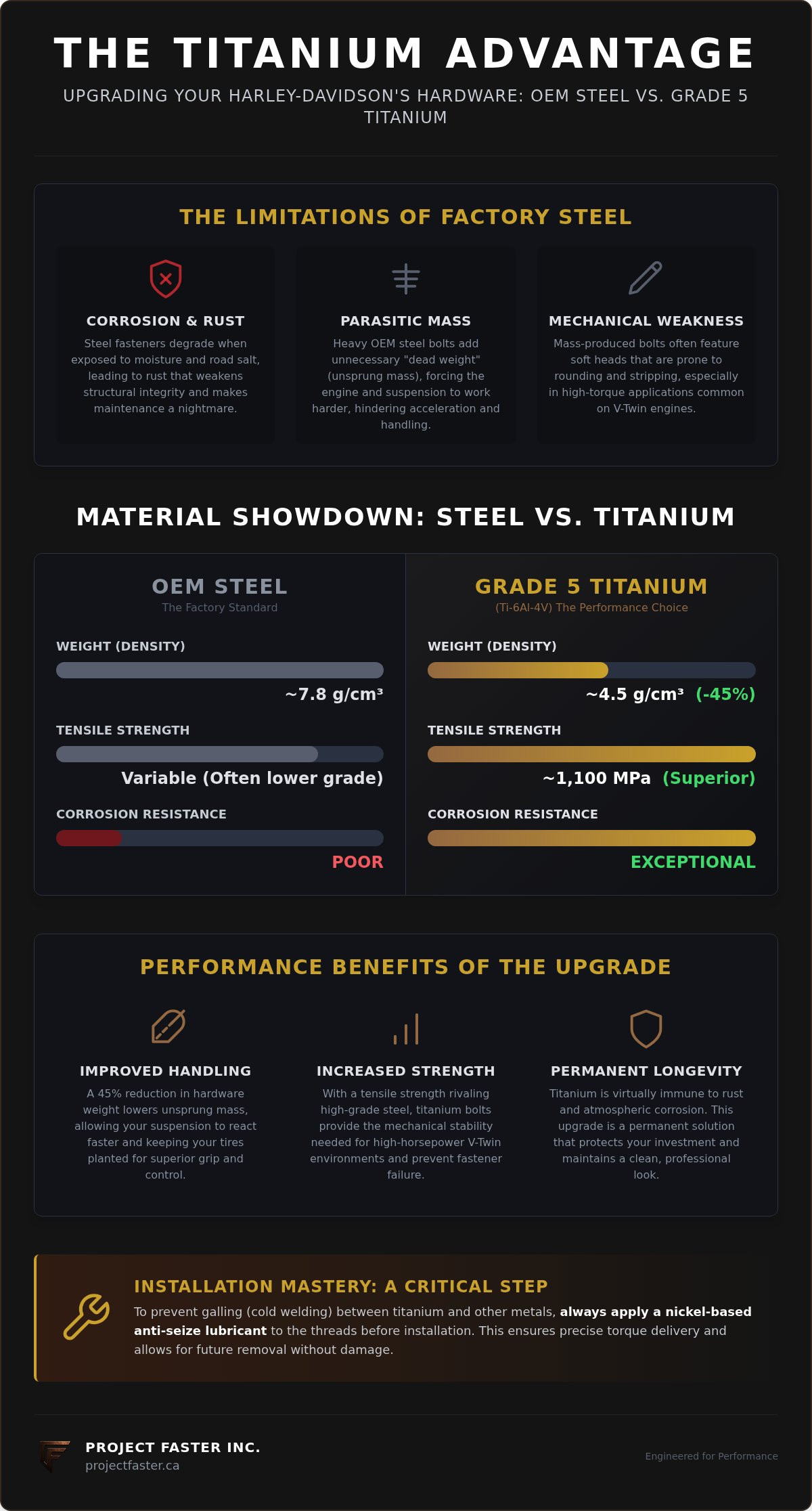
The "orange glow" of rust on a bolt head is more than an aesthetic eyesore. It is a visible sign of mechanical degradation. In the Canadian climate, road salt and humidity cycles accelerate galvanic corrosion, effectively welding steel fasteners into aluminum cases or frames. This chemical bond makes routine maintenance a nightmare, often leading to rounded-off heads or snapped bolts. Oxidation is the primary enemy of long-term mechanical integrity. Using hardware like Grade 5 Titanium (Ti-6Al-4V) eliminates this risk entirely, as titanium forms a passive oxide layer that prevents further environmental decay.
Mass and Mechanical Efficiency
Parasitic mass is the enemy of acceleration and handling. Heavy steel bolts contribute to the overall "dead weight" of the motorcycle, forcing the engine and suspension to work harder than necessary. For riders investing in High Performance Harley Parts, keeping the chassis light and rigid is essential. High-performance builds are often limited by the weight of their own assembly. By stripping away the unnecessary bulk of OEM steel, you allow the chassis to respond more fluidly to rider input. This isn't just about shedding pounds for the sake of it; it's about optimizing the mechanical efficiency of the entire platform through strategic harley davidson titanium bolt upgrade benefits.
Materials Science: Why Grade 5 Titanium (Ti-6Al-4V) is the Superior Choice
Grade 5 Titanium, technically known as Ti-6Al-4V, is an alpha-beta alloy consisting of 6 percent aluminium and 4 percent vanadium. This specific chemical composition creates a material that is significantly lighter than steel while maintaining comparable, and often superior, mechanical strength. In the world of high-performance motorcycles, the primary appeal of this alloy is its incredible strength-to-weight ratio. Comparing the two materials reveals a stark contrast in physics. Steel has a density of approximately 7.8 g/cm³, whereas titanium sits at just 4.5 g/cm³. This reduction in mass is the foundation for reducing unsprung weight, a critical factor for any rider looking to sharpen their bike's handling and suspension response.
In the high-vibration environment of a Harley-Davidson chassis, fasteners eventually succumb to fatigue. Titanium possesses an exceptional fatigue life, meaning it can withstand millions of stress cycles without developing the micro-cracks that lead to catastrophic failure in lower-grade hardware. Additionally, the material naturally forms a stable, tenacious oxide layer upon exposure to oxygen. This microscopic shield makes the alloy virtually immune to rust and atmospheric corrosion, ensuring the harley davidson titanium bolt upgrade benefits remain a permanent part of your build rather than a temporary aesthetic fix.
Tensile Strength and Yield Points
Tensile strength defines the maximum stress a bolt can withstand before failure. Grade 5 titanium offers a tensile strength of roughly 1,000 to 1,100 MPa. This outperforms standard Grade 8.8 steel and closely matches the capabilities of high-tensile Grade 10.9 fasteners. For engine cases and primary covers, having a high yield point is essential. It ensures the fastener maintains its clamping force under load without stretching or deforming. This structural rigidity is one of the most overlooked harley davidson titanium bolt upgrade benefits, providing a level of reliability that mass-produced steel simply cannot match.
Thermal Stability in V-Twin Engines
Air-cooled V-Twin engines experience massive temperature swings that can reach extremes during summer idling or high-speed touring. Titanium is prized for its low coefficient of thermal expansion. While steel fasteners might expand and contract significantly, potentially loosening or over-tightening during heat cycles, titanium remains remarkably stable. This stability ensures that the torque values you set in the garage remain consistent on the road. Titanium maintains its structural properties at temperatures where other metals soften. If you have questions about specific fitment for your performance build, reach out to our engineering team for a technical consultation.
Quantifiable Performance Benefits: Weight, Handling, and Vibration
Upgrading to titanium isn't a cosmetic choice; it's a calculated engineering decision that yields measurable results on the road. The most immediate of the harley davidson titanium bolt upgrade benefits is a verified 45 percent reduction in mass compared to stock hardware. While a single bolt may seem insignificant, the cumulative effect of replacing dozens of fasteners across the chassis and engine is substantial. This reduction isn't just about the total scale weight of the bike. It's about where that weight is removed. Lighter sprocket bolts, for instance, reduce rotating inertia. This allows the powertrain to transfer torque to the rear wheel with less resistance, resulting in snappier acceleration and improved throttle response.
Fasteners also play a role in how a motorcycle manages energy. Titanium possesses a different modulus of elasticity than steel, which allows it to absorb high-frequency harmonics rather than simply vibrating with them. This characteristic protects surrounding components from the "buzz" often associated with high-performance V-Twin builds. By understanding these harley davidson titanium bolt upgrade benefits, riders can build a machine that is lighter, faster, and more comfortable over long distances.
Suspension and Handling Optimization
Every gram counts when you're chasing cornering precision. Reducing unsprung mass—the weight of components not supported by the suspension springs—is the fastest way to improve handling. When you use titanium hardware in conjunction with a Vector Billet Swing Arm, the shock absorber reacts to road imperfections with greater speed. Lighter hardware at the axle and brake mounts means the wheel can track the pavement more accurately. This ensures more consistent tyre contact and a more planted feel through aggressive sweepers.
Vibration Dampening and Rider Fatigue
Rider fatigue often stems from the relentless high-frequency vibration of large-displacement engines. Because Grade 5 Titanium (Ti-6Al-4V) has distinct resonant characteristics, it acts as a subtle dampener for the harmonics produced by Milwaukee-Eight and Twin Cam powerplants. This is why professional race teams prioritize titanium. It isn't just for the weight savings. The material's natural fatigue resistance ensures that fasteners don't work themselves loose or fail under the constant stress of racing conditions, providing a level of reliability that stock steel cannot match.
Installation Mastery: Managing Torque and Preventing Galling
Precision engineering demands precision installation. While the harley davidson titanium bolt upgrade benefits are extensive, they are only fully realized when the hardware is seated with technical accuracy. The primary challenge during installation is galling. This is a form of abrasive wear that occurs when two metal surfaces slide against each other under high pressure, causing them to effectively cold-weld together. This risk is particularly high when threading titanium into aluminium engine cases or other titanium components. Without proper lubrication, the friction can destroy both the fastener and the internal threads of your chassis before the bolt is even fully tightened.
To mitigate this, high-quality nickel-based anti-seize is a mandatory component of the assembly process. It acts as a sacrificial barrier between the threads, ensuring smooth engagement and preventing the molecular bonding that leads to seized hardware. Furthermore, our performance kits utilize 12-point heads rather than traditional hex designs. This geometry provides significantly more surface area for tool engagement. It allows for superior torque transfer and ensures that even at high clamping forces, you won't round off the fastener head. This level of mechanical stability is a hallmark of professional-grade builds.
The Step-by-Step Installation Protocol
Success begins with thread preparation. You must clean all internal threads using a dedicated solvent or a thread chaser to remove old locking compounds and debris. This ensures your torque wrench provides an accurate reading of the clamping force rather than just measuring thread friction. Use nickel-based anti-seize for most applications to prevent galling, but utilize a medium-strength thread locker only where specifically required by service manuals. Always use a calibrated torque wrench. Titanium has different friction coefficients than steel, so following exact torque specifications is the only way to ensure the fastener stays within its elastic range without over-stretching.
Maintenance and Long-Term Care
Once properly torqued, titanium hardware is essentially a "set it and forget it" upgrade. Unlike factory steel, which requires constant cleaning to manage oxidation, titanium remains chemically stable. During your seasonal maintenance in Canada, a simple visual inspection is usually sufficient. Check for any signs of movement or loosening, especially on high-vibration areas like the primary cover or exhaust mounts. Because titanium does not rust, you won't have to struggle with seized bolts during future teardowns. If you're unsure about the specific torque values for your model, contact our engineering team for technical support and installation guidance.
The Project Faster Advantage: Engineering the Ultimate Titanium Kit
At Project Faster, we don't view hardware as a secondary consideration. Fasteners are the foundation of mechanical integrity. Our kits represent a commitment to engineering excellence that matches the intensity of your performance build. Every component is selected to provide the maximum harley davidson titanium bolt upgrade benefits, ensuring that your machine is held together by aerospace-grade materials rather than mass-produced compromises. Beyond the physics of the alloy, there is the undeniable aesthetic of Grade 5 titanium. The natural, "race-spec" finish never fades, peels, or chips like chrome or powder-coated steel. It provides a clean, technical look that signals a focus on functional superiority and meticulous attention to detail.
We realize that a performance build is a system of interconnected parts. Our hardware is designed to withstand the violent harmonics of high-horsepower V-Twin engines without backing out or stretching. This reliability is built into every thread. By choosing a curated kit, you ensure that every critical fastener on your motorcycle meets a uniform standard of strength and precision. This approach eliminates the weak links in your chassis, allowing you to push the machine to its absolute limits with total confidence in its structural stability.
Precision Fitment and Engineering Certification
Project Faster kits are not generic assortments of hardware. We curate each package for specific Harley-Davidson platforms, including Touring and Softail models, to ensure perfect fitment for every application. Our engineering process prioritizes the high-stress areas of the chassis and engine, such as motor mounts, primary covers, and suspension pivots. Buying a complete kit is significantly more efficient than piecing together hardware from multiple sources. It guarantees that every bolt has the correct grip length and thread pitch for your specific model. Our commitment to quality is a point of pride; even our supporting components, like the PF Men's T-Shirt and Odin Mfg Hoodie, reflect the same Canadian-made durability and rugged standards as our titanium hardware.
Building a Performance Ecosystem
A titanium kit is the essential companion to the Mako Billet Swing Arm. When you combine lightweight fasteners with a rigid billet arm and a PF Liberator High-HP Exhaust, you transform the chassis dynamics of the bike. The reduction in mass and the increase in rigidity work together to sharpen handling and acceleration. We encourage you to view your Harley as a precision performance machine, not just a cruiser. Every upgrade should contribute to a more responsive and reliable ride. Complete your hardware reset and explore our full range of engineered components at our Shop All Parts page to realize the full potential of your build.
Securing the Future of Your Performance Build
Fasteners are the structural links that define your motorcycle's reliability. By choosing aerospace-grade Ti-6Al-4V alloy, you move beyond the compromises of factory steel and invest in a chassis that is 45 percent lighter than OEM alternatives. We've detailed how these components eliminate the risk of seized bolts and improve suspension response by reducing unsprung mass. Realizing the full harley davidson titanium bolt upgrade benefits means prioritizing mechanical integrity over mass-production shortcuts. This hardware reset ensures your machine remains immune to the oxidative decay typical of Canadian winters while maintaining precise torque under extreme thermal stress. We provide a zero corrosion guarantee because our engineering process leaves no room for material weakness. It's time to treat your Harley-Davidson as the precision machine it was meant to be. If you're ready to finalize your build with the highest standard of titanium hardware, reach out to our engineering team for technical support. Your pursuit of uncompromising performance starts with the right foundation.
Frequently Asked Questions
Will titanium bolts seize in my Harley engine cases?
Titanium bolts will not seize if you utilize a high-quality nickel-based anti-seize during the installation process. While factory steel hardware often bonds to aluminium cases through oxidation, Grade 5 titanium is virtually immune to atmospheric corrosion. This makes it a superior choice for riders facing humid or salty conditions. Proper lubrication prevents the cold-welding effect often feared in high-stress engine environments, ensuring the hardware remains easy to remove during future maintenance cycles.
Is Grade 5 titanium stronger than the factory steel bolts on my Harley?
Grade 5 titanium (Ti-6Al-4V) is significantly stronger than the low-grade steel utilized in mass-produced factory hardware. It offers a tensile strength of approximately 1,000 to 1,100 MPa, which matches or exceeds the performance of high-tensile Grade 10.9 steel fasteners. This structural integrity is one of the primary harley davidson titanium bolt upgrade benefits, providing a higher yield point that prevents fastener stretching in high-vibration V-Twin applications where mechanical stability is paramount.
Do I need to use a different torque spec for titanium bolts?
You should generally follow the factory torque specifications found in your service manual, but technical precision is mandatory. Because titanium requires anti-seize to prevent galling, the lubricant reduces thread friction, which can lead to over-tightening if you aren't careful. We recommend using a calibrated torque wrench to ensure the fastener stays within its elastic range. Following these exact values preserves the mechanical integrity of your engine cases and prevents damage to the internal threads.
What is the actual weight saving of a full titanium bolt kit?
A complete titanium bolt kit provides a verified 45 percent weight reduction over the equivalent OEM steel hardware. While the mass of a single bolt is small, replacing the fasteners across the entire chassis and engine removes significant dead weight. This reduction is particularly valuable for unsprung mass in the suspension and rotating mass in the drivetrain. Shedding this weight allows your motorcycle to accelerate faster and react more fluidly to road imperfections and rider input.
Can I use Blue Loctite on titanium bolts?
You can use Blue Loctite on titanium bolts if the specific application requires a thread-locking compound, but nickel-based anti-seize is often the priority. For most engine and chassis fasteners, preventing galling with a lubricant is more critical for long-term maintenance. If a service manual specifies a thread locker, ensure the threads are perfectly clean before application. Never use a permanent red locker, as the strength of titanium makes removal extremely difficult without applying excessive heat to the chassis.
Why should I choose titanium over stainless steel for my motorcycle?
Titanium is the superior choice for performance-oriented riders because it is 45 percent lighter than stainless steel while offering higher tensile strength. Stainless steel is often used for aesthetic purposes but lacks the fatigue resistance and strength-to-weight ratio found in Grade 5 Ti-6Al-4V. By choosing titanium, you realize the harley davidson titanium bolt upgrade benefits of reduced mass and increased structural rigidity, whereas stainless steel simply offers a rust-resistant finish without any performance gains.
What does "galling" mean and how do I prevent it during installation?
Galling is a form of abrasive wear that occurs when metal surfaces cold-weld together under high pressure during installation. It is a common risk when threading titanium into aluminium or other titanium components. You can prevent this failure by applying a thin layer of nickel-based anti-seize to the threads. This lubricant acts as a sacrificial barrier, ensuring smooth engagement and protecting the internal threads of your motorcycle's engine and chassis from permanent mechanical damage during high-torque assembly.
Are titanium bolts worth the investment for a daily rider?
Titanium bolts are a worthwhile investment for daily riders because they eliminate the issue of rust and corrosion permanently. OEM steel hardware often degrades after a single winter, leading to rounded heads and seized fasteners that complicate simple repairs. Upgrading to a titanium kit provides a permanent solution to environmental wear while improving the overall mechanical efficiency of the machine. It is a "set it and forget it" upgrade that pays for itself in long-term reliability and ease of maintenance.