

Every gram of unsprung weight you strip from your motorcycle's wheels, brakes, and axle directly improves suspension response and handling precision. When choosing between titanium vs stainless steel motorcycle bolts, you are making a critical engineering decision that dictates how your machine handles high-stress loads. While factory steel hardware is functional, it often fails to meet the standards required for elite V-Twin builds. You've likely noticed surface corrosion on stock bolts or felt the heavy, sluggish feedback during high-speed cornering.
We understand that you demand mechanical integrity that matches the precision of high-end billet aluminium components. This guide analyzes the technical differences between these alloys to determine which best eliminates mechanical weaknesses. You'll discover how Grade 5 titanium provides a 45% weight saving over steel while maintaining a tensile strength of up to 950 MPa. We also examine how 316 stainless steel compares in terms of fatigue resistance and long-term durability. This engineering perspective ensures you can strategically optimize your bike's power-to-weight ratio and achieve professional-grade results.
Key Takeaways
- Understand the material science behind density and tensile strength to select fasteners that maintain structural integrity under high-stress loads.
- Discover how to prevent mechanical issues like thread galling while achieving permanent resistance to road salt and moisture.
- Identify the strategic locations on your chassis where reducing unsprung mass provides the most significant improvements to handling and suspension feedback.
- Evaluate the technical differences between titanium vs stainless steel motorcycle bolts to determine the best fit for your performance goals and maintenance schedule.
- See how engineer-certified hardware integrates with precision components like the Vector and Mako swing arms to create a cohesive, high-performance assembly.
The Role of Premium Fasteners in High-Performance Motorcycle Engineering
Fasteners serve as the fundamental structural links within high-stress motorcycle assemblies. They aren't merely decorative accessories. Factory-grade steel is often chosen by manufacturers for cost efficiency, yet it frequently falls short in high-performance environments where mechanical limits are tested. Transitioning to specialized alloys allows riders to manage the violent vibrations inherent in large-displacement V-Twin engines. The choice between titanium vs stainless steel motorcycle bolts represents a move toward mechanical integrity where every gram of mass is scrutinized. Balancing the pursuit of reduced mass with the necessity for absolute strength is the hallmark of professional-grade engineering.
Beyond Aesthetics: The Functional Purpose of an Upgrade
Performance-oriented riders prioritize material science over superficial appeal. While a polished finish is a secondary benefit, the real value lies in how these materials behave under load. Different Titanium alloys offer specific advantages in strength-to-weight ratios that traditional stainless steel cannot match. This weight reduction isn't just about the total number on the scale. It's about shifting the centre of gravity and reducing the rotational and unsprung mass of the chassis. Premium hardware is the natural partner for high-performance components like the Vector billet swing arm. Using elite fasteners ensures the entire assembly remains rigid, responsive, and free from the flex associated with lower-grade hardware.
Identifying High-Stress Zones on a V-Twin
Certain areas of a motorcycle require hardware where failure simply isn't an option. These high-stress zones include brake caliper mounts, engine cradles, and suspension pivots. These points endure constant shear forces and rapid thermal cycling. Understanding the relationship between torque specifications and material elasticity is vital for long-term reliability. If a bolt is too rigid, it may snap under the intense vibration of a high-horsepower V-Twin. If it's too soft, it won't maintain the necessary clamping force over time.
- Brake Systems: These areas experience high heat and extreme hydraulic pressure during aggressive deceleration.
- Drivetrain Mounts: These points must withstand the massive torque loads generated by high-output engines.
- Suspension Pivots: These require fasteners that handle continuous oscillation and heavy impact absorption without fatigue.
Standardizing your hardware with professional-grade kits ensures consistent maintenance intervals. It eliminates the guesswork often found with mixed factory hardware. By choosing the right material for the specific application, you don't just fix a problem; you engineer a permanent solution for the life of the machine.
Material Science: Density, Tensile Strength, and Weight Analysis
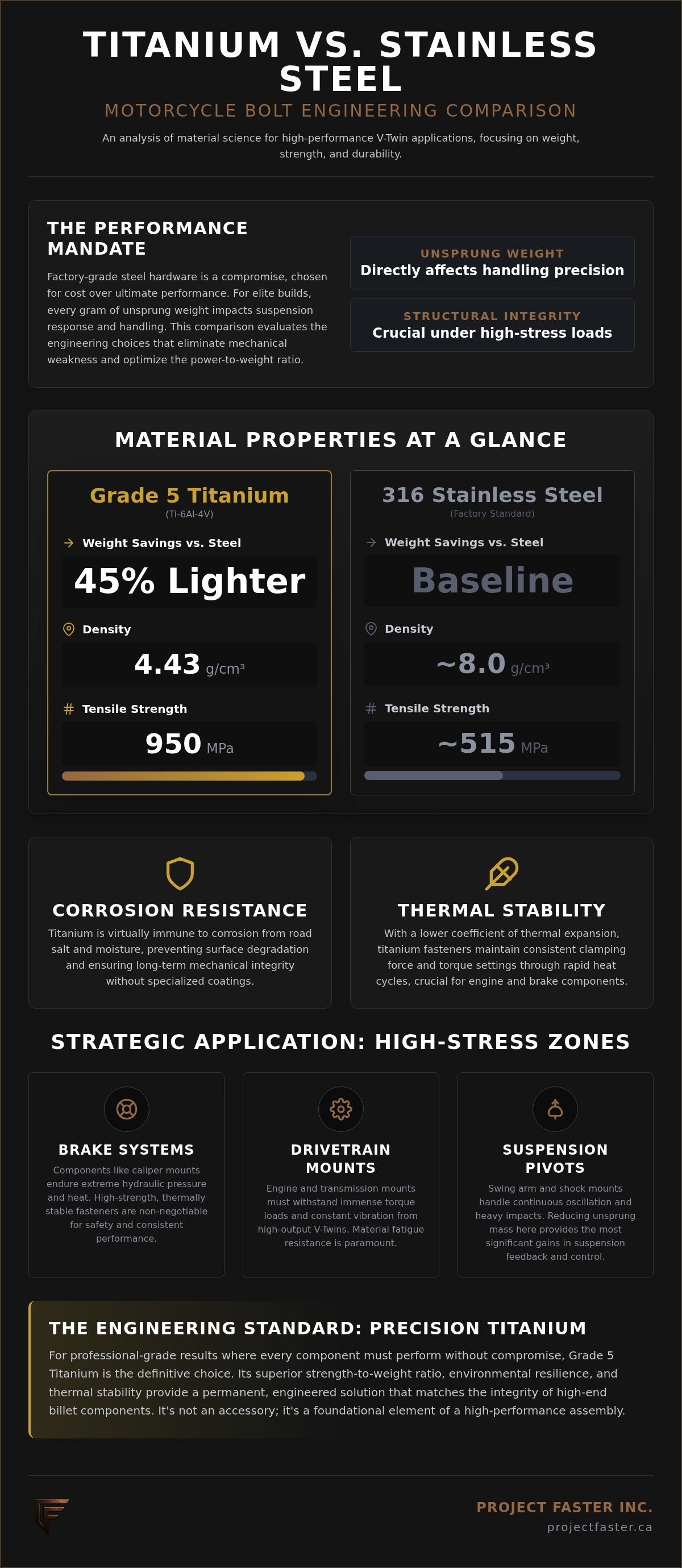
The physical performance of a V-Twin chassis depends heavily on the materials binding it together. When analyzing titanium vs stainless steel motorcycle bolts, the most striking delta exists in their density. Grade 5 Titanium (Ti-6Al-4V) possesses a density of approximately 4.43 g/cm³, while 316 stainless steel sits near 8.0 g/cm³. This results in a verified 45% weight reduction when swapping to a full titanium kit. For a performance build, this isn't just about the total mass. It's about reducing the energy required to move and stop the machine. Titanium also exhibits superior thermal properties, with a lower coefficient of thermal expansion that ensures torque settings remain consistent during intense heat cycles.
The Titanium Advantage: Strength-to-Weight Ratio
Titanium outperforms steel in almost every power-to-weight calculation. Grade 5 titanium is the industry standard for titanium bolt kits because it offers a tensile strength of 895 to 950 MPa. This is comparable to Class 10.9 high-strength steel but at nearly half the weight. Scientific research into the properties of beta titanium alloys and alpha-beta variants like Ti-6Al-4V confirms their exceptional fatigue resistance. By reducing rotational inertia and unsprung mass, these fasteners allow the suspension to track the road surface with greater accuracy. This results in a motorcycle that feels lighter on its feet and more composed through mid-corner bumps.
Stainless Steel: Durability and Tensile Limits
Stainless steel remains a viable alternative for non-structural components where weight is less critical. 316 stainless steel is highly prized for its corrosion resistance, yet it has distinct tensile limits. With a typical tensile strength of roughly 515 to 580 MPa, it doesn't match the structural capacity of Grade 5 titanium. It's often unsuitable for high-torque scenarios like engine through-bolts or brake caliper mounts. While stainless steel handles long-term stress cycles well in static applications, it lacks the elasticity and strength-to-weight benefits required for elite performance. If you're unsure which material fits your specific application, you can consult with our engineering team for a technical recommendation.
Choosing the correct material requires looking past the surface. While both alloys offer a significant upgrade over factory zinc-plated hardware, titanium is the only choice that actively improves the mechanical dynamics of the motorcycle. It provides the rigidity needed for high-stress assemblies while simultaneously stripping away the dead weight that dulls suspension feedback. For riders who realize that every fraction of a second counts, the material science points toward a single conclusion.
Environmental Resilience and Long-Term Maintenance Requirements
Environmental exposure dictates the longevity and reliability of your hardware. While factory-grade fasteners succumb to road grime and oxidation, premium alloys offer superior protection against the elements. When evaluating titanium vs stainless steel motorcycle bolts, the primary differentiator is how each material interacts with corrosive agents like road salt and moisture. Beyond simple rust prevention, long-term maintenance requires an understanding of mechanical behaviours such as thread galling and the impact of lubricants on torque accuracy. Proper management ensures your hardware remains as functional as it is visually striking.
Managing Oxidation in Harsh Climates
Stainless steel is a significant upgrade over stock zinc-plated hardware, yet it isn't entirely invincible. Even high-quality 316 stainless steel can suffer from "tea-staining" or pitting when exposed to high concentrations of chlorides. This surface oxidation creates small brown discolourations that, while often non-structural, detract from the professional finish of a high-end build. Titanium offers a different level of protection. It naturally forms a stable, self-healing oxide layer upon contact with oxygen. This microscopic barrier makes titanium effectively immune to salt-induced corrosion. For riders navigating Canadian winters or coastal environments, titanium provides a permanent solution that requires no protective coatings or frequent polishing to maintain its integrity.
The Essential Protocol for Titanium Installation
The technical superiority of titanium comes with specific installation requirements. Thread galling, a form of cold welding where threads lock together during tightening, is a genuine risk when using titanium fasteners in aluminium or titanium bores. To prevent this, the use of a high-quality anti-seize compound is non-negotiable.
- Lubricant Selection: Nickel-based anti-seize is generally preferred for high-temperature applications or when mating titanium with stainless steel. Copper-based compounds are also effective but should be used carefully to avoid galvanic reactions in specific environments.
- Torque Adjustment: Lubricated threads reduce friction, which means reaching a specific torque value requires less force. You must adjust your torque settings, typically reducing them by 20% to 25%, to prevent over-stretching the bolt or stripping the threads in your component.
- Inspection Cycles: High-stress hardware should be inspected during regular service intervals. Check for signs of "creep" or loosening, especially in high-vibration areas like engine mounts or exhaust brackets.
Aesthetic maintenance is equally straightforward. Unlike chrome which can flake or steel which can rust, titanium maintains its satin or anodized finish with minimal effort. A simple wipe-down with a mild degreaser is usually sufficient to restore the original lustre. By following these engineering-led installation protocols, you protect your investment and ensure that your hardware performs reliably under the most demanding riding conditions.
Strategic Application: Optimizing Unsprung Mass and Structural Integrity
Maximizing the performance of a heavy V-Twin requires a calculated approach to weight distribution. Unsprung mass refers to the weight of components located below the suspension springs, such as wheels, tyres, brake calipers, and axles. These parts must move rapidly to follow road contours. When debating titanium vs stainless steel motorcycle bolts for these specific areas, the mechanical advantage of titanium is absolute. Reducing weight at the wheel centre allows the suspension to react faster, maintaining better tyre contact and improving overall chassis stability. While stainless steel provides excellent corrosion protection for static engine covers or fairing mounts, it lacks the weight saving benefits required for dynamic components.
Unsprung Weight and Handling Dynamics
Reducing unsprung mass creates a measurable difference in flickability and braking precision. Every gram removed from the rotating assembly or the brake system reduces the energy needed to change direction. This is particularly noticeable during aggressive transitions or heavy trail braking. Integrating titanium into your PF Vector 108mm Radial Mount Brake Arm setup ensures that the clamping force is backed by a lightweight, rigid structure. By prioritizing titanium for rotor bolts and caliper mounts, you strip away the sluggishness inherent in factory steel hardware. The result is a front end that feels lighter and a suspension that tracks accurately through mid-corner imperfections.
Structural Integrity in High-Torque Assemblies
High-performance V-Twins generate massive torque loads that place immense shear forces on the rear suspension and drivetrain mounts. The Mako swing arm is designed for maximum rigidity, and using low-grade fasteners in this assembly would create a mechanical weak point. Titanium's high tensile strength makes it the ideal candidate for managing these stresses. Unlike stainless steel, which may reach its yield point under extreme engine vibrations, Grade 5 titanium maintains its shape and clamping force. This engineering logic extends to engine and transmission kits, where maintaining a consistent load is vital for preventing leaks and structural fatigue.
- Brake Calipers and Rotors: Use titanium to minimize unsprung mass and improve cooling.
- Axle Nuts and Pinch Bolts: Titanium provides the necessary strength while reducing weight at the furthest points of the chassis.
- Engine Covers and Accessories: Use stainless steel for cost-effective corrosion resistance where weight is a secondary concern.
- Swing Arm Pivots: Titanium ensures the highest possible rigidity for critical suspension links.
Strategic hardware selection is the final step in refining a high-performance build. If you are ready to engineer a superior chassis, contact our specialists for a custom hardware consultation to ensure your fasteners match the calibre of your components.
Why Precision-Engineered Titanium is the Standard for Project Faster
Project Faster Inc. operates on a principle of uncompromising functional superiority. We recognize that a high-performance V-Twin is only as reliable as its weakest link. When we evaluate the merits of titanium vs stainless steel motorcycle bolts, our selection process is dictated by the specific mechanical demands of the chassis and drivetrain. We avoid the generic, one-size-fits-all approach common in the aftermarket industry. Instead, we curate hardware kits that address the exact stress profiles of modern performance builds, ensuring that each fastener contributes to the overall stability of the machine.
The Project Faster Engineering Advantage
Our focus remains on precision fitment and the application of high-strength Grade 5 alloys. We don't just sell hardware; we provide engineer-certified components that have undergone rigorous evaluation. This testing ensures they withstand the extreme vibrational frequencies inherent in high-displacement engines. By eliminating mechanical weak points through superior material selection, we provide a level of reliability that factory hardware cannot match. This engineering-first perspective is why our hardware remains the preferred choice for elite V-Twin builds. We prioritize the physics of performance, ensuring that our fasteners maintain exact clamping forces under the most demanding conditions.
Completing Your High-Performance Build
A true performance package requires every component to work in harmony. Integrating our titanium hardware with precision-machined parts like Vector billet swing arms creates a unified assembly designed for maximum rigidity. This synergy ensures that the weight savings achieved through our billet components are supported by fasteners of an equal calibre. We realize that every build has unique requirements, which is why we encourage riders to consult with our experts for custom performance requirements. This collaborative approach ensures that your hardware selection aligns with your specific handling and power goals.
Building a world-class motorcycle requires a commitment to quality that extends to the smallest bolt. Our Canadian-based design process emphasizes durability and exactness, providing a professional-grade solution for those who refuse to compromise. Whether you are upgrading a single assembly or performing a complete chassis overhaul, you can find the necessary components to optimize your machine when you Shop All Parts. By choosing hardware that matches the engineering excellence of your bike, you ensure long-term performance and mechanical integrity on every ride.
Engineering the Ultimate V-Twin Performance Package
Optimizing a high-output machine requires a meticulous approach to every fastener. Choosing between titanium vs stainless steel motorcycle bolts isn't just about reducing total mass; it's about matching material properties to specific mechanical demands. High-strength Grade 5 Ti-6Al-4V titanium provides the 45% weight reduction necessary to sharpen handling and reduce unsprung mass at the wheels. Meanwhile, stainless steel offers a durable, corrosion-resistant solution for static components where weight is less critical. By strategically applying these alloys, you eliminate mechanical weaknesses and ensure your chassis remains rigid under extreme V-Twin performance loads.
Project Faster focuses on delivering engineer-certified billet components that meet these exact standards. Our hardware is designed to handle the intense vibrational frequencies and massive torque requirements of elite builds without compromise. If you're ready to refine your bike's power-to-weight ratio and long-term durability, it's time to invest in professional-grade hardware that reflects your commitment to excellence. Upgrade your V-Twin with engineer-certified titanium bolt kits at Project Faster. Your pursuit of precision starts with the structural links that hold your machine together.
Frequently Asked Questions
Are titanium bolts stronger than stainless steel for motorcycle applications?
Grade 5 titanium (Ti-6Al-4V) is significantly stronger than standard 316 stainless steel. It provides a tensile strength of 895 to 950 MPa; this is comparable to Class 10.9 high-strength steel. Standard 316 stainless steel typically offers only 515 to 580 MPa. This makes titanium the superior choice for high-stress areas like engine mounts or brake assemblies where mechanical integrity is paramount for both safety and performance.
Do titanium bolts require special torque settings compared to steel?
You must adjust your torque values when installing titanium fasteners. Because titanium requires anti-seize or lubrication to prevent galling, the friction in the threads is significantly reduced. You typically need to reduce the factory torque specification by 20% to 25% to account for this lubricated state. Failing to adjust these settings can lead to over-stretching the bolt or stripping the internal threads of your aluminium components during the assembly process.
Will titanium bolts prevent thread galling on my motorcycle?
Titanium bolts won't prevent galling on their own. Titanium is actually more prone to this mechanical failure than steel if installed dry. Galling occurs when the threads of two reactive metals cold weld together under pressure. To eliminate this risk, you must apply a high-quality nickel-based or copper-based anti-seize compound. This creates a protective barrier that ensures smooth assembly and future removal without damaging the structural threads.
Is it worth upgrading to titanium bolts for a street-ridden Harley?
Upgrading to titanium is worth it if you value handling precision and long-term corrosion resistance. While a street-ridden bike might not reach the limits of a track machine, reducing unsprung mass through a dedicated kit improves suspension feedback and reduces steering effort. Additionally, the immunity of titanium to road salt and moisture ensures your hardware remains pristine. It eliminates the maintenance required for stock zinc-plated fasteners or the pitting seen on lower-grade stainless options.
Can I use stainless steel bolts for my motorcycle's brake calipers?
We don't recommend using standard 316 stainless steel for brake calipers due to its lower tensile strength. Brake systems endure extreme thermal cycling and high shear loads during deceleration. When comparing titanium vs stainless steel motorcycle bolts for this application, titanium is the clear engineering standard. It provides the necessary structural rigidity and fatigue resistance required for safety-critical components while simultaneously reducing the unsprung weight of the braking assembly for better suspension response.
Why is Grade 5 titanium the preferred alloy for motorcycle fasteners?
Grade 5 titanium, or Ti-6Al-4V, is the preferred alloy because it offers the optimal balance of high tensile strength and low density. It's roughly 45% lighter than steel but maintains the structural capacity of high-tensile alloy steels. This specific alpha-beta alloy is also highly resistant to fatigue and crack propagation. These properties make it ideal for the high-vibration environment of a V-Twin engine where mechanical failure is a significant risk.
How much weight can I actually save with a full titanium bolt kit?
You can expect a weight reduction of approximately 45% compared to stock steel hardware. While the total mass saved may seem small, the impact is magnified because much of this hardware is located in unsprung or rotating areas. Removing weight from axles, rotors, and calipers has a disproportionate effect on handling. It allows your suspension to track road imperfections more accurately. This leads to a more composed and responsive ride during high-speed cornering.
Do titanium motorcycle bolts rust or corrode over time?
No, titanium is effectively immune to atmospheric corrosion and road salt. Unlike steel, which requires plating or alloying to resist rust, titanium naturally forms a stable oxide layer that heals itself if scratched. This makes it an ideal choice for riders in harsh climates where road grime and moisture quickly degrade factory fasteners. Your hardware will maintain its finish and structural integrity for the life of the machine without the need for constant polishing.