

Mechanical flex is the silent thief of stopping power on every heavy V-Twin still running traditional axial calipers. When you're aggressive on the lever, those standard mounts actually twist under the immense torque of a heavy machine. You've likely felt that unsettling sponginess during a hard stop or noticed the lever travel increasing as heat builds up. It's a common frustration for riders who demand more than just adequate performance from their bikes. Understanding the engineering benefits of radial brakes on harley motorcycles is the first step toward reclaiming control over your stopping distances.
By shifting the mounting bolts from a perpendicular to a parallel orientation, radial technology eliminates the leverage-induced distortion that plagues factory setups. We'll show you how this transition transforms your front end into a high-performance stopping centre, providing the rigidity needed for consistent, one-finger modulation. This guide examines the physics of caliper stability, the necessity of precision-machined billet components, and how modernizing your braking system fixes the mechanical weaknesses inherent in heavy-duty touring frames.
Key Takeaways
- Understand how radial mounting eliminates mechanical flex by aligning bolts parallel to the disc, providing a more stable foundation for heavy V-Twins.
- Learn how the engineering benefits of radial brakes on harley bikes translate to a precise "one-finger" lever feel and consistent stopping power under high heat.
- Discover why the 108mm mounting standard has become the preferred choice for modernizing the front end of high-performance touring models.
- Explore how using 6061-T6 billet aluminum components, like the PF Vector Radial Mount, maximizes the rigidity of your braking centre.
- Realize the performance synergy gained by combining radial braking systems with lightweight titanium hardware to reduce unsprung weight.
The Evolution of Braking: Why Radial Mounting is Dominating the V-Twin Scene
The V-Twin landscape has shifted toward high-output builds that demand track-level control. Performance baggers now routinely see speeds and lean angles that were once the exclusive domain of sportbikes. Stopping an 800-pound machine requires immense clamping force, and standard factory setups often struggle to maintain consistency. This shift has led to the widespread adoption of radial-mount technology. One of the primary benefits of radial brakes on harley motorcycles is the massive reduction in mechanical flex during aggressive deceleration.
Radial mounting originated in the high-stakes world of MotoGP. Engineers needed a way to keep calipers perfectly aligned under extreme thermal and mechanical stress. As V-Twin riders began pushing their machines harder, the limitations of traditional cruiser architecture became obvious. Modern Motorcycle braking systems have moved toward radial designs to provide the rigidity necessary for precise modulation. This technology ensures that every bit of pressure applied at the lever is converted directly into stopping power at the rotor.
What is an Axial Brake Mount?
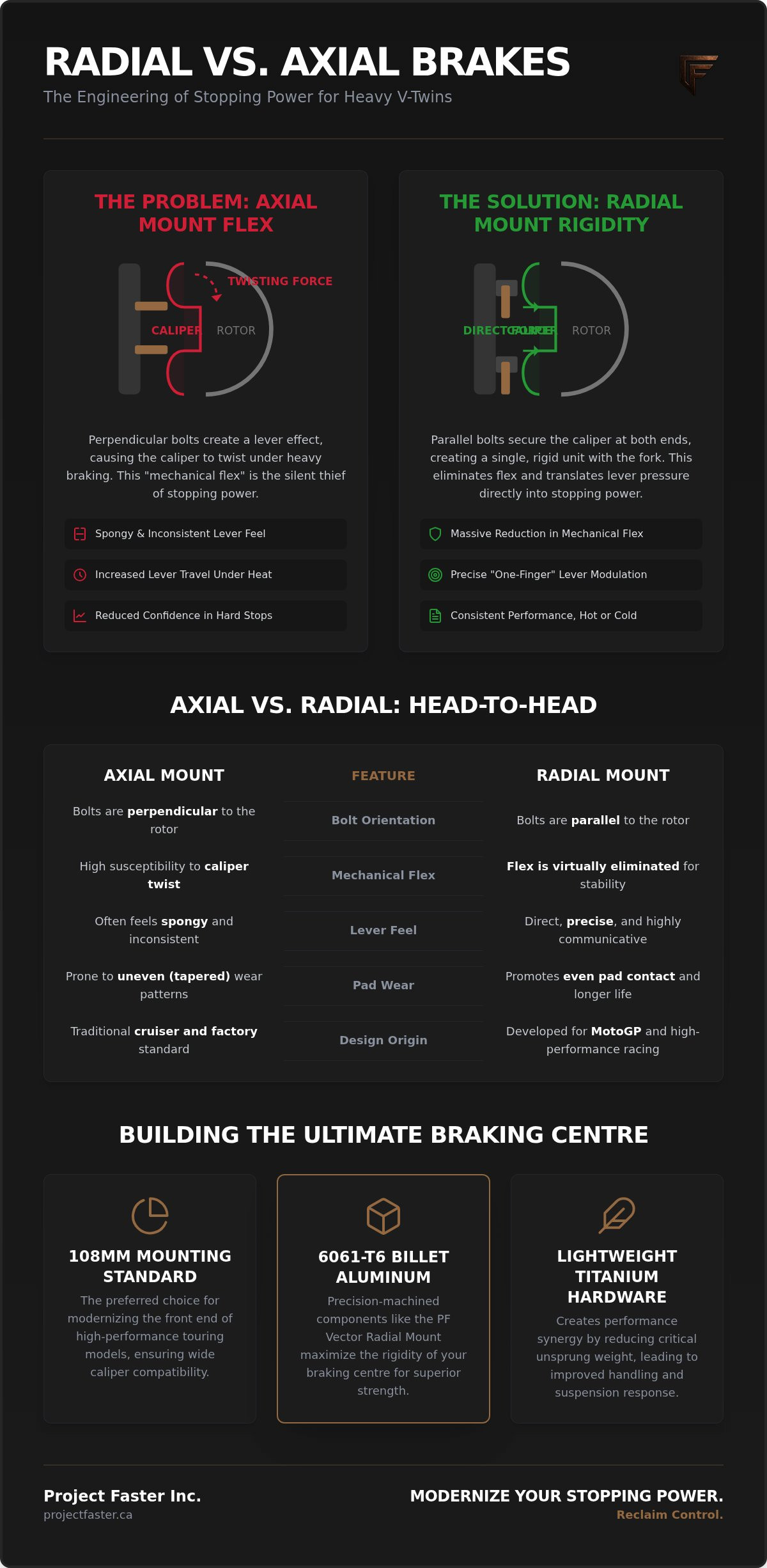
Axial mounts have been the industry standard for decades. These systems use bolts that run through the fork leg at a 90-degree angle to the brake rotor. While this design is simple to manufacture, it creates a significant mechanical disadvantage. Under heavy load, the caliper acts like a lever against the mounting bolts. This creates a minute twisting motion, or flex, which translates to a spongy feeling at the handlebar. Axial mounting was the standard for the cruiser market because traditional riding styles rarely pushed the hardware to its limits. However, on a heavy machine being ridden aggressively, this flex leads to inconsistent pad wear and reduced confidence.
The Radial Revolution in Performance V-Twins
Radial mounting fixes the flex issue by running the bolts parallel to the brake disc. This secures the caliper at both ends of the mount, effectively turning the caliper and the fork leg into a single, rigid unit. The result is a dramatic increase in lever feedback and stopping power. Achieving this level of precision requires a commitment to high performance Harley parts that are engineered for strength rather than just aesthetics. This transition isn't just about looking fast. It's about ensuring your bike's stopping centres can handle the torque and weight of a modern V-Twin without compromising safety or mechanical integrity.
Engineering the Stop: Radial vs. Axial Mounting Mechanics
The mechanical distinction between Radial vs. Axial Brakes is defined by the direction of the mounting hardware. Axial mounts, found on factory Harley forks, utilize bolts that enter the fork leg at a perpendicular angle to the brake rotor. This design is cost-effective for mass production but introduces a mechanical disadvantage. When the pads engage, the caliper body essentially tries to pivot around those mounting points. This creates a lever effect that puts significant shear stress on the bolts, often resulting in minute but perceptible caliper movement.
Radial systems reorganize this geometry by running the mounting bolts parallel to the plane of the rotor. This alignment ensures that the braking forces are distributed along the entire length of the mount rather than being concentrated on a single pivot point. High-performance radial setups often incorporate precision-machined locating dowels that act as shear pins, locking the caliper into a fixed position. This engineering choice eliminates the "caliper twist" that plagues axial systems. One of the primary benefits of radial brakes on harley setups is this structural stability, which ensures the caliper remains perfectly indexed to the disc during the most aggressive maneuvers.
Mechanical Rigidity and Structural Integrity
Securing the caliper at both ends drastically reduces lateral movement under heavy load. This rigidity is essential for maintaining a consistent contact patch between the pads and the rotor. When a caliper remains stable, pad wear remains even across the entire friction surface, which prevents the "tapered" wear patterns that often lead to premature pad replacement. Torsional flex is the elastic deformation of the brake mount or caliper body that occurs when braking torque overcomes the structural stiffness of an axial mounting point. By providing a dual-point anchor, radial mounting ensures the entire assembly resists this deformation, preserving the mechanical integrity of the front end.
Alignment Precision and Better Bite
Surgical precision in caliper alignment is the difference between a soft lever and an immediate, confidence-inspiring bite. Radial mounts allow the caliper to be centred perfectly over the rotor, ensuring that the pistons on both sides of the caliper extend and retract at the same rate. This symmetry eliminates the "dead zone" in lever travel where the caliper body would otherwise flex before the pads fully engage. Billet aluminum mounts are critical here because they offer superior dimensional stability compared to cast axial components. These high-precision parts maintain their tolerances even as heat builds up during heavy touring or canyon riding. If you're looking to optimize your bike's stopping power, it's a good idea to reach out to an expert to ensure your mounting hardware is perfectly matched to your fork and rotor combination.
The Performance Advantage: Rigidity, Feel, and Heat Dissipation
Transitioning to a radial setup isn't merely about aesthetics; it's about optimizing the interface between rider and machine. One of the most immediate benefits of radial brakes on harley motorcycles is the shift toward "one-finger braking." On a standard axial system, stopping an 800-pound bagger often requires a full-hand grip on the lever to generate sufficient clamping force. Radial mounting provides the structural stiffness needed to maximize hydraulic leverage. This allows you to achieve superior stopping power with significantly less physical effort. It's a level of control that transforms how you handle a heavy V-Twin in technical sections or emergency scenarios.
The engineering behind this is clear. According to Brembo engineers on radial caliper benefits, treating the caliper and fork as a single integrated unit drastically increases resistance to the massive torque generated during deceleration. This integration ensures that the force you apply at the handlebar isn't wasted on mechanical deformation. Instead, it moves directly into the pistons, providing a linear and predictable response every time you reach for the lever.
Eliminating the Spongy Lever
Sponginess is the enemy of precision. When an axial mount flexes under load, it creates a "dead zone" in the lever travel. This happens because the hydraulic fluid must first overcome the physical expansion and twisting of the mount before the pads can exert full pressure on the rotor. Radial brakes eliminate this inefficiency. By providing a rigid foundation, they ensure that the hydraulic system operates at peak efficiency. The result is a firm, consistent lever feel that doesn't change, even during aggressive riding. You gain a direct connection to the front tire, allowing for better trail braking and more accurate speed adjustments.
Managing Heat in Heavy V-Twins
Stopping a heavy motorcycle involves a massive transfer of energy. Kinetic energy is converted into thermal energy, which can quickly lead to brake fade if not managed correctly. Radial calipers are typically designed with a more open architecture that promotes better airflow around the pads and pistons. This improved cooling is essential for riders who have utilized V-twin performance exhaust benefits to increase their bike's horsepower and top speed. High-speed Canadian highway travel puts immense strain on braking components. Maintaining thermal stability ensures that your brakes won't soften when you need them most, providing the psychological confidence to push your machine to its engineered limits.
Conversion Logistics: Selecting Calipers, Mounts, and Hardware
Moving from a theoretical understanding of stopping power to a functional installation requires a disciplined approach to component selection. A radial conversion isn't a "one-size-fits-all" procedure. It demands an exact match between the fork, the mounting arm, and the caliper body. The primary objective is to maintain the structural integrity of the front end while maximizing hydraulic leverage. To realize the full benefits of radial brakes on harley builds, riders must navigate the specific standards of the performance aftermarket, ensuring that every fastener and bracket is engineered for the task.
One often overlooked aspect of this conversion is the master cylinder bore size. Pairing high-piston-count radial calipers with a stock axial master cylinder can result in an incorrect hydraulic ratio. This mismatch often leads to either an overly stiff lever with no modulation or a soft lever that requires too much travel to engage. Achieving that signature "one-finger" feel depends on matching the total piston area of the calipers to the displacement of the master cylinder. It's a technical balance that ensures the system remains responsive and linear.
The 108mm Radial Standard
The industry recognizes two primary spacing standards for radial mounts: 100mm and 108mm. While 100mm is common on European sportbikes, the 108mm standard is the preferred choice for Harley-Davidson conversions. This spacing offers the greatest compatibility with a wide variety of high-performance calipers from both Japanese manufacturers and specialized aftermarket brands. This standard provides the necessary clearance for various rotor diameters, whether you're outfitting a heavy touring machine or a nimble Softail. For detailed fitment data on specific models, refer to the PF Vector 108mm Radial Mount Brake Arm Guide.
Hardware Matters: Titanium and Billet
The mounting arm is the critical link in this system. Using a mount machined from 6061-T6 billet aluminum ensures that the caliper remains perfectly indexed under extreme thermal load. However, the mount is only as strong as the bolts securing it. Grade 5 titanium has become the gold standard for these applications. Titanium offers a superior strength-to-weight ratio compared to stainless steel, which is vital for reducing unsprung weight. Reducing the mass at the front wheel allows the suspension to react more quickly to road imperfections, improving both grip and ride quality. You can find specific weight-saving metrics in the Engineering Guide to Titanium Bolt Kits. If you're unsure which hardware combination is right for your specific fork leg, consult with a performance specialist to finalize your build specifications.
Precision Control: The Project Faster Vector 108mm Radial Solution
The PF Vector 108mm Radial Mount Brake Arm serves as the definitive engineering solution for riders transitioning from dated axial hardware to modern stopping centres. While earlier sections of this guide established the physics of flex and hydraulic efficiency, the hardware you choose to bridge that gap determines the ultimate reliability of the system. This component isn't just an adapter. It's a precision-machined interface designed to handle the extreme torque loads generated by high-performance V-Twins. By utilizing 6061-T6 billet aluminum, we ensure a strength-to-weight ratio that cast components simply cannot match. This material choice is critical for maintaining dimensional stability when the braking system reaches peak operating temperatures.
One of the most significant benefits of radial brakes on harley setups is the ability to lock the caliper into a fixed, zero-flex plane. The PF Vector mount achieves this through meticulous manufacturing tolerances. Every unit is CNC machined to ensure that the locating dowels and mounting faces are perfectly square to the rotor. This level of precision eliminates the "walking" or vibration often found in lower-quality conversion brackets. If you're planning a complex front-end overhaul, it's best to contact the engineering team for specific advice on caliper offset and hardware compatibility.
Engineer-Certified Rigidity
Rigidity is the cornerstone of braking performance. When we describe a part as "engineer-certified," it means the component has been analyzed for structural integrity under high-stress scenarios that simulate emergency stops at highway speeds. The PF Vector mount organizes braking forces by distributing the shear load across a broader section of the fork lower. This protects the fork legs from the localized stress concentrations common with axial mounts. Our zero-tolerance CNC process ensures that the caliper remains perfectly indexed to the disc, preventing the pad drag and heat buildup that can compromise your stopping power during long tours through the Canadian Rockies.
Completing the Performance Chassis
Elite braking performance shouldn't exist in a vacuum. There is a deep mechanical synergy between a rigid front-end stopping centre and a stabilized rear axle. High-horsepower builds require a holistic approach to handling. Pairing your radial brake upgrade with a Mako swing arm or a Vector billet swing arm creates a chassis that remains composed under both hard acceleration and aggressive deceleration. When the rear end is braced against twisting, the front end can do its job more effectively, providing a predictable platform for trail braking. You can find our full range of chassis-stiffening components by visiting the Shop All Parts collection. Modernizing your Harley is about more than just adding power. It's about ensuring every mechanical link in the chain is capable of managing that power with absolute precision.
Elevate Your V-Twin Stopping Performance
Modernizing your braking system is a mechanical necessity for any high-output build. By eliminating the torsional flex inherent in axial mounts, you regain the hydraulic efficiency required for precise control. The engineering benefits of radial brakes on harley motorcycles centre on this structural stability, providing a linear lever feel that doesn't fade under heavy thermal load. Whether you're navigating technical curves or managing an emergency stop on the highway, the transition to radial technology transforms your bike's performance profile.
The PF Vector 108mm Radial Mount Brake Arm is precision CNC-machined from 6061-T6 billet aluminum and engineer-certified for maximum rigidity. It's designed and tested specifically for heavy-duty V-Twin performance, ensuring your stopping power matches your engine's output. Combining this mount with titanium hardware further reduces unsprung weight, optimizing your front-end response. It's time to demand more from your machine's stopping centre.
Upgrade your stopping power with the PF Vector 108mm Radial Mount Brake Arm and experience the difference of a precision-engineered braking centre.
Frequently Asked Questions
Do radial brakes really make a difference on a heavy Harley-Davidson?
Yes, radial brakes provide a significant performance jump by eliminating the mechanical flex found in factory axial mounts. On heavy machines, the torque generated during braking can twist standard calipers, leading to a spongy lever. One of the primary benefits of radial brakes on harley bikes is the resulting rigidity, which ensures that every millimetre of lever travel translates into direct clamping force. This creates a more predictable and confidence-inspiring stopping experience.
What is the difference between 100mm and 108mm radial calipers?
The difference lies in the bolt-to-bolt spacing of the caliper mounts. 100mm is the European standard, found mostly on Italian and Austrian motorcycles. In contrast, 108mm is the Japanese and aftermarket standard, which is why we utilize it for our PF Vector mounts. Choosing the 108mm standard gives you access to a much larger selection of high-performance calipers, making it easier to find the right hardware for your specific V-Twin build.
Can I keep my stock master cylinder when switching to radial brakes?
While it is physically possible to use a stock master cylinder, it often results in sub-optimal hydraulic leverage. Radial calipers typically have larger or more numerous pistons than stock units, requiring more fluid displacement. If the master cylinder bore is too small, you'll experience excessive lever travel before the pads bite. To achieve a true high-performance feel, we recommend pairing radial calipers with a matched radial master cylinder to ensure the hydraulic ratio is perfectly balanced.
Is it difficult to install a radial brake conversion kit on a Softail?
Installation is a bolt-on process that replaces the stock caliper with a radial mount arm and a new caliper. While the mechanical steps are simple, the precision required is high. You must verify that the caliper is perfectly centred over the rotor and that the brake lines are correctly routed without tension. Because this is a critical safety component, many riders choose to have the conversion performed by a qualified technician to ensure absolute accuracy.
Why should I use titanium bolts for my brake calipers?
Grade 5 titanium bolts offer a superior strength-to-weight ratio and exceptional resistance to the thermal stress found in braking systems. By replacing heavy steel fasteners with titanium, you reduce the unsprung weight of the front end. This allows the suspension to track the road more effectively, improving overall grip. Additionally, titanium won't rust or seize, ensuring that your high-performance stopping centre remains easy to service and visually clean over years of use.
Do radial brakes help with brake fade during mountain riding?
Radial brakes are highly effective at combating brake fade because their rigid mounting and open-body architecture facilitate superior heat dissipation. During long mountain descents, standard axial brakes can overheat, causing the lever to feel soft as the fluid expands. The engineering benefits of radial brakes on harley motorcycles include maintaining a firm lever even under extreme thermal load. This ensures you have consistent stopping power from the top of the pass to the bottom.
What calipers are compatible with the PF Vector 108mm Radial Mount?
The PF Vector 108mm Radial Mount is compatible with a vast array of industry-standard 108mm calipers. This includes elite options like Brembo M4 and GP4-RS, as well as reliable Tokico or Nissin units from various sportbike platforms. This universal spacing allows you to tailor your braking system to your specific performance goals. Whether you're seeking maximum bite or better modulation, our mount provides the rigid foundation needed for any 108mm high-performance caliper.
Will radial brakes work with my stock Harley-Davidson rotors?
Radial brakes can be configured to work with stock rotors, provided the caliper is correctly spaced to match the disc diameter. Most performance builds utilize 11.8 inch or 13 inch rotors to maximize leverage. If you're keeping your factory discs, you must use precision-machined spacers to ensure the brake pads are fully engaged with the friction surface. While stock rotors are functional, floating rotors are often recommended to complement the precision of a radial setup.