

Raw horsepower is a secondary metric if your chassis cannot translate torque into forward momentum without flexing. You've likely felt that unsettling wobble during high-speed cornering or noticed the frustrating lag in power delivery as stock components struggle to manage high horsepower v-twin upgrades. It's a common reality for riders who invest heavily in engine work only to find their motorcycle becomes unstable when the throttle is pinned.
We agree that building for speed requires more than just a bigger bore; it demands a foundation that can handle the stress. This guide focuses on the engineering principles needed to create a build that balances raw output with structural rigidity and precision handling. You'll discover how to eliminate mechanical weaknesses and achieve a superior power-to-weight ratio without compromising safety.
We'll examine the physics of elite performance by looking at billet swing arms, titanium hardware, and high-flow exhaust systems. By the end of this article, you'll understand how to organize your build around engineering excellence to ensure your bike stays planted and responsive at high speeds.
Key Takeaways
- Avoid the common "Displacement Trap" by understanding why chassis integrity must precede engine output to prevent structural failure.
- Learn how to utilize 7075-T6 aluminum and titanium bolt kits as essential high horsepower v-twin upgrades to optimize your power-to-weight ratio.
- Discover the mechanical relationship between high torque and lateral flex and how billet swing arms ensure the rear wheel remains tracked under load.
- Master the science of exhaust scavenging and pipe geometry to precisely locate your torque peak and maximize cylinder efficiency.
- Implement an engineer-certified build plan that prioritizes chassis rigidity to ensure your motorcycle remains stable and responsive at high speeds.
The Foundation of High Horsepower V-Twin Performance
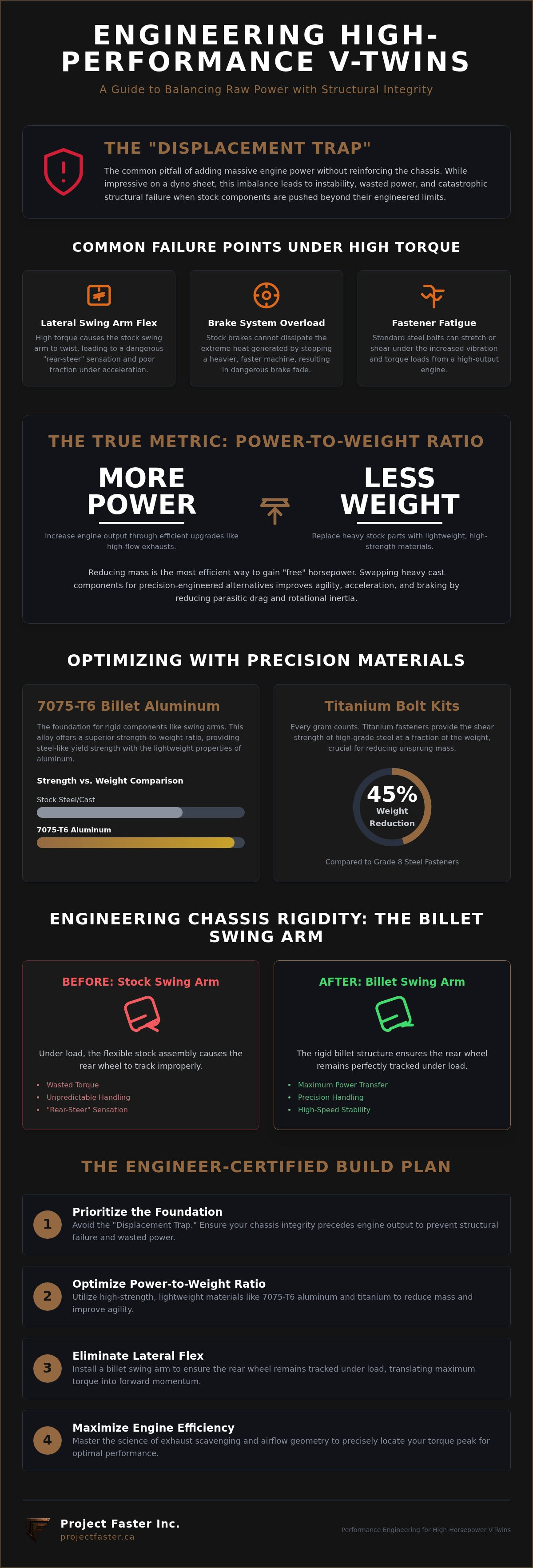
Performance isn't measured by a dyno sheet alone. We define high-HP V-Twin builds as those that significantly exceed original factory torque limits, pushing the mechanical boundaries of the stock platform. Many riders fall into the "Displacement Trap," assuming that increasing cubic inches is the only metric that matters. While Stage 1-4 kits are popular on forums, they often ignore the parasitic power loss through heavy, flexible components. A 131-cubic-inch engine provides impressive numbers, but it often leads to catastrophic chassis failure if the frame cannot support the increased stress. Effective high horsepower v-twin upgrades must account for the mechanical synergy between the engine and the frame. If the chassis flexes under load, that expensive engine power is wasted on twisting metal rather than propelling the bike forward. Structural rigidity and stability are at the centre of this philosophy.
Identifying common failure points is essential before you begin a build. When torque output doubles, stock components often become the weakest link. These failures typically manifest in several ways:
- Lateral Swing Arm Flex: The rear wheel tracks poorly under heavy acceleration, causing a "rear-steer" sensation. Upgrading to a Mako swing arm or similar rigid structure is the only way to neutralize this effect.
- Brake System Overload: Stock calipers and rotors cannot dissipate the heat generated by stopping a high-output machine, leading to dangerous brake fade.
- Fastener Fatigue: Standard steel bolts can shear or stretch under the increased vibration and torque of a performance engine.
The Shift Toward Performance Engineering
The Canadian motorcycle scene is moving away from aesthetic-only "choppers" toward performance baggers designed for high-speed stability. Modern builders prioritize function, seeking components with engineering certification to ensure safety at the limit. Setting realistic performance goals for street and track applications requires realizing that every horse added to the engine demands a corresponding upgrade to the chassis. This shift in mindset treats the motorcycle as a cohesive system where every component is rated for the loads it will encounter.
Defining the Power-to-Weight Advantage
Reducing mass is the most efficient way to gain "free" horsepower. Heavy cast components, such as stock swing arms, create parasitic drag during acceleration and sluggishness during deceleration. By swapping these for precision-engineered alternatives, you improve the bike's agility and response. The power-to-weight ratio is the measure of engine output relative to the total mass of the motorcycle. Improving this ratio through high horsepower v-twin upgrades allows for faster corner exit speeds and more reliable braking, as there is less inertia to overcome when changing direction or speed.
Optimizing Power-to-Weight with Precision Materials
Engineering elite performance starts with meticulous material selection. In the context of high horsepower v-twin upgrades, the transition from factory cast iron or heavy steel to 7075-T6 billet aluminum is a fundamental requirement. This specific alloy provides a superior yield strength that rivals many steels while maintaining the lightweight properties of aluminum. When an engine produces high torque, every component in the driveline experiences immense stress. Using materials with high fatigue resistance ensures that your motorcycle can handle repeated hard launches without structural deformation or failure.
Reducing unsprung weight is a critical factor that many builders overlook. Unsprung weight includes any component not supported by the suspension, such as the wheels, tires, braking systems, and the swing arm. By minimizing this mass, you allow the suspension to react with greater speed and precision to road irregularities. This improved response keeps the tire's contact patch firmly planted on the pavement, which is vital for maintaining traction when delivering high output to the rear wheel. Furthermore, reducing rotational mass decreases the gyroscopic inertia of the wheels, making the motorcycle more agile and easier to tip into corners at speed.
Titanium Bolt Kits: Every Gram Counts
Fastener integrity is often the difference between a successful build and a mechanical catastrophe. Titanium bolt kits offer a 45% weight reduction over traditional Grade 8 steel fasteners without sacrificing shear strength. Titanium is the gold standard for braking and suspension hardware because it resists corrosion and maintains its physical properties under extreme thermal cycles. For a deeper look into these mechanics, read The Engineering Guide to Titanium Bolt Kits for Motorcycles. If you are unsure which kit fits your specific application, you can always consult with our technical team for a precise recommendation.
Billet Aluminum vs. Cast Components
The manufacturing process of billet aluminum provides a significant advantage over factory cast parts. Casting involves pouring molten metal into a mould, a process that frequently introduces porosity—tiny air bubbles that create internal weak points. Billet components are CNC-machined from a single, solid block of material, ensuring a continuous and predictable grain structure. This allows for significantly tighter tolerances and eliminates the unpredictable flex found in stock components. In high-HP builds, these tighter tolerances ensure that bearings and axles remain perfectly aligned, even under the most aggressive acceleration loads.
Engineering Chassis Rigidity: Billet Swing Arms and Stability
High torque loads create extreme torsion on the rear axle. Stock swing arms, often constructed from thin-walled steel or cast components, are prone to lateral flex. When you apply power through high horsepower v-twin upgrades, this flex manifests as a misalignment between the front and rear wheels. This isn't just a handling annoyance; it's a structural failure to maintain the motorcycle's geometry under load. A rigid swing arm ensures the rear wheel remains tracked, translating engine output into linear acceleration instead of wasting kinetic energy through frame twist.
Many riders attempt to solve the infamous "death wobble" with steering stabilizers or thicker oil in the forks. These are band-aid fixes that mask a deeper engineering flaw. The instability often originates at the rear of the bike, where a flexible swing arm allows the rear wheel to oscillate. Structural engineering is the only permanent solution. By replacing the flexible stock unit with a precision-machined billet component, you neutralize the oscillation at its source. This provides a stable platform that remains predictable at speeds exceeding 160 km/h, ensuring the chassis stays composed under the most aggressive throttle inputs.
The Mako vs. Vector Billet Swing Arm
Choosing the correct foundation depends on your chassis type. The Mako swing arm is engineered specifically for Touring models, providing the mass and rigidity needed for heavy baggers. In contrast, the Vector Billet Swing Arm is optimized for 2018+ Softail frames. Both utilize intricate internal pocketing and bracing to maximize strength while shedding unnecessary weight. This design philosophy is detailed in The Engineering of Performance: A Guide to the Vector Billet Swing Arm, which explains how CNC machining achieves tolerances that factory casting cannot match.
Radial Mount Brake Arms and Stopping Power
High-speed performance is useless without the ability to shed velocity with absolute precision. Standard axial mount brakes often suffer from caliper flex during hard deceleration, resulting in a "spongy" lever feel and reduced confidence. Upgrading to a 108mm radial mount brake arm is essential for managing the increased kinetic energy of high-output builds. Radial mounting secures the caliper at both ends, ensuring it remains perfectly parallel to the rotor under stress. This eliminates flex and significantly improves modulation and pad bite. For a full technical breakdown, see the Engineering Maximum Rigidity: The PF Vector 108mm Radial Mount Brake Arm Guide.
Maximizing Engine Output: Exhaust Scavenging and Airflow
Engine efficiency is largely a function of gas velocity and pressure wave timing. Exhaust scavenging is the process where the kinetic energy of exiting exhaust pulses creates a partial vacuum, effectively pulling spent gases out of the cylinder and drawing in a fresh air-fuel charge. For high horsepower v-twin upgrades, this physical phenomenon is more critical than mere volume. Pipe diameter and length dictate exactly where the torque peak occurs in the RPM range. A pipe that is too wide reduces gas velocity, stalling the scavenging effect at lower speeds, while a pipe that is too narrow restricts top-end flow. Precision engineering allows us to find the balance where velocity and volume intersect for maximum output.
Misconceptions about "straight pipes" often lead to poor performance results. While they may sound aggressive, they typically destroy low-end torque because they lack the necessary backpressure to maintain gas velocity at lower engine speeds. Without a tuned collector or stepped design, the exhaust pulses can actually reflect back toward the cylinder, contaminating the fresh intake charge. High-output engines also generate significant thermal stress. Efficient exhaust flow is a primary method of heat management, as it moves combustion byproducts away from the cylinder heads as quickly as possible to prevent detonation and power loss.
The PF Liberator: Engineered for High-HP
The PF Liberator exhaust is designed to solve the conflict between low-end responsiveness and high-RPM power. It utilizes a stepped header design, where the primary tube diameter increases at specific intervals. This geometry maintains high gas velocity near the exhaust port while providing the necessary volume for peak horsepower as the RPMs climb. You can learn more about these physics in our guide on V-Twin performance exhaust benefits: The Engineering of High-HP Power. If you need assistance selecting the right configuration for your specific displacement, contact our engineering team for a consultation.
Integrating Intake and Tuning
Increasing exhaust efficiency is only half of the equation. A high-flow air cleaner is mandatory to match the increased demand for oxygen. In Canadian climates, air density changes significantly with temperature, making a precise air-fuel ratio difficult to maintain without professional intervention. Dyno tuning is not an optional luxury; it's a structural requirement for any engine build. It ensures that the fuel map accounts for the specific flow characteristics of your intake and exhaust system, protecting your investment from lean conditions that cause engine failure. This holistic approach ensures that your mechanical components work in harmony rather than fighting against one another.
The Project Faster Standard: Building Your Performance V-Twin
Building an elite machine requires a methodical departure from common forum advice. We advocate for a "Chassis First, Power Second" philosophy. Before installing high horsepower v-twin upgrades, you must ensure the frame, suspension, and braking systems are rated for the anticipated load. An engine producing 150 foot-pounds of torque will expose every weakness in a stock frame. By reinforcing the foundation first, you create a stable platform that can actually utilize the power you plan to add later. This sequence reduces the risk of mechanical failure and ensures the motorcycle remains predictable at the limit.
Every component we manufacture is engineer-certified. This means the parts have undergone rigorous stress analysis to verify their performance under extreme conditions. Selecting parts that complement each other is vital. For example, a high-output exhaust like the PF Liberator works best when paired with a rigid rear end that can handle the sudden surge in torque. Investing in premium Canadian-made components provides long-term value because these parts are designed to survive the harsh vibrational environment of a high-performance V-Twin. It isn't just about strength; it's about fitment and how the entire system functions as one unit.
Selecting the Right Components
Prioritizing your upgrade path depends on your specific model and riding style. Touring riders might focus on rear-end stability to eliminate bagger wobble, while Softail owners often look for weight reduction and braking precision. For a detailed breakdown of how materials science influences these choices, refer to High Performance Harley Parts: The Engineering Behind V-Twin Excellence. Consulting with engineering experts before purchasing ensures your high horsepower v-twin upgrades are technically compatible and logically sequenced. Don't waste resources on parts that fight for space or compromise structural integrity.
Next Steps for Your Build
Optimization is a process of refinement. We encourage you to explore our Shop All Parts collection to identify the components that will have the most significant impact on your current setup. If you have specific technical questions regarding fitment or structural requirements, contact Project Faster for expert support. Taking a methodical approach ensures that your build isn't just fast, but is also a masterpiece of mechanical integrity. Start with the components that stabilize the ride, then build the power to match.
Master the Physics of V-Twin Performance
Mastering the physics of a high-performance build requires moving beyond superficial metrics. You've learned that structural rigidity must precede engine output to avoid the displacement trap. By utilizing high-strength 7075-T6 aluminum construction and engineer-certified billet swing arms, you can neutralize chassis flex and ensure your motorcycle remains stable under aggressive load. These high horsepower v-twin upgrades don't just add speed; they provide the precision handling and mechanical integrity necessary for elite results on the street or track.
We specialize in providing the components and expertise required to transform your vision into a functional reality. With national Canadian shipping and dedicated technical support, we are here to help you navigate the complexities of materials science and mechanical engineering. It's time to stop guessing and start building with components designed to handle the stress of high-output performance. Our focus remains on the elimination of mechanical weaknesses to ensure every horse reaches the pavement.
Engineer your elite V-Twin build with Project Faster components today. Your motorcycle is a cohesive system, and it's time it performed like one.
Frequently Asked Questions
What are the best initial high horsepower v-twin upgrades for a stock Softail?
The most effective initial high horsepower v-twin upgrades for a Softail focus on chassis stabilization. We recommend starting with a Vector Billet Swing Arm and a high-performance braking system to create a rigid foundation. Follow this with a titanium bolt kit to reduce unsprung weight. This methodical approach ensures that your motorcycle remains safe and controllable as you continue to increase engine output and torque levels.
Do I really need a billet swing arm for a street-legal V-Twin?
Yes, if your build exceeds factory torque specifications. Street-legal motorcycles often encounter unpredictable road surfaces where lateral flex can cause dangerous instability. A billet swing arm provides the structural rigidity required to keep the rear wheel tracked during aggressive acceleration or emergency manoeuvres. While stock units suffice for casual cruising, they lack the engineering tolerances needed for high-performance applications where chassis composure is a priority.
How much weight can I save with a titanium bolt kit?
You can typically achieve a 45% weight reduction compared to standard Grade 8 steel fasteners. While the total mass saved might seem small in kilograms, the impact is significant when applied to unsprung areas like calipers and axles. Reducing this mass allows the suspension to react faster to road changes. This improves tire contact and overall traction, making titanium a strategic choice for serious performance builds.
What is the difference between the Mako and Vector swing arms?
The primary difference lies in the chassis application and specific engineering goals. The Mako swing arm is designed for Touring models, focusing on stabilizing heavy baggers against high-speed oscillation. The Vector Billet Swing Arm is engineered for 2018+ Softail frames. Both utilize 7075-T6 aluminum and internal pocketing, but their geometries are optimized for the unique stress points and fitment requirements of their respective motorcycle families.
Will a high-HP exhaust system make my motorcycle too loud for the street?
Engineering a high-output exhaust like the PF Liberator focuses on gas velocity and scavenging rather than raw decibel levels. While performance exhausts are generally louder than stock units, the sound profile is often deeper and more refined due to the materials used. The goal is to optimize the torque peak and airflow efficiency. A well-designed system provides a performance-oriented tone without the harshness associated with unbaffled straight pipes.
Can I install these performance parts myself or do I need a specialist?
Installation requirements vary by component. While bolt-on items like titanium kits are accessible for those with mechanical experience, critical structural components like swing arms require precise torque settings and alignment. We recommend consulting a professional technician for the installation of major high horsepower v-twin upgrades. Proper fitment is essential to maintain the engineering integrity of the parts and ensure the motorcycle remains stable at high speeds.
How does unsprung weight affect my motorcycle’s handling?
Unsprung weight dictates how quickly your suspension can respond to the road. Higher mass in the wheels, brakes, and swing arm creates more inertia, making it harder for the shocks to keep the tire planted. By reducing this weight, you improve the suspension's ability to track irregularities. This results in superior traction during hard acceleration and more predictable handling through corners, as the bike feels more responsive to rider input.
Why does Project Faster use 7075 aluminum instead of 6061?
We select 7075-T6 aluminum because its tensile strength is nearly double that of 6061. In the context of high horsepower v-twin upgrades, components like swing arms must resist immense twisting forces without deforming. While 6061 is common in the industry, it lacks the fatigue resistance required for elite performance. Using 7075 ensures that our parts maintain their precision and structural integrity over years of aggressive riding.