

Most V-Twin riders accept high-speed rear-end wobble as an inherent quirk of the platform, but this instability is actually a symptom of a structural failure in the stock chassis. You've likely felt that unsettling flex during aggressive cornering, realizing that your factory setup isn't built to handle the torque of a high-performance build. Integrating a Mako swing arm addresses these mechanical weaknesses at the source, replacing heavy cast parts with precision engineering to ensure your bike tracks straight under load.
This guide examines how engineer-certified components redefine motorcycle handling through superior materials and significant weight reduction. By utilizing 7075-T6 billet aluminum, riders can finally eliminate chassis flex while improving their power-to-weight ratio. We'll analyze the technical advantages of this aerospace-grade upgrade, including the impact of reduced unsprung mass on suspension response and the necessity of structural certification for high-horsepower applications. You'll discover how the synergy of precision machining and titanium hardware creates a stable, predictable ride that prioritizes physics over aesthetic trends.
Key Takeaways
- Recognize how the Mako swing arm eliminates chassis flex and rear-end instability by providing an engineer-certified, zero-flex foundation.
- Analyze the mechanical superiority of 7075-T6 billet aluminum over standard cast materials for high-torque V-Twin applications.
- It's essential to understand the physics of unsprung weight reduction and its direct effect on accelerating suspension response times.
- Identify how to organize your performance build for 2009+ Touring models using precision-machined Canadian components.
- Evaluate the performance synergy achieved by combining billet aluminum structures with lightweight titanium bolt kits.
Redefining V-Twin Stability with the Mako Swing Arm
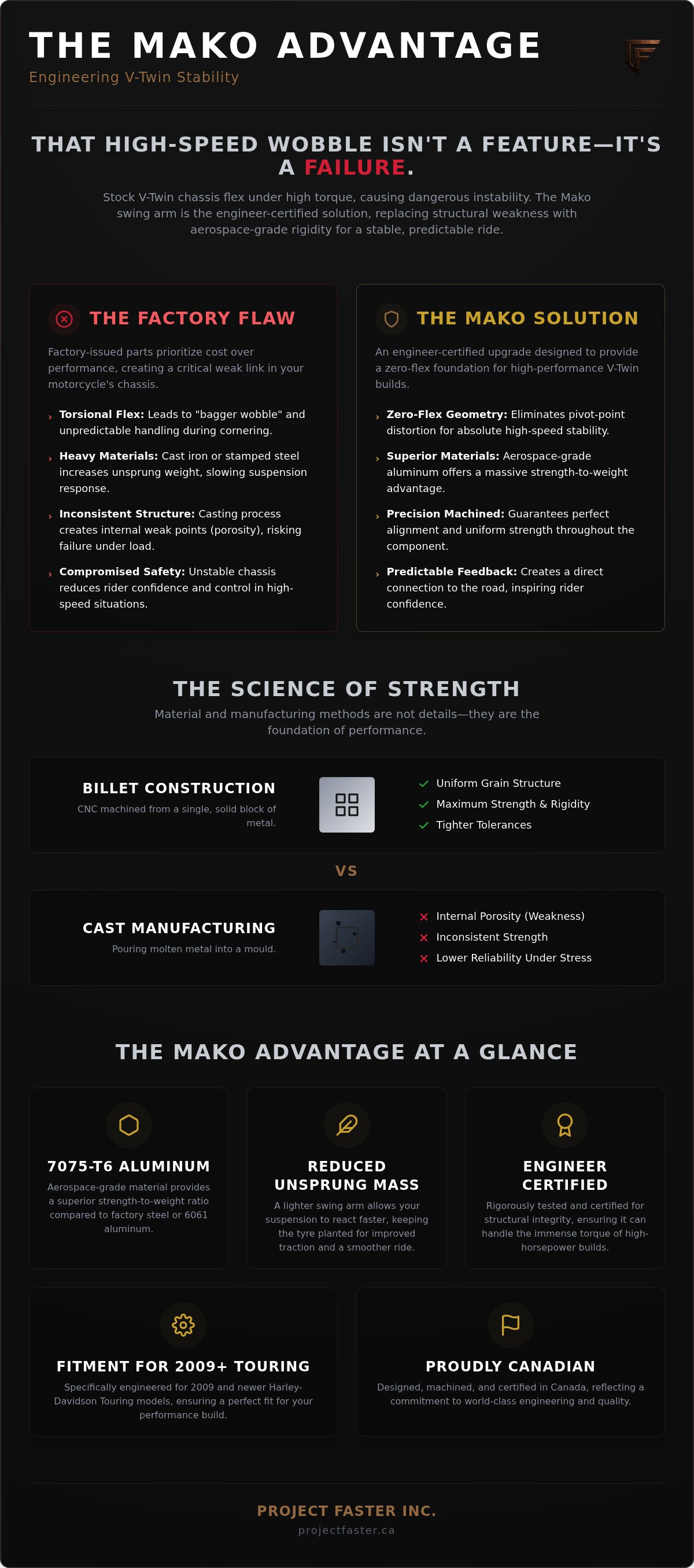
The swing arm is the critical pivot point between the motorcycle frame and the rear wheel. While search results sometimes confuse this performance component with medical equipment, the Mako swing arm is strictly a structural solution for high-output motorcycles. Factory-issued cast or stamped steel arms are designed for mass production and cost efficiency, not maximum rigidity. Under heavy loads, these stock components suffer from significant torsional flex. This mechanical weakness leads to the notorious "bagger wobble" that compromises safety during high-speed manoeuvres. Rigidity is the essential foundation of any performance motorcycle build, ensuring that the chassis remains stable under the immense torque of a modern V-Twin.
The Role of the Swing Arm in Chassis Rigidity
Lateral flex is the primary enemy of predictable handling. When you lean into a corner, the swing arm must resist intense side-loading forces. If the arm twists even slightly, the tyre contact patch shifts. This causes the rear end to feel disconnected, leading to a loss of traction and reduced rider confidence. Stock components often fail because they lack the structural density required to maintain alignment under stress. By utilizing a rigid platform, you ensure that engine energy translates into forward motion rather than frame distortion. A stable rear end allows the bike to track straight, which is critical for high-horsepower engines that demand absolute precision.
Identifying the Performance Bagger Requirements
The evolution of the touring chassis has seen massive increases in torque, yet the swing arm often remains a weak link. Many riders spend thousands on high-end shocks only to realize their handling remains vague. This occurs because even the most advanced suspension cannot compensate for a flexible structural member. The Mako swing arm is specifically engineered for 2009+ Harley-Davidson Touring models, addressing the specific needs of riders who demand more than factory standards. These requirements include:
- Zero-flex geometry: Eliminating the pivot-point distortion that causes high-speed instability.
- Material integrity: Moving away from heavy steel to 7075-T6 billet aluminum for a superior strength-to-weight ratio.
- Predictable feedback: Providing the rider with a direct connection to the road surface without mechanical interference.
Long-distance riders seeking better handling must realize that the swing arm is the heart of the rear chassis. Standard upgrades are limited by the stock arm's inability to maintain a true axis. Replacing it with an engineer-certified component provides the uncompromising confidence needed for aggressive riding and high-horsepower applications.
The Science of 7075-T6 Billet Aluminum Construction
Engineering excellence begins with meticulous material selection. While many manufacturers settle for 6061 aluminum due to lower costs and easier machining, Project Faster Inc. utilizes 7075-T6 billet aluminum for the Mako swing arm. This aerospace-grade alloy offers a significantly higher strength-to-weight ratio, providing the structural integrity required for high-horsepower V-Twin applications. When comparing tensile strength, 7075-T6 significantly outperforms standard factory cast iron or stamped steel components. This allows for a lighter part that doesn't compromise on durability. Selecting materials typically reserved for airframe construction ensures that every component can withstand the extreme stresses of aggressive riding without deforming.
Billet vs. Cast: Why the Manufacturing Process Matters
Manufacturing methods dictate the long-term reliability of a chassis component. Factory parts are typically cast, a process that involves pouring molten metal into a mould. This often results in internal porosity, where microscopic air pockets weaken the structure from within. In contrast, the Mako swing arm is CNC machined from a single, solid block of aluminum. This preserves the continuous grain structure of the metal, ensuring uniform strength throughout the piece. Machining also allows for much tighter tolerances than casting. This precision is vital for perfect axle alignment and consistent belt tension. If you have questions about specific fitment for your build, you can consult with our engineering team to ensure total compatibility.
Engineering for Torsional Rigidity
A motorcycle's handling is deeply influenced by the structural behavior of swingarms under load. During hard acceleration or aggressive cornering, the rear end is subjected to intense twisting forces. The structural geometry of the Mako design is optimized to resist this torsional flex without adding unnecessary bulk. We adopt an "over-engineered" philosophy, meaning the component is designed to exceed the maximum possible stress it will encounter on the road. This creates a rock-solid foundation for the rear wheel. It ensures that your suspension works as intended rather than the chassis acting as an undamped spring. By prioritizing mechanical integrity over aesthetic trends, we deliver a component that feels planted at any speed. This rigidity is what allows the bike to track true, even when you're pushing the limits of a high-output engine.
Performance Metrics: Weight Savings and Handling Precision
Unsprung weight reduction is arguably the most effective way to improve motorcycle suspension performance. In a factory setup, the heavy cast steel arm creates a high moment of inertia, forcing the rear shocks to work harder to maintain tire contact. The Mako swing arm changes this dynamic by significantly reducing the mass that the suspension must manage. A lighter assembly allows the shock absorbers to react faster to road imperfections, ensuring the rear wheel stays planted rather than skipping over bumps. This improved power-to-weight ratio doesn't just help with acceleration; it enhances braking efficiency by reducing the kinetic energy the rear brake must overcome. By stripping away dead weight, you allow the engine to spend less energy moving the chassis and more energy driving the bike forward.
Understanding Unsprung Weight in Motorcycles
Unsprung weight refers to any component not supported by the motorcycle's springs, including the wheels, tires, and the swing arm itself. When you hit a bump, the suspension must move this mass upward and then quickly push it back down. A heavy stock arm has more momentum, making it slower to change direction. By installing the Mako swing arm, you decrease this resistance, allowing the rear end to feel more responsive during quick transitions. Riders will realize a tangible difference when flicking the bike through S-curves, as the reduced mass simplifies the physics of leaning. To maximize these gains, many builders organize their projects to combine the arm with titanium bolt kits, further stripping away unnecessary grams from the pivot and axle points.
Handling Precision at High Speeds
Precision is the byproduct of stability. At high speeds, even minor axle movements can lead to unpredictable tracking. The Mako design ensures that the rear axle remains perfectly perpendicular to the frame, even under the stress of high-torque acceleration. This stability is why professional racers and elite-level builders prioritize a billet upgrade over factory components. Predictable cornering requires a chassis that doesn't "hunt" for a line. By eliminating the heavy, flexible factory arm, you provide the rear wheel with a rigid, lightweight path to follow. This results in a bike that feels significantly more composed at the limit, giving the rider the uncompromising confidence to push harder. Because the part is engineer-certified, you can trust that this precision remains consistent even under the extreme loads of high-horsepower applications.
Fitment and Integration: Optimizing Your Performance Build
The foundation of a high-performance touring build relies on exact fitment and mechanical synergy. The PF Mako Billet Swing Arm - 2009+ Touring is specifically engineered for Harley-Davidson Touring models from 2009 to the current production year. This precision ensures that the critical geometry of the rear suspension remains intact while providing a massive upgrade in structural integrity. Perfect alignment is not just about tyre wear; it's about the efficiency of power transfer. A misaligned rear wheel forces the engine to work against friction, reducing the effective horsepower reaching the pavement. Whether you're running a traditional belt or have transitioned to a chain drive conversion, the Mako swing arm provides the necessary adjustability to maintain perfect tracking under extreme loads.
Compatible Models and Years
Performance baggers demand components that can handle both long-distance touring and aggressive riding. While the Mako serves the touring market, it's distinct from the Vector Billet Swing Arm, which is purpose-built for the 2018+ Softail chassis. Riders must realize that these platforms have vastly different mounting requirements and pivot point stresses. For a seamless installation, we include titanium hardware and a high-strength axle with every Mako unit. These materials ensure that the connection between the frame and the rear wheel is as rigid as the arm itself. Using inferior factory bolts can introduce unwanted movement, negating the benefits of a billet upgrade. The engineering behind the Mako arm accounts for the increased weight of touring bikes, ensuring that the pivot blocks and axle adjusters don't slip under heavy torque.
The Ultimate Upgrade Path: Titanium and Brakes
A comprehensive build doesn't stop at the swing arm. Pairing the Mako with titanium bolt kits is the gold standard for weight-conscious builders. These kits offer superior tensile strength while further reducing the mass of the rear assembly, allowing the suspension to track road imperfections with surgical precision. To complete the performance overhaul, many riders integrate the PF Vector 108mm Radial Mount Brake Arm. This allows for the use of high-performance radial calipers, providing the stopping power needed for high-horsepower builds. You can Shop All Parts to see how these components organize into a cohesive performance package. Building a bike that handles as well as it accelerates requires a holistic approach to the chassis.
If you're ready to modernize your touring chassis and eliminate rear-end instability, contact our technical specialists to verify your specific build requirements.
The Project Faster Advantage: Why Engineering Certification Matters
Engineering integrity is the dividing line between a cosmetic upgrade and a performance necessity. While the market is flooded with unverified imports that prioritize visual appeal, Project Faster Inc. focuses on the structural realities of high-output motorcycles. Every Mako swing arm is "Engineer Certified," a designation that confirms the component has undergone rigorous evaluation to meet specific safety and performance standards. This certification provides riders with the uncompromising confidence that their chassis can handle the extreme torque of a performance build without catastrophic failure. Investing in an engineered part is a commitment to mechanical excellence that goes far beyond surface-level aesthetics.
The Certification Process
What does it mean for a motorcycle component to be "Engineer Certified"? During the design phase, we utilize Finite Element Analysis (FEA) to simulate the immense stresses placed on a touring chassis. This digital stress testing identifies potential weak points before the first cut of aluminum is ever made. We organize the internal geometry of the arm to resist the specific torsional forces that cause factory units to flex. This level of scrutiny is essential for high-speed and high-torque applications where mechanical failure is not an option. It's about moving beyond industry guesswork and relying on proven physics to deliver a stable, predictable ride. Every unit is a testament to our commitment to eliminating mechanical weaknesses at the source.
The Project Faster Philosophy
Our approach is rooted in the physics of performance rather than passing industry trends. We build components for riders who demand the best in mechanical integrity and real-world results. By manufacturing every Mako swing arm in Canada, we maintain total control over quality and material traceability. This local oversight ensures that the 7075-T6 billet aluminum used in our parts meets the exact specifications required for aerospace-grade applications. We don't build parts to be "pretty"; we build them to be the strongest link in your motorcycle's chassis.
A bike that tracks straight and responds predictably to rider input is a bike that allows you to push your limits with confidence. Safety and performance are inextricably linked, and an engineered chassis is the only way to ensure both. If you have technical enquiries regarding your specific application or need guidance on how our components integrate into your build, you can contact the team for an expert consultation. Our engineering-first perspective ensures that every rider receives the technical precision their build deserves.
Transforming Chassis Performance with Precision Engineering
Upgrading your motorcycle's structural foundation is a necessity for anyone pushing the limits of a high-performance touring build. We've explored how the Mako swing arm eliminates chassis flex by utilizing 7075-T6 billet aluminum, a material that offers a vastly superior strength-to-weight ratio compared to factory steel. This isn't just about weight reduction; it's about providing the suspension with a rigid, predictable platform to track the road. Every component is precision CNC machined in Canada and remains engineer certified for safety, ensuring it withstands the extreme torque of modern V-Twin engines.
You don't have to settle for the vague handling and instability inherent in stock chassis designs. You'll realize that prioritizing mechanical integrity ensures every bit of power translates into forward momentum with uncompromising stability. If you're ready to redefine your ride's handling characteristics, Upgrade to the Engineer-Certified Mako Swing Arm and experience the difference that structural excellence makes. It's time to build a bike that handles with absolute precision.
Frequently Asked Questions
Will the Mako swing arm fit my 2024 Harley-Davidson Road Glide?
Yes, the Mako swing arm is engineered specifically for 2009 to current Harley-Davidson Touring models, including the 2024 Road Glide. The chassis geometry on these years remains consistent at the pivot point, allowing for a direct bolt-on installation. This upgrade ensures that even the newest Milwaukee-Eight powered baggers benefit from increased structural rigidity. It addresses factory handling limitations that often persist even in the latest production cycles, providing a more stable ride.
How much weight does the Mako swing arm save compared to the stock arm?
Replacing the factory cast steel component with a Mako swing arm results in a significant reduction of unsprung weight. While exact savings vary based on your specific year's factory configuration, the transition from heavy steel to 7075-T6 billet aluminum drastically lowers the mass your rear shocks must manage. This reduction improves suspension response times. It allows your motorcycle to track road imperfections with much higher precision than the bulky and heavy stock assembly.
Do I need special tools to install the Mako swing arm?
Installation requires standard high-quality mechanical tools found in most performance shops. However, using a calibrated torque wrench is mandatory to ensure all hardware meets the exact specifications required for an engineer-certified component. You don't need proprietary equipment, but you must realize that precision during assembly is critical. Proper alignment and fastener tension are essential to maintain the structural integrity and safety standards established during the design and manufacturing phase.
Is the Mako swing arm compatible with a chain drive conversion?
Yes, the Mako swing arm is fully compatible with both factory belt drives and aftermarket chain drive conversions. The design includes sufficient adjustability to accommodate various sprocket sizes and chain lengths. This flexibility is vital for high-horsepower builds where chain conversions are often necessary to handle increased torque. The rigid billet construction ensures that axle alignment remains perfect, preventing premature wear on your chain and sprockets even under heavy acceleration.
What is the difference between 6061 and 7075 aluminum for swing arms?
The primary difference lies in tensile strength and fatigue resistance. 7075-T6 aluminum is an aerospace-grade alloy that offers nearly double the strength of standard 6061 aluminum. While 6061 is easier to weld and cheaper to machine, it doesn't provide the same level of torsional rigidity required for a high-performance swing arm. Project Faster utilizes 7075-T6 to ensure the component remains zero-flex even under the extreme stresses of aggressive, high-speed riding.
Does the Mako swing arm come with an engineering certification?
Every unit is officially "Engineer Certified," meaning it has been reviewed and approved by a structural engineer. This process involves Finite Element Analysis to verify that the design can withstand forces far beyond typical road use. Unlike many unverified aftermarket parts, this certification provides documented proof of safety and mechanical integrity. It's a critical distinction for riders who prioritize reliability and engineering excellence over simple aesthetic modifications or unproven imported components.
Can I use my stock rear axle with the Project Faster Mako arm?
No, you shouldn't use your factory axle. Every Project Faster Mako arm includes a high-strength axle and titanium hardware specifically designed for this assembly. Using the included hardware ensures that the tolerances between the axle and the billet blocks are perfect, eliminating any potential for movement. This integrated approach is part of our "Performance First" philosophy, ensuring that every connection point in the rear chassis meets our rigorous safety and durability standards.
Why is a billet swing arm better than a stock cast component?
Billet components are machined from a solid block of aluminum, which preserves the metal's grain structure and eliminates the internal porosity found in cast parts. This results in a much stronger and more rigid component that doesn't flex under load. A cast arm is a compromise made for mass production and cost savings. A billet arm is a performance-driven solution that provides superior handling, better power transfer, and a significantly improved power-to-weight ratio.