

Most riders assume the unsettling "wobble" at highway speeds is an unavoidable trait of the heavy V-twin cruiser, but it's actually a symptom of structural compromise. You've likely felt that vague, swimming sensation in the rear end when pushing through a high-speed sweeper or the sluggishness during high-torque acceleration. It's a frustrating mechanical limitation that keeps you from trusting your machine's potential when the pace quickens. This article explores why a softail high speed stability upgrade is essential for those who prioritize performance over factory aesthetics.
By replacing flexible cast-iron components with CNC-machined 7075-T6 billet aluminum, you can finally eliminate the lateral flex that plagues the modern Softail chassis. You'll learn how precision engineering transforms handling from unsettled to "planted," providing the sharper turn-in and predictable tracking required for aggressive riding. We'll break down the physics of reducing unsprung weight and explain how our engineer-certified components realize the true performance potential of your 2018+ Harley-Davidson. It's time to stop fighting your bike and start commanding it with absolute confidence.
Key Takeaways
- Identify how factory cast-iron swing arms introduce structural flex and contribute to the unsettling "high-speed wobble" on modern cruisers.
- Discover why CNC-machined 7075-T6 billet aluminum provides a significantly more rigid foundation than traditional steel or cast components.
- Learn how a precision-engineered swing arm eliminates rear-end steer to provide a planted, predictable feel during high-speed cornering.
- Realize the benefits of a softail high speed stability upgrade that integrates seamlessly with factory ABS sensors and axle configurations for 2018+ models.
- Explore the Project Faster advantage of engineer-certified, Canadian-made components designed specifically for high-horsepower applications.
Beyond the Factory Standard: Addressing the Softail Stability Gap
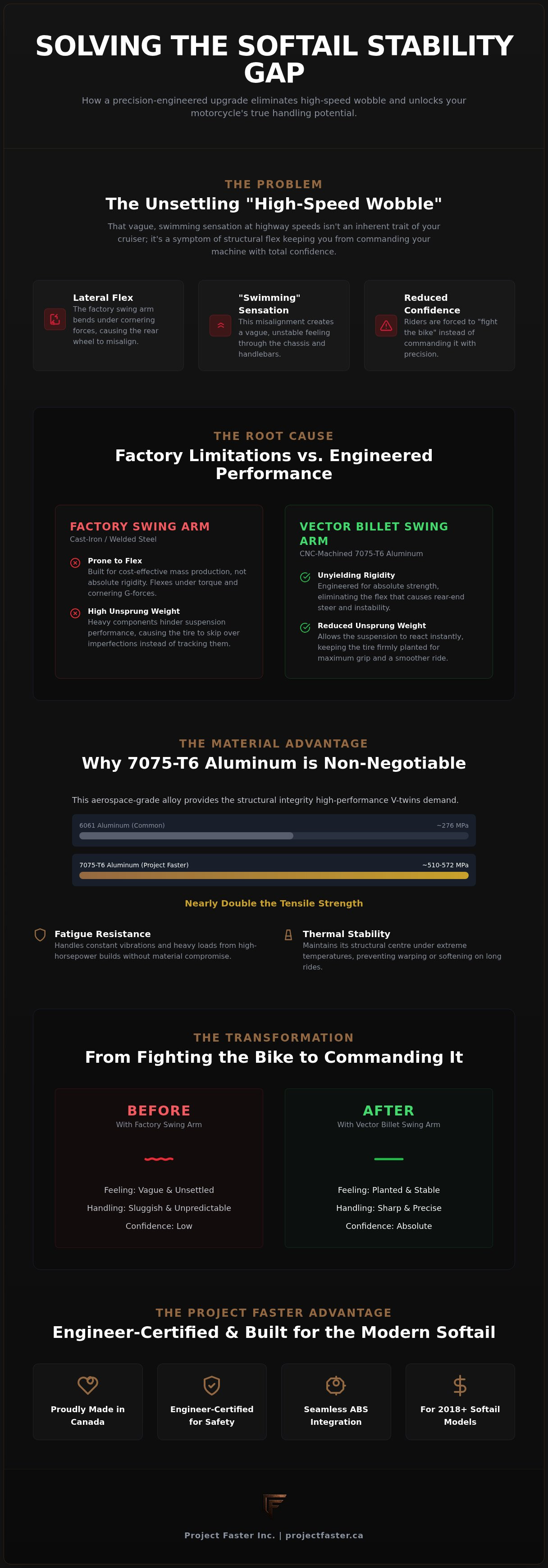
The 2018+ Harley-Davidson Softail platform represents a significant leap in chassis design, yet high-speed instability remains a persistent complaint for performance-oriented riders. While many attribute the unsettled feeling to tire pressure or steering dampers, the root cause is often mechanical deflection within the rear suspension assembly. Factory swing arms are typically constructed from cast-iron or welded steel. These materials are chosen for cost-effective mass production, not for the absolute rigidity required to manage high-torque loads and cornering forces at highway speeds. This structural compromise is particularly evident in models like the Low Rider S or Fat Bob, where the engine's power frequently exceeds the chassis's ability to remain composed.
When you're searching for a softail high speed stability upgrade, you're essentially looking to solve a problem of structural integrity. Under load, the factory swing arm acts as a massive lever, transferring force back into the pivot point and the frame. If this component lacks sufficient lateral stiffness, the rear wheel fails to track perfectly in line with the front wheel. This misalignment creates a feedback loop of instability that riders feel as a vague, swimming sensation through the seat and handlebars during aggressive manoeuvres.
The Physics of Lateral Flex and Rear-End Instability
Mechanical stability relies on the precise alignment of the contact patches. In the study of bicycle and motorcycle dynamics, any deviation in the rear wheel's plane of rotation relative to the chassis results in unintended steering inputs. During aggressive cornering, lateral force pushes against the swing arm. A factory cast-iron unit will flex, causing the rear end to steer independently of your input. This effect is amplified in high-horsepower builds where torque from the belt drive literally twists the swing arm. A precision-engineered Vector Billet Swing Arm eliminates this movement by providing a rigid, unyielding foundation.
Unsprung Weight: The Hidden Handling Killer
Beyond rigidity, the sheer mass of the factory assembly hinders suspension performance. Unsprung weight refers to any component not supported by the springs, including the wheel, brakes, and swing arm. A heavy swing arm has high inertia, meaning it's slow to react to road imperfections. When the rear tire hits a bump at 110 km/h, the shock must move that heavy mass instantly to maintain contact. If the component is too heavy, the tire loses contact with the pavement, leading to a skip-and-chatter effect. Seeking a softail high speed stability upgrade requires addressing this mass to allow the monoshock to respond with surgical precision, keeping the rubber firmly planted on the road surface.
The Vector Billet Swing Arm: Engineering a Rigid Foundation
The Vector Billet Swing Arm is not merely a replacement part; it is a structural recalibration of the 2018+ Softail chassis. While factory components are often mass-produced using casting methods that prioritize cost, our approach focuses on absolute mechanical integrity. This component serves as the definitive softail high speed stability upgrade by replacing the flexible factory foundation with a rigid, engineer-certified structure. Every unit is designed to withstand the immense torque of high-performance V-twin engines, ensuring that the rear wheel remains perfectly aligned under extreme stress. This commitment to vehicle integrity aligns with the safety frameworks discussed in the National Agenda for Motorcycle Safety, where handling and stability are recognized as critical factors for rider control.
Material Science: Why 7075-T6 Aluminum is Non-Negotiable
We utilize 7075-T6 aluminum because its tensile strength is nearly double that of the more common 6061 variants. This aerospace-grade material provides the fatigue resistance necessary to handle the constant vibrations and heavy loads of a modern cruiser. It maintains its structural centre even under extreme thermal stress, preventing the warping or softening that can occur with lesser alloys during long, high-speed hauls. For riders pushing high-horsepower builds, this material choice is the only way to guarantee the chassis won't yield when the throttle is pinned.
Precision CNC Machining for Uncompromising Tolerances
Each swing arm is CNC-machined from a single solid block of aluminum. This process eliminates the internal porosities and structural voids inherent in traditional casting, which can lead to hidden weak points. We use intricate internal pocketing to shed unnecessary mass while actually increasing overall rigidity. The result is a component that looks as sharp as it performs, featuring a technical lustre that highlights the precision of the machining process. This method ensures that every pivot point and mounting surface is perfectly square, providing a level of accuracy that factory assembly lines simply cannot match.
The integration of precision-machined axle blocks further enhances this stability. These blocks allow for surgical wheel alignment, ensuring the rear wheel tracks true to the frame's centre line. By removing the play found in factory adjusters, we eliminate the "rear-end steer" that often triggers high-speed instability. If you are planning a performance build, you can consult with our engineering team to ensure your chassis is ready for the road ahead.
Measurable Performance Gains: Stability and Cornering Precision
Achieving a "planted" feel at highway speeds isn't just a subjective preference; it's a measurable result of structural rigidity. When the chassis remains stiff under load, the rider experiences a direct connection to the pavement that factory components simply cannot provide. This predictability is the primary objective of a softail high speed stability upgrade. Unlike factory parts that allow the rear axle to shift slightly during high-speed sweepers, a billet arm ensures the rear wheel follows the front wheel's path with surgical precision. This elimination of "rear-end steer" transforms the riding experience from one of constant correction to one of total control. Organizations focused on motorcycle stability emphasize the importance of predictable handling, and structural upgrades are the most effective way to achieve it on a heavy cruiser.
The feedback loop between the rider and the road becomes much clearer when the "swimming" sensation of a flexing swing arm is removed. You'll notice that the bike no longer feels unsettled by longitudinal grooves in the highway or sudden gusts of wind. Instead, the motorcycle tracks straight, allowing you to relax your grip on the bars and focus on the road ahead. This predictable nature is what separates a performance build from a standard cruiser, providing a foundation that handles aggressive manoeuvres without the unpredictable wallowing common in stock configurations.
Eliminating Twist Under High-Torque Loads
High-horsepower Milwaukee-Eight engines generate immense torque that can literally twist a factory cast-iron swing arm during hard acceleration. This deflection doesn't just feel unstable; it compromises the alignment of your drive belt or chain. When the swing arm twists, the sprocket or pulley angles away from the engine, increasing wear and risking mechanical failure. The Vector Billet Swing Arm is engineered to resist these torsional forces. By maintaining perfect alignment during a launch, the chassis ensures that every bit of power is transferred to the ground rather than being lost to structural deformation. It's a critical upgrade for riders who have invested in stage IV kits or forced induction.
Improving Tire Contact and Traction
Rigidity is only half the equation. The other half is managing unsprung mass to improve tire contact. As discussed earlier, a lighter swing arm allows the rear shock to work more efficiently. When the rear tire hits a mid-corner bump at 120 km/h, the suspension must react instantly to keep the rubber in contact with the road. Heavy factory components have high inertia, causing the tire to "skip" over imperfections. By reducing this weight, the Vector arm allows the shock to track the road surface with much higher fidelity. This synergy between the billet structure and high-performance rear shocks creates a level of traction that factory bikes simply cannot match. You'll find yourself leaning deeper into corners with the confidence that the rear end won't wash out or chatter.
Technical Integration: Upgrading the Modern Softail Chassis
The 2018+ Harley-Davidson Softail lineup, featuring the redesigned monoshock frame, demands a level of structural precision that factory components often fail to meet. Our Vector Billet Swing Arm is engineered as a direct-fit solution for this specific architecture, ensuring compatibility across models like the Low Rider S, Fat Bob, and Heritage Classic. Unlike many aftermarket modifications that require relocating sensors or grinding tabs, this softail high speed stability upgrade integrates seamlessly with factory ABS sensors and axle configurations. We've prioritized a bolt-on installation process that maintains the mechanical integrity of your bike's safety systems while providing a massive leap in chassis rigidity.
To achieve the ultimate performance build, we recommend upgrading to titanium bolt kits during the installation. Replacing heavy factory steel hardware with aerospace-grade titanium reduces unsprung mass even further. This weight reduction, combined with the extreme tensile strength of titanium, ensures your rear assembly is as light and strong as possible. It's a meticulous detail that separates a standard upgrade from a professional-grade performance machine.
Optimizing the 2018+ Monoshock Architecture
The hidden monoshock design relies on the swing arm to act as a rigid member of the suspension triangle. Any lateral flex in the arm causes the shock to bind, which prevents it from damping road imperfections effectively. The Vector swing arm's billet construction ensures the monoshock remains perfectly aligned through its entire stroke, allowing the suspension to track the pavement with surgical accuracy. Furthermore, our design provides increased clearance for riders who prefer wider rear tyres or performance-oriented chain drive conversions, ensuring no interference during deep suspension compression.
The Synergy of Braking and Stability
Stability isn't just about going fast; it's about staying composed when you need to slow down. The PF Vector 108mm Radial Mount Brake Arm is a critical component of this equation. Radial brakes provide superior stopping power and modulation, but they also exert significant leverage on the swing arm. A rigid billet foundation prevents the brake-induced flex that can cause the rear end to "chatter" under heavy deceleration. By integrating these high performance Harley parts, you create a cohesive handling package that feels "planted" in every scenario.
If you have specific questions regarding your model's axle configuration or ABS compatibility, contact our engineering team for a technical consultation.
The Project Faster Advantage: Canadian-Engineered Excellence
Project Faster Inc. operates at the intersection of mechanical engineering and high-performance V-twin culture. We don't manufacture accessories; we build engineer-certified structural solutions that address the inherent weaknesses of factory chassis. Based in Canada, our team utilizes advanced CAD modelling and finite element analysis to ensure every component meets the highest standards of durability. This localized expertise allows us to maintain strict quality control over the entire production cycle, from the initial raw billet to the final precision-machined finish. When you invest in a softail high speed stability upgrade, you're choosing a product that's been rigorously tested against the real-world forces of high-torque acceleration and high-speed cornering.
The "industrial-tech" aesthetic of our components is a direct reflection of their functional superiority. We avoid the superficiality of decorative chrome in favour of a design language that highlights the precision of CNC machining. This focus on performance over fluff ensures that every line and pocket on a Project Faster component serves a structural purpose, reducing weight without sacrificing an ounce of strength. You can explore our full collection of shop parts to see how this philosophy extends across our entire product line, providing riders with the components they need to build a truly elite machine.
What "Engineer Certified" Means for Your Safety
Every Vector and Mako swing arm carries an engineer-certified designation. This isn't a marketing slogan; it's a guarantee that the component has undergone rigorous structural validation by licensed professionals. We test for fatigue resistance, torsional rigidity, and impact strength to ensure our parts exceed factory specifications. Settling for uncertified aftermarket components in a high-horsepower build is a significant risk to your stability and safety. By choosing certified parts, you're prioritizing the long-term mechanical integrity of your motorcycle and ensuring it can handle the demands of aggressive riding.
Next Steps for Your Performance Build
The transformation from a factory Softail to a precision-handling machine begins with the foundation. While many riders focus on engine power or cosmetic upgrades, the most impactful changes happen at the chassis level. Prioritizing structural integrity allows you to actually use the power your Milwaukee-Eight produces without the unsettling "wobble" or "swim" associated with stock parts. Once the lateral flex is eliminated and the unsprung weight is reduced, your bike will finally track with the predictability of a purpose-built racer. If you're ready to transform your ride, contact our engineering team to discuss your Softail stability upgrade and find the right configuration for your specific performance goals.
Mastering the Physics of High-Performance Handling
Realizing the full potential of your 2018+ Softail requires moving beyond the structural limitations of factory-cast components. We've explored how lateral flex at the pivot point creates the unsettling swimming sensation many riders experience at highway speeds. By integrating a softail high speed stability upgrade like the Vector Billet Swing Arm, you replace those vague feedback loops with surgical precision. Our components are CNC machined from high-strength 7075-T6 billet aluminum and are engineer-certified for maximum structural integrity. This ensures your chassis remains composed under high-torque loads while providing the superior tracking necessary for aggressive cornering. Every part is designed and tested in Canada specifically for high-horsepower applications, giving you the confidence to push your machine to its absolute limits. You've invested in the engine and the aesthetics; it's time to invest in the mechanical foundation that keeps the rubber planted. Don't settle for a chassis that fights your input when you can have a foundation that commands the road with uncompromising strength. Your journey toward a more predictable, high-performance ride starts with the right engineering.
Consult with our Engineers to Upgrade Your Softail Stability
Frequently Asked Questions
Is the Vector Billet Swing Arm a direct bolt-on for my 2018+ Softail?
Yes, the Vector Billet Swing Arm is a direct-fit component for the 2018+ Softail platform. It's engineered to integrate seamlessly with the redesigned monoshock frame, including models like the Fat Bob and Low Rider S. This softail high speed stability upgrade requires no frame modifications or grinding, as it uses factory mounting points. We've ensured that all necessary tabs for ABS sensors and brake lines are precisely machined into the structure for a clean, professional finish.
How much weight will I save by switching to a billet aluminum swing arm?
Switching to a billet aluminum swing arm significantly reduces unsprung mass compared to the factory cast-iron unit. While the exact weight savings can vary based on your specific model and hardware configuration, the reduction in inertia is immediately noticeable. This allows your rear shock to respond more fluidly to road imperfections, keeping the tire in contact with the pavement. Lighter components mean better suspension fidelity and a more predictable ride at highway speeds.
Will a more rigid swing arm make my ride feel too harsh on long trips?
A more rigid swing arm actually improves ride quality by allowing the suspension to function as designed. Factory flex often causes the monoshock to bind, which creates a harsh, unpredictable feeling over bumps. By eliminating this lateral movement, the shock can move through its stroke without interference. This results in a smoother experience on long trips, as the bike remains composed and "planted" rather than vibrating or skipping across uneven Canadian road surfaces.
Do I need to change my rear axle when installing the Vector swing arm?
The Vector swing arm is designed to work with your factory axle and hardware, though we provide precision-machined axle blocks to ensure perfect alignment. You don't need to source a custom axle for standard installations. However, many riders choose to upgrade to our titanium bolt kits during the process to further reduce weight and increase strength. Always verify your specific model's axle diameter before starting the installation to ensure a perfect fitment for your chassis.
What is the difference between 7075-T6 and 6061 aluminum for stability?
7075-T6 aluminum offers nearly double the tensile strength of 6061 variants, making it the superior choice for a softail high speed stability upgrade. This aerospace-grade material provides the fatigue resistance required for high-horsepower V-twins that experience intense vibration and torque. While 6061 is common in decorative accessories, it lacks the structural rigidity needed to eliminate the chassis flex that causes high-speed instability. We prioritize 7075-T6 to ensure your chassis remains unyielding under load.
Can I still use my factory belt guard with a Project Faster swing arm?
Most factory belt guards can be retained, though our swing arm is designed with a focus on high-performance aesthetics and function. Depending on your specific tire width and drive configuration, some minor adjustments might be necessary for perfect clearance. Many performance builders choose to omit the guard to showcase the technical lustre of the CNC-machined billet. If you plan on running an oversized rear tire, please contact our team to discuss specific fitment nuances for your build.
Does the swing arm come with an engineer certification for structural safety?
Every swing arm we manufacture carries an engineer certification to guarantee its structural integrity. This means the design has been validated through rigorous testing protocols to handle the extreme forces of high-performance riding. We don't believe in guessing when it comes to critical chassis components. This certification provides peace of mind, knowing your stability upgrade is designed by experts who prioritize mechanical safety and real-world durability over simple cosmetic appeal or unverified aftermarket designs.
Is professional installation required for this stability upgrade?
We strongly recommend professional installation for any critical structural component like a swing arm. While the Vector is a direct bolt-on part, proper torque sequences and perfect wheel alignment are essential for achieving maximum stability. A qualified technician can also ensure that your ABS sensors are correctly calibrated and that your rear suspension is dialled in for your specific weight. Precision installation is the final step in transforming your bike's high-speed handling and cornering characteristics.