

Most V-Twin exhaust systems on the market are little more than expensive noise makers that actually choke your engine's potential. You've likely spent thousands on a big-bore kit or high-lift cams, only to find your power curve flattening out because your exhaust can't keep up with the increased air volume. We've engineered a solution that treats the exhaust as a critical extension of the combustion cycle, ensuring you realize the full PF Liberator high-HP exhaust performance gains your build deserves. It's a common frustration for riders who prioritize mechanical integrity over aesthetic fluff.
You'll discover how our 3-step internal architecture is designed to eliminate restrictive backpressure while optimizing fluid dynamics for maximum horsepower. This article breaks down the Canadian engineering behind our 304 stainless steel systems, explaining how enhanced scavenging transforms raw displacement into usable torque. We'll examine how our high-quality finish resists bluing under extreme heat and why precision fitment is non-negotiable for high-output builds. By the end, you'll understand why the right geometry is the difference between a loud bike and a fast one.
Key Takeaways
- Learn why aesthetic-first exhaust systems often restrict high-displacement Milwaukee-Eight and Twin Cam engines, creating performance bottlenecks that limit your build's potential.
- Understand the fluid dynamics of our 3-step engineering and how it creates a vacuum effect to pull exhaust gases out more efficiently through optimized scavenging.
- Discover how to achieve significant PF Liberator high-HP exhaust performance gains and eliminate the common torque dip found in Stage 3 and Stage 4 builds.
- Explore the benefits of 304 stainless steel and precision TIG welding for superior thermal stability and corrosion resistance in the Canadian climate.
- See how integrating the Liberator with a PF Mako Billet Swing Arm provides the necessary chassis stability to manage high-horsepower and torque output effectively.
Beyond the Noise: Why High-HP V-Twins Require Specialized Exhaust Engineering
Standard aftermarket exhaust systems often prioritize a specific "bark" or aesthetic over actual fluid dynamics. While a loud pipe might suggest power, it frequently creates a bottleneck for high-displacement Milwaukee-Eight and Twin Cam engines. When you move beyond factory displacements into the territory of 124ci, 128ci, or 131ci builds, the engine's air volume requirements change drastically. A pipe designed for a stock motor simply cannot facilitate the PF Liberator high-HP exhaust performance gains required for a high-compression build.
The physics are straightforward: more displacement equals more exhaust gas. If these gases aren't evacuated efficiently, they create excessive backpressure that fights against the incoming intake charge. This mechanical resistance effectively "chokes" the motor, preventing high-lift cams from performing to their full potential. Conversely, simply using a massive, open pipe often destroys exhaust gas velocity, leading to the dreaded torque dip in the low-to-mid RPM range where most street riding occurs.
The Problem with Universal Fitment
Many manufacturers design pipes for a 107ci base and simply offer different mounting brackets for larger models. This universal approach is a compromise that costs you power. A 131ci build with aggressive cam timing requires a specific scavenging profile to pull heat and spent gases away from the cylinder head. Without this, you face increased operating temperatures and potential detonation. Precision engineering ensures that the exhaust volume matches the engine's output, maintaining the high velocity needed for torque while providing the flow capacity for peak horsepower.
Defining "Real" Horsepower Gains
True performance isn't just about a single peak number on a dyno sheet; it's about the area under the curve. We focus on optimizing the entire RPM range, ensuring that your bike pulls hard from the moment you twist the throttle. The Project Faster philosophy rejects the "louder is better" myth in favour of mechanical integrity. We realize that serious riders want components that handle the rigours of high-heat, high-vibration environments without sacrificing structural stability. We engineer systems that function as performance tools, not just decorative accessories, to ensure you see the full PF Liberator high-HP exhaust performance gains across your entire powerband.
The Science of Scavenging: Breaking Down the PF Liberator’s 3-Step Design
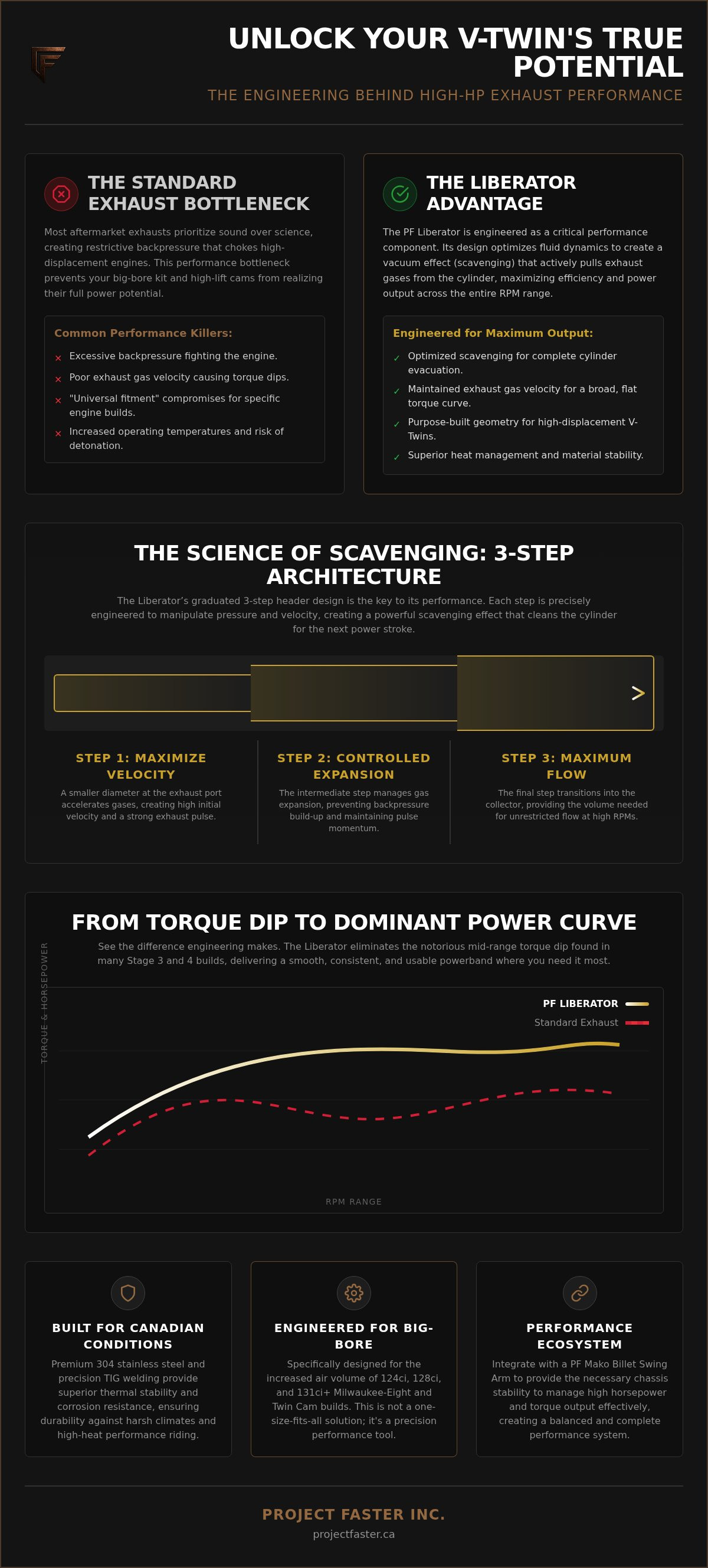
The PF Liberator isn't just a pipe; it's a precision fluid dynamics tool. A 3-step exhaust features a graduated increase in pipe diameter from the exhaust port to the collector. This architecture is fundamental to realizing the PF Liberator high-HP exhaust performance gains that big-bore V-Twins require. By stepping the pipe at specific intervals, we create pressure differentials that generate a vacuum effect. This effect actively pulls exhaust gases out of the combustion chamber, ensuring the cylinder is completely evacuated before the next intake stroke begins.
Maintaining exhaust gas velocity is vital for performance. If gases slow down too much, they can stall or even reverse back into the chamber, a phenomenon known as reversion. Reversion dilutes the fresh air-fuel mixture, which effectively kills power and causes erratic idling. Our 3-step design manages gas expansion carefully to keep momentum high, preventing these pressure waves from pushing back against the engine's natural cycle. This level of control over fluid dynamics is what allows a high-compression motor to breathe without restriction.
Step 1 to Step 3: The Velocity Curve
Step one begins at the exhaust port with a smaller diameter to maximize initial gas velocity. As the gas travels, the intermediate step allows for controlled expansion, preventing the backpressure build-up that typically chokes high-lift cams. The final step transitions into the full-length collector, providing the volume necessary for maximum flow at high RPM. This methodical expansion ensures that the exhaust pulse remains organized and energetic throughout the system's entire length, optimizing cylinder filling across the board.
Full-Length Architecture and Scavenging
Scavenging is the process of using exhaust gas inertia and pressure waves to pull a fresh air-fuel mixture into the cylinder during the valve overlap period. Pipe length is a primary variable in this equation. Shorty pipes often fail because the pressure waves return to the exhaust valve at the wrong time, disrupting the scavenging cycle. A full-length system provides the necessary real estate for these waves to be timed correctly. This timing is what fills the torque valleys mentioned earlier, providing a linear power delivery that short pipes simply cannot match. If you have questions about how these steps integrate with your specific engine build, feel free to reach out to our engineering team for technical guidance.
By prioritizing the physics of wave reflection and timing, the PF Liberator ensures that every combustion cycle is as efficient as possible. This engineering-first approach is why the system produces consistent PF Liberator high-HP exhaust performance gains on everything from a high-output 114ci to a monstrous 131ci build. It’s about more than just flow; it’s about the precise management of energy within the pipe.
Quantifying the Gains: Horsepower and Torque Improvements in Big-Motor Builds
Raw data provides the ultimate validation for any performance component. When measuring PF Liberator high-HP exhaust performance gains, the results on Stage 3 and Stage 4 Milwaukee-Eight builds demonstrate a significant departure from industry-standard 2-into-1 systems. Most off-the-shelf pipes suffer from a pronounced "torque dip" between 2,500 and 3,500 RPM, exactly where riders need power for passing or merging. Our engineering eliminates this valley, providing a smooth, upward trajectory that supports the aggressive lift and duration of performance cams. By optimizing gas evacuation, we also reduce the thermal load on the cylinder heads, which is critical for maintaining engine integrity during long hauls in varying Canadian temperatures.
Achieving these gains requires more than just a large pipe; it requires the precise management of backpressure. Many riders assume that "bigger is better," but an oversized primary tube will kill low-speed gas velocity and destroy bottom-end grunt. The Liberator's 3-step design ensures that even at lower engine speeds, the exhaust pulses maintain enough inertia to facilitate effective scavenging. This results in a power curve that feels linear and predictable, giving the rider total control over the bike's torque output. Whether you're pulling a loaded touring bike through the Rockies or chasing a personal best on the track, the power is always available.
Low-End Torque vs. Top-End Horsepower
Heavy touring bikes require massive low-end grunt to overcome their static weight. While many competition pipes focus exclusively on top-end horsepower, the PF Liberator prioritizes a balanced powerband. The initial steps in our design maintain the necessary pressure to keep the motor responsive at low RPM, while the final expansion allows the engine to breathe freely as it nears the redline. This duality ensures that you don't have to choose between stop-light performance and high-speed efficiency.
The Role of the Collector and Baffle
The collector is the heart of a 2-into-1 system, where the two primary pulses merge into a single stream. We engineer our collectors to ensure these pulses don't collide and create turbulence, which would otherwise impede flow. Inside, our baffle design strikes a deliberate balance between high-flow capacity and sound management. Unlike thinner stainless pipes that produce a thin, tinny resonance, the Liberator delivers a deep, authoritative tone. This is a direct result of the material density and the structural integrity of our 304 stainless steel, which eliminates the vibration-induced noise common in lower-quality builds.
Material Integrity and Fitment: Built for the Rigours of Canadian Performance
Selecting the right material is just as critical as the pipe's geometry. We utilize 304 stainless steel because it offers superior thermal stability and corrosion resistance, which is mandatory for the Canadian climate. Unlike lower-grade steels that become brittle under extreme heat or rust when exposed to road salt, 304 stainless maintains its structural integrity through thousands of heat cycles. This durability is essential to sustain the PF Liberator high-HP exhaust performance gains over the life of the motorcycle. Whether you choose the satin or polished finish, the material properties remain identical, ensuring that aesthetic preferences never compromise mechanical performance.
Vibration is the enemy of any V-Twin component. To combat this, we employ precision TIG welding throughout the entire assembly. These high-penetration welds create a unified structure that resists cracking, even on high-compression builds with aggressive engine harmonics. We've engineered specific fitment for 2018+ Softail and 2017+ Touring models, ensuring that the exhaust mounts securely without creating stress points on the cylinder head studs. A perfect fit is a performance requirement, not an option.
Canadian Manufacturing Standards
By keeping production local, we maintain absolute control over every stage of the manufacturing process. Every PF Liberator undergoes rigorous testing to ensure it meets our internal standards for quality and fitment. This commitment to Canadian engineering supports a national performance ecosystem and ensures that our products are built to withstand the unique environmental challenges found from coast to coast. We don't outsource our quality; we build it right here.
Tuning and Fuel Mapping for Maximum Output
Installing a high-flow system like the Liberator fundamentally changes the engine's volumetric efficiency. To fully realize the PF Liberator high-HP exhaust performance gains, a professional tune is mandatory. Adjusting air-fuel ratios and ignition timing ensures the motor remains within safe operating parameters while maximizing the synergy between the exhaust and a high-flow intake. Without proper fuel mapping, you leave power on the table and risk running lean. If you need assistance selecting a tuner or finding a qualified shop, contact our technical support team for recommendations tailored to your specific build.
Maximizing Your Build: Integrating the Liberator into a Performance Ecosystem
Realizing the full PF Liberator high-HP exhaust performance gains is a significant milestone for any high-displacement build. However, raw horsepower is only effective if the chassis can translate that energy to the pavement. When you increase torque output through optimized scavenging and fluid dynamics, you simultaneously increase the mechanical stress on your motorcycle's frame and drivetrain. A balanced performance strategy requires more than just engine modifications; it demands a chassis that can manage the increased load without compromising stability. We view the exhaust as one component in a broader performance ecosystem where power, handling, and braking must work in unison.
One of the most critical upgrades for managing high-HP output is the PF Mako Billet Swing Arm. Factory swing arms are often made of stamped steel or cast aluminium, which can flex under the massive torque loads generated by a 131ci Milwaukee-Eight. This flex leads to rear-end instability and poor power delivery. By replacing the stock unit with a billet component, you reduce unsprung weight and significantly increase rigidity. This ensures that the PF Liberator high-HP exhaust performance gains result in forward momentum rather than chassis distortion.
Chassis Rigidity and Power Delivery
For those on the 2018+ Softail platform, the Vector Billet Swing Arm provides the structural integrity needed to prevent rear-end oscillation during hard acceleration. This rigidity is essential for maintaining tyre contact and predictable handling when the engine enters the meat of its powerband. To complement this increased speed, we recommend upgrading to the PF Vector 108mm Radial Mount Brake Arm. Stopping power must always exceed engine output to ensure rider safety. Additionally, utilizing titanium bolt kits in high-stress areas like engine mounts and suspension pivot points provides superior tensile strength while further reducing overall mass. These are the details that separate a street bike from a precision-engineered machine.
Finalizing Your Performance Strategy
Building a high-output V-Twin is a methodical process that benefits from expert consultation. Investing in engineer-certified components ensures that your build stages are logically organized and that every part can handle the rigours of high-performance riding. We prioritize mechanical integrity over aesthetic trends, focusing on the physics of how these components interact at speed. This disciplined approach guarantees long-term reliability and consistent performance results. If you are ready to move beyond basic bolt-ons and want to develop a comprehensive performance strategy, contact Project Faster to discuss your high-HP build goals with our engineering team.
Elevate Your V-Twin Performance Standards
Engineering a high-displacement V-Twin requires more than just high-flow components; it demands a synchronized system where every part supports the engine's volumetric efficiency. We've demonstrated how the 3-step architecture of our exhaust manages fluid dynamics to eliminate torque valleys and provide a linear power curve. This specialized design is the only way to truly realize the PF Liberator high-HP exhaust performance gains that elite builders expect. By utilizing 304 stainless steel and precision TIG welding, we ensure your investment survives the thermal stress of high-compression combustion and the rigours of the Canadian climate.
Realizing peak output is just the beginning of the performance journey. Integrating your exhaust with engineer-certified chassis components, like our billet swing arms, ensures that every ounce of torque is transferred to the road with absolute stability. We take pride in designing and manufacturing these elite components in Canada for riders who refuse to compromise on mechanical integrity. If you're ready to transform your build into a balanced, high-performance machine, it's time to consult with our engineering team about your high-HP build. We're here to help you unlock the full potential of your machine.
Frequently Asked Questions
How much horsepower can I realistically gain with the PF Liberator?
Real-world gains vary based on your specific engine configuration and displacement. While stock systems prioritize noise suppression, our design focuses on fluid dynamics to maximize PF Liberator high-HP exhaust performance gains on Stage 3 and Stage 4 builds. Dyno testing often shows a significant smoothening of the torque curve, particularly in the mid-range. We recommend consulting with your builder to align the exhaust geometry with your cam profile for optimal results.
Do I need to remap my ECU after installing the PF Liberator exhaust?
A professional remap is mandatory to protect your engine and realize the system's full potential. Installing a high-flow exhaust fundamentally alters the air-fuel ratio requirements of your motor. Running without a proper tune can lead to lean conditions, excessive heat, and potential damage to your valves. We suggest using a reputable flash tuner or a professional dyno service to calibrate the ECU for the increased volumetric efficiency.
Is the PF Liberator exhaust compatible with my 2026 Harley-Davidson model?
We currently offer precision fitment for 2017+ Touring and 2018+ Softail models. For 2026 production runs, we advise contacting our team to confirm specific lead times and any incremental design updates for future Harley-Davidson platforms. Our Canadian manufacturing process allows us to adapt quickly to new frame geometries, ensuring that your high-performance build maintains perfect alignment and structural stability regardless of the model year.
What is the difference between a 2-step and a 3-step exhaust design?
A 3-step design utilizes three distinct diameter increases rather than two. This additional transition allows for more precise management of exhaust gas velocity as it leaves the port. By graduating the expansion, we maintain higher inertia at lower RPM while providing the volume needed for peak flow. This level of engineering is what facilitates the PF Liberator high-HP exhaust performance gains across a wider powerband compared to simpler 2-step systems.
Does the full-length design affect cornering clearance on Softail models?
Our full-length architecture is engineered to provide maximum scavenging while maintaining aggressive lean angles. We design the headers to sit high and tight against the frame, ensuring that cornering clearance isn't compromised during spirited riding. This balance allows Softail riders to enjoy the torque benefits of a full-length pipe without the scraping issues associated with lower-quality aftermarket systems. It's a design priority for our engineering team.
Will the stainless steel finish change colour over time?
You'll notice a natural change in colour as the 304 stainless steel undergoes heat cycles. This thermal tint typically ranges from a golden straw to a deep blue near the exhaust ports. Unlike chrome, which can flake or peel, this patina is a characteristic of high-quality stainless steel and doesn't indicate a failure of the material. It's a badge of performance that reflects the extreme temperatures handled by the system.
Is the PF Liberator too loud for daily commuting or long tours?
We've tuned the baffle to deliver a deep, authoritative rumble that avoids the high-pitched raspiness of cheaper pipes. While it's a high-performance system designed for "big motor" builds, the tone remains manageable for long-distance tours and daily riding. The goal is to provide a sound that reflects the mechanical integrity of the engine without causing rider fatigue. It's an exhaust for those who value performance over pure decibel levels.
Why is 304 stainless steel preferred over chrome-plated mild steel?
304 stainless steel is a superior material for the Canadian climate because it resists corrosion and oxidation. Mild steel relies on a thin layer of chrome for protection, which can easily crack or rust once exposed to road debris and salt. Our stainless steel construction provides long-term thermal stability, ensuring the pipe doesn't become brittle or lose its structural integrity under the intense heat generated by high-horsepower V-Twin engines.