

Why does a high-output V-Twin still feel like it is hinged in the middle when you tip it into a high-speed sweeper? This unsettling mid-corner chassis flex is not a failure of your riding technique; it is a fundamental limitation of factory engineering. When you search for the best handling upgrades for Harley Softail models, you must look beyond basic suspension adjustments to address the structural core of the machine. You likely realize that the stock swingarm and heavy steel hardware create a sluggish response that fails to track true over harsh Canadian road imperfections.
We promise to show you how to eliminate this mechanical instability by focusing on structural rigidity and the critical physics of unsprung weight. By replacing cast components with precision-machined 7075-T6 aluminum and high-strength titanium, you can achieve a modern, high-performance ride feel that remains composed during aggressive braking. This article provides an engineering perspective on stabilizing the chassis foundation at the centre of your build, reducing mass for faster suspension response, and ensuring your Softail handles with surgical precision.
Key Takeaways
- Understand why factory cast-steel components introduce mid-corner flex and how structural rigidity serves as the necessary foundation for any performance build.
- Identify why upgrading to a 7075-T6 billet swingarm constitutes one of the best handling upgrades for Harley Softail motorcycles by providing a flex-free chassis.
- Explore how minimizing unsprung mass with titanium hardware and radial brake arms allows your suspension to track road imperfections with greater accuracy.
- Learn to organize your performance upgrades by addressing mechanical weaknesses in the swingarm and frame before fine-tuning your suspension damping.
- Realize the engineering benefits of high-strength materials that offer a superior strength-to-weight ratio compared to heavy OEM cast parts.
Understanding the Softail Chassis: Why Stock Handling Often Falls Short
The Softail chassis design is iconic for its clean, rigid-look lines, yet this aesthetic choice introduces significant engineering hurdles. While the hidden rear suspension provides a smoother ride than a true hardtail, the factory triangular swingarm is often the weak link. Constructed from heavy cast steel, this component lacks the torsional rigidity required for aggressive cornering. When you push into a turn, lateral forces cause the swingarm to twist, leading to an unpredictable sensation often described as a wobble. Identifying the best handling upgrades for Harley Softail models requires moving beyond simple bolt-on accessories to address these foundational structural flaws.
A true handling package must be holistic. It should account for the frame, the swingarm, and the total unsprung mass. If the chassis foundation is unstable, even the most expensive aftermarket shocks will fail to deliver precision. True performance is achieved when the structural components are rigid enough to allow the suspension to do its job without interference from metal fatigue or frame distortion.
The Problem with Unsprung Weight on V-Twins
Unsprung weight includes every component not supported by the motorcycle's springs, such as the wheels, tires, brakes, and the swingarm itself. In physics, mass equals inertia. Heavy OEM components require more energy to move and more time to settle, which directly inhibits the suspension's ability to track road surface imperfections. On rough Canadian pavement, a heavy swingarm forces the shock to work harder, leading to a harsh ride and reduced tire contact. This is why high performance Harley parts prioritize weight reduction as a primary functional objective. By shedding kilograms from the rear assembly, you allow the suspension to react with the speed and accuracy necessary for high-speed stability.
Identifying Mid-Corner Chassis Flex
Chassis flex is often misdiagnosed as poor shock damping. Riders frequently report a vague, wandering feeling during mid-corner transitions. This occurs because the stock pivot points and axle carriers allow for minute geometry changes under load. When the rear axle is no longer perfectly parallel to the swingarm pivot, the bike effectively tries to steer from the rear. This misalignment also introduces "stiction" in the shock, as the internal components are forced to operate under side-load rather than moving smoothly through their vertical centre. Upgrading shocks alone cannot rectify a twisting chassis. Precision handling is only achievable when the rear end remains mechanically true, ensuring that the force of the turn is transferred directly into the suspension rather than being absorbed by a flexing frame.
Engineering Rigidity: Why a Billet Swingarm is the Ultimate Handling Foundation
Many performance enthusiasts prioritize inverted forks or high-end triple trees, yet overlooking rear structural integrity compromises the entire build. A billet swingarm is a precision-machined component carved from a solid block of high-grade aluminum, designed to replace the flexible OEM steel unit. While the factory arm serves the average rider, it lacks the torsional stiffness required for high-output engines and aggressive lean angles. Installing an engineer-certified Vector Billet Swing Arm provides the necessary rigidity to prevent the rear wheel from "steering" the bike through a corner. This is one of the best handling upgrades for Harley Softail models because it ensures the rear tire tracks exactly where the front tire points, eliminating the vague sensation of mid-corner wandering.
As documented in the principles of Motorcycle Handling and Chassis Design, maintaining geometric stability under load is non-negotiable for high-performance machines. When a swingarm flexes, it introduces unintended steering inputs and forces the rear shock to operate at an angle, creating internal friction. A rigid billet foundation allows the suspension to move through its stroke without binding, resulting in a more predictable and communicative ride.
The Science of 7075-T6 Aluminum in Motorcycle Design
Project Faster utilizes 7075-T6 aluminum because it offers a superior strength-to-weight ratio compared to the 6061 alloy typically found in aesthetic accessories. 7075-T6 is an aerospace-grade material with nearly double the tensile strength of 6061, making it ideal for the high-stress environment of a V-Twin chassis. Unlike stock swingarms that rely on welded tubes and cast sections, billet construction is machined as a cohesive unit. This process eliminates the heat-affected zones caused by welding, which can be points of failure or flex. Billet construction utilizes CNC machining from a single datum point to ensure that axle bores remain perfectly parallel to the pivot axis, eliminating the alignment errors inherent in welded assemblies.
Vector vs. Mako: Choosing the Right Swingarm for Your Build
The Vector series is specifically engineered for 2018 and newer Softail models, integrating seamlessly with the modern mono-shock configuration. It provides a significant reduction in unsprung mass while drastically increasing lateral stiffness. For riders demanding the ultimate in rigidity and a more aggressive aesthetic, the Mako Billet Swing Arm represents the pinnacle of our structural engineering. Both designs are optimized to work with high-performance mono-shocks, allowing for precise spring rate matching to the lighter rear assembly. If you are unsure which configuration suits your specific performance goals, you can speak with our engineering team for a technical consultation.
Optimizing Unsprung Weight: The Impact of Titanium Hardware and Radial Brakes
Precision handling is often won in the smallest increments. While a billet swingarm provides the structural foundation, the cumulative effect of weight reduction at the axle determines how effectively your tires track the pavement. Reducing unsprung mass is among the best handling upgrades for Harley Softail builds because it directly lowers the inertia the suspension must overcome. When the wheel assembly is lighter, the shock can react faster to road imperfections, maintaining a consistent contact patch. This transition from heavy steel to lightweight, high-strength materials transforms a sluggish front end into a responsive, flickable machine that tips into corners with minimal effort.
The Engineering Guide to Titanium Bolt Kits
Replacing standard steel fasteners with titanium is a functional necessity for riders seeking elite performance. Titanium offers a 45% weight reduction compared to Grade 8 steel while maintaining equivalent or superior tensile strength. In high-stress areas such as the brake calipers, axle pinch bolts, and sprocket bolts, this weight saving is critical. Titanium is also naturally resistant to corrosion, ensuring that the mechanical integrity of your fasteners does not degrade over time. By shedding grams at the furthest points from the motorcycle's centre of gravity, you reduce the gyroscopic effect of rotating parts. For a deeper technical breakdown of these benefits, consult The Engineering Guide to Titanium Bolt Kits for Motorcycles.
Radial Mount Braking: Stability Under Pressure
Standard axial brake mounts are prone to microscopic flex under heavy load, which leads to a "spongy" lever feel and inconsistent pad wear. Radial mounting solves this by securing the caliper at both ends, aligning the mounting bolts parallel to the direction of the brake disc's rotation. The PF Vector 108mm Radial Mount Brake Arm is engineered to eliminate this deflection. A stiffer mount ensures that the braking force is transmitted directly into the pads rather than being absorbed by a flexing bracket. This rigidity is essential for managing front-end dive during aggressive deceleration, providing the rider with clear feedback through the lever.
When you combine a radial mount with titanium hardware, the entire braking system becomes a stabilized extension of the chassis. This setup prevents geometry changes during the transition from braking to lean, allowing you to hold a tighter line. Achieving this level of mechanical precision is what separates a standard cruiser from a high-performance Softail. It is not about the aesthetic of the components; it is about the physics of stability under pressure.
Developing a Balanced Performance Package: Beyond Just Shocks and Forks
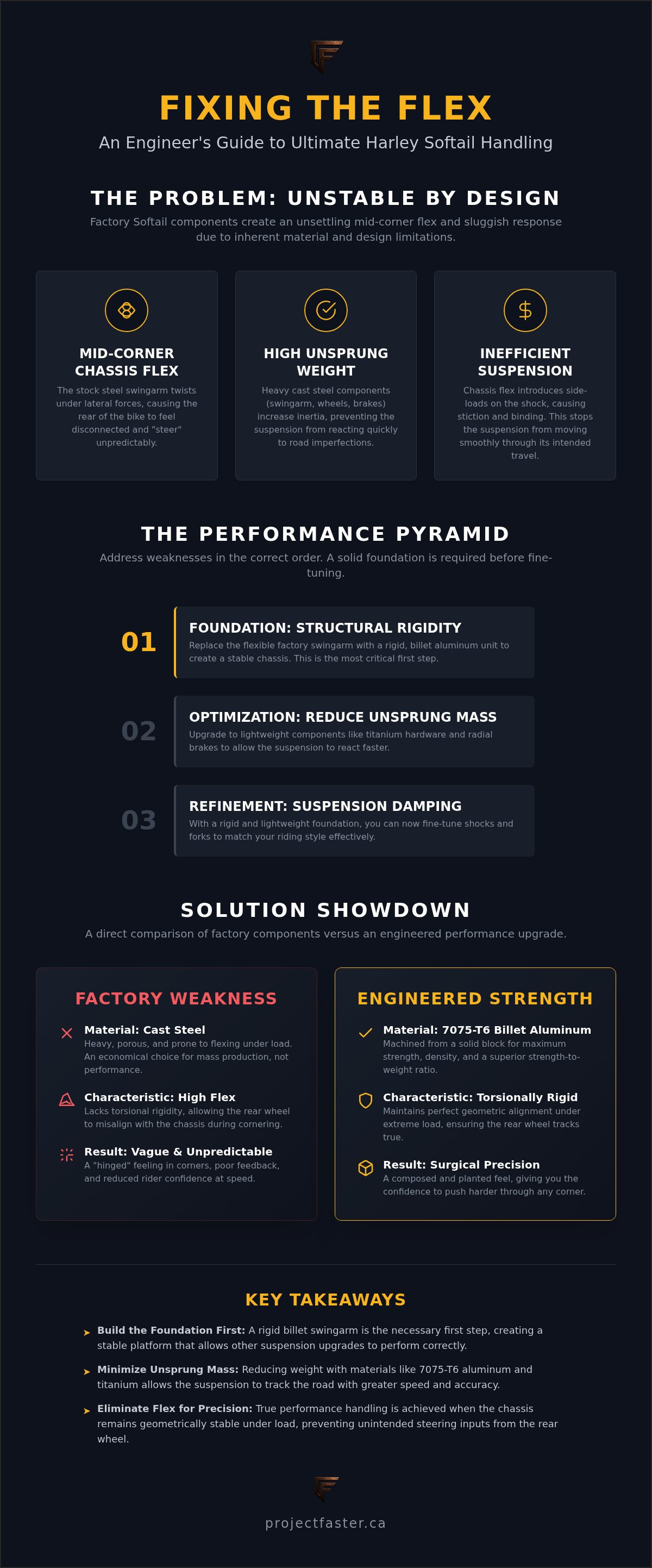
Achieving elite-level performance requires a holistic strategy that treats the motorcycle as a single, integrated system. Many riders mistakenly prioritize damping adjustments before securing the chassis foundation. A "top-down" engineering approach dictates that you must first establish structural rigidity before fine-tuning the suspension. Identifying the best handling upgrades for Harley Softail builds involves realizing that even the most advanced shocks cannot compensate for a twisting frame or a flexing swingarm. When the chassis is stable, every subsequent adjustment becomes more effective, leading to a predictable and communicative machine.
Tuning Suspension for a Rigid Chassis
A stiffer billet swingarm does more than just reduce flex; it provides a stable platform for precision shock valving. In a stock setup, the inherent movement of the steel swingarm acts as an uncontrolled "spring," which masks the true behaviour of the rear shock. Once you install a rigid component like the Vector swingarm, the shock is finally able to move through its stroke without lateral interference. This allows you to run more precise rebound and compression settings because the suspension is no longer fighting chassis distortion.
Weight distribution also shifts when you replace heavy OEM cast parts with lightweight aluminum and titanium. Reducing the mass at the rear of the bike can change the required spring rate. To optimize your setup, follow this baseline checklist for a modified Softail:
- Set Static Sag: Ensure the bike's weight is correctly supported by the springs before adding rider weight.
- Adjust Rider Sag: Target roughly 25 to 30 percent of total travel to maintain the ideal geometry under load.
- Rebound Damping: Set the return speed so the rear tire stays glued to the pavement without "pogoing" after a bump.
- Alignment Verification: Use precision tools to ensure the rear wheel is perfectly centred within the new swingarm.
The Role of Exhaust and Ergonomics
Handling is also a matter of clearance and leverage. A high-performance build is often limited by the physical lean angle of the machine. Installing a high-clearance system like the PF Liberator High-HP Exhaust ensures that you don't scrape hard parts before reaching the tire's edge. Beyond lean angle, there are significant V-Twin performance exhaust benefits regarding power-to-weight ratios that improve the overall flickability of the bike.
Finally, consider your ergonomics. The position of your foot controls and handlebars determines how much leverage you can apply to the chassis. Mid-controls generally offer better body positioning for aggressive riding, allowing you to use your legs to stabilize the bike through transitions. When you combine ergonomic leverage with the best handling upgrades for Harley Softail models, the result is a machine that feels significantly lighter and more responsive than its factory counterpart. If you are ready to engineer a complete handling solution for your build, contact our technical team for a consultation on component compatibility.
Elevating Your Ride with Project Faster Precision Components
Project Faster Inc. operates with a singular focus: the elimination of mechanical weakness through engineering excellence. We believe that performance is a measurable result of material science and precision manufacturing rather than a subjective aesthetic choice. By integrating the best handling upgrades for Harley Softail models into a cohesive build, you move beyond cosmetic modifications toward true functional superiority. The Vector billet swing arm serves as the structural cornerstone of this philosophy, providing a level of rigidity that factory cast components cannot match. We invite you to browse our full collection of performance parts to realize the potential of an engineer-certified chassis.
The Project Faster Advantage: Canadian Engineering
Every component we manufacture undergoes a rigorous testing and certification process before it reaches your motorcycle. Our engineering team prioritizes 7075-T6 aluminum and titanium for their exceptional strength-to-weight ratios, ensuring that every gram removed contributes to a faster suspension response. This no-compromise approach to material selection and CNC machining ensures that your upgrades provide long-term reliability under extreme stress. We focus on the physics of the ride, ensuring that each part is optimized for the structural demands of high-horsepower V-Twins. If you require specific technical build advice or have questions regarding fitment for your particular model, you should contact the team for an authoritative consultation.
Next Steps for Your Softail Build
A logical upgrade path begins at the rear of the machine. Replacing the flexible OEM swingarm and heavy steel fasteners with our Vector series and titanium bolt kits provides the most immediate improvement in tracking and stability. This structural foundation allows you to later extract the maximum performance from high-end shocks and radial braking systems discussed earlier in this guide. Handling is a cumulative result of these efficiencies; each precision part works in tandem to stabilize the machine.
For those embedded in the high-performance culture, we also offer branded gear like the Project Faster | Odin Mfg hoodie to represent the brand when you are away from the workshop. Choosing engineer-certified components is a commitment to safety and mechanical integrity. Organize your performance-focused winter build now to ensure your Softail is a precision-handling machine by the time the next riding season begins. High-performance riding demands a chassis that does not compromise, and we provide the components to achieve that standard.
Stabilize Your Chassis for the Next Level of Performance
Transforming a Softail into a precision-handling machine requires a shift from aesthetic trends to mechanical integrity. You now realize that the foundation of stability lies in a rigid chassis and the deliberate reduction of unsprung mass. By replacing flexible OEM steel with 7075-T6 aluminum and high-strength titanium, you eliminate the tracking errors that compromise your confidence in high-speed corners. These represent the best handling upgrades for Harley Softail builds because they allow your suspension to operate exactly as intended, free from the interference of frame flex.
Project Faster provides engineer-certified components that are precision-machined in Canada and trusted by performance V-Twin enthusiasts across the country. Every millimetre of our Vector Billet Swing Arm is designed to ensure your bike remains composed under the most demanding conditions. Stop adjusting for mechanical flaws. Start engineering for results. Shop the Vector Billet Swing Arm and Transform Your Softail to begin your journey toward a truly stabilized ride. Apply your technical knowledge. Build for performance.
Frequently Asked Questions
Will a billet swingarm really make a difference on my Softail?
Yes, it provides a night and day difference in mid-corner stability by eliminating the torsional flex inherent in OEM cast-steel units. While stock arms twist under high lateral loads, a billet unit stays rigid. This allows the rear wheel to maintain perfect alignment with the front. It is foundational for anyone seeking the best handling upgrades for Harley Softail models, as it stops the rear-steering sensation during aggressive lean angles.
How much weight can I save by switching to titanium bolts?
You can reduce the weight of your fasteners by approximately 45 percent compared to standard Grade 8 steel hardware. While the individual savings per bolt seem small, the cumulative effect on unsprung mass is significant. Reducing this weight allows the suspension to react faster to bumps and road imperfections. This improvement in shock recovery time directly translates to better tire contact and a more communicative ride feel on rough surfaces.
Do I need to upgrade my shocks if I install a Vector swingarm?
You don't strictly need new shocks, but a Vector swingarm allows your current suspension to perform more efficiently. By removing chassis flex, the shock only has to manage vertical movement rather than resisting side-loads. However, to maximize the best handling upgrades for Harley Softail builds, we recommend matching the swingarm with a high-performance mono-shock. This ensures the valving and spring rates are optimized for the reduced unsprung weight of the billet assembly.
Is the PF Vector brake arm compatible with stock Harley calipers?
The PF Vector 108mm Radial Mount Brake Arm is designed specifically for radial-mount calipers, which differ from the factory axial-mount units found on most stock Softails. You will need to install a 108mm radial caliper to utilize this component. This transition is essential for riders demanding superior stiffness and lever feedback. Radial calipers provide a more consistent clamping force, which is necessary for managing high-speed deceleration without bracket deflection.
What is the benefit of 7075-T6 aluminum over 6061?
7075-T6 offers nearly double the tensile strength of 6061 aluminum, making it the superior choice for structural chassis components. While 6061 is common in aesthetic accessories, it lacks the fatigue resistance required for a high-stress swingarm. Using 7075-T6 allows us to machine a lighter part that remains stiffer under extreme loads. This aerospace-grade material ensures that the component won't stretch or deform over thousands of kilometres of hard riding through Canadian road conditions.
Can I install these handling upgrades myself or do I need a shop?
These components are designed for a precise fit, but installation requires advanced mechanical knowledge and specialized tools like a motorcycle lift and torque wrenches. Since these parts are critical to the structural integrity and safety of the machine, we recommend professional installation. A qualified technician ensures that the pivot bearings are properly seated and that the rear axle is perfectly aligned to maintain the geometric precision these parts are engineered to provide.
How does a radial mount brake arm improve handling?
A radial mount improves handling by securing the caliper at both ends, which drastically reduces flex during heavy braking. This rigidity prevents the caliper from twisting relative to the disc, ensuring even pad pressure and more predictable stopping power. By stabilizing the braking force, the front end remains more composed during the transition into a corner. This consistency allows the rider to trail-brake deeper into a turn with total confidence in the front-end feedback.
Are Project Faster parts engineer-certified for safety?
Yes, every structural component we manufacture, including the Mako and Vector swingarms, is engineer-certified. We utilize Finite Element Analysis (FEA) to simulate real-world stresses and ensure each part exceeds factory safety standards. This certification process involves rigorous testing of the strength-to-weight ratios and torsional rigidity. We prioritize mechanical integrity above all else, providing serious riders with the peace of mind that their high-performance components are built to withstand elite-level riding conditions.