

A single seized fastener in your swing arm can transform a routine afternoon of maintenance into a multi-hour battle against physics and oxidation. For riders who demand uncompromising performance, the sight of rust-pitted hardware on a premium V-Twin is more than an aesthetic failure; it represents a vulnerability in the machine's structural integrity. You shouldn't have to choose between the original colour of your hardware and its mechanical reliability. Investing in high-quality corrosion resistant motorcycle bolts is the only way to ensure your bike remains as resilient as the day it left the shop, regardless of the weather or road conditions.
In this engineering guide, you'll discover why material science is the ultimate solution for eliminating rust and enhancing the stability of your high-performance drivetrain. We'll break down the technical advantages of Grade 5 titanium over traditional steel, focusing on how these components provide a 45 percent weight reduction while maintaining a tensile strength of up to 1,050 MPa. From securing your engine to optimizing the unsprung weight of a Mako swing arm, we'll show you how to centre your build around hardware that is functionally superior in every environment.
Key Takeaways
- Understand why standard zinc-plated factory hardware fails in harsh Canadian environments and how to prevent permanent oxidation through material science.
- Discover how upgrading to corrosion resistant motorcycle bolts made from Grade 5 titanium reduces mass while maintaining the tensile strength required for high-stress V-Twin applications.
- Learn to distinguish between structural and non-structural fasteners to prioritize hardware upgrades that enhance the mechanical integrity of your build.
- Master the professional installation techniques and thread preparation required to prevent galling and ensure consistent torque values on high-performance components.
- Realize the performance benefits of matching precision-engineered titanium hardware with structural upgrades like the Mako or Vector billet swing arms.
The Hidden Cost of Corrosion: Why Factory Motorcycle Bolts Fail
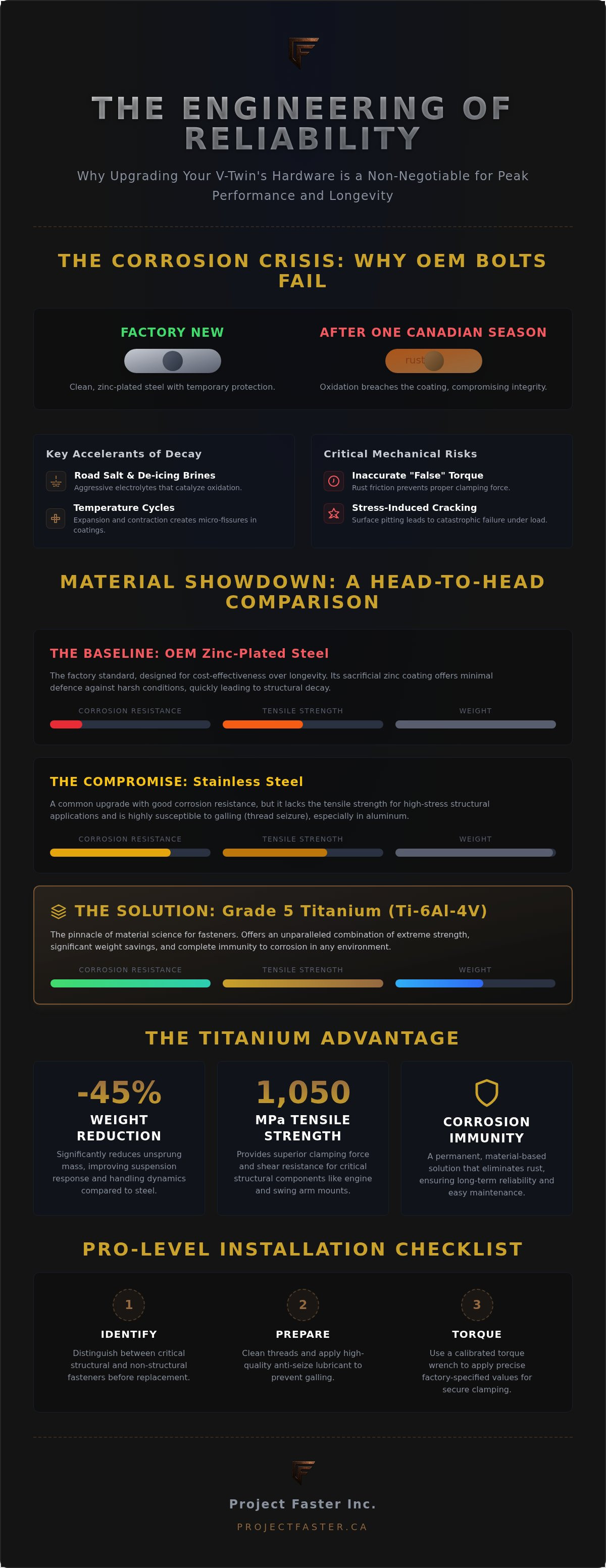
Corrosion is more than a cosmetic nuisance; it's a systematic degradation of a fastener's metallurgical properties. In the context of motorcycle hardware, this process typically involves oxidation, where the iron in steel reacts with oxygen and moisture to form iron oxide. Most original equipment manufacturers (OEMs) rely on zinc-plated steel bolts. While zinc acts as a sacrificial barrier, it's a temporary solution designed for a limited lifespan. Once this thin layer is breached, the underlying steel is exposed to the elements, initiating a cycle of decay that compromises the mechanical integrity of the entire assembly. The orange-red colour of oxidation on a bolt head is a clear signal that the fastener's structural life is reaching its limit.
Environmental Factors in Canada
Canadian riders face unique challenges that accelerate the failure of factory hardware. Road salt and liquid de-icing brines are highly aggressive electrolytes that catalyze the oxidation process. These chemicals often become trapped within the thread engagement of the bolt, causing internal decay that remains invisible from the outside. Temperature cycles also play a critical role. As metal expands and contracts with shifting seasons, microscopic fissures form in protective coatings, allowing moisture to penetrate. Even motorcycles kept in climate-controlled garages aren't immune. Atmospheric humidity can lead to condensation within the frame and engine components, fostering a quiet but persistent environment for corrosion to take hold. You must realize that "garage-kept" does not mean "corrosion-proof."
Mechanical Risks of Rusted Fasteners
The presence of rust on a fastener creates significant mechanical risks that go beyond simple aesthetics. Surface pitting acts as a stress riser, concentrating loads on specific points of the bolt rather than distributing them evenly. This often leads to stress-induced cracking, especially in high-vibration environments like a V-Twin engine or a Mako swing arm mount. Additionally, achieving an accurate torque reading on corroded threads is nearly impossible. The increased friction from rust creates "false torque," where the wrench indicates the target value has been met, but the actual clamping force is insufficient.
When dissimilar metals interact in the presence of an electrolyte, Galvanic corrosion can occur, potentially fusing the bolt to the component. This results in "frozen" fasteners that require drilling or heat to remove, risking damage to expensive billet parts. It's difficult to organize a proper maintenance schedule when every bolt removal carries the risk of a snapped head. Hydrogen embrittlement serves as a silent killer of high-tensile steel bolts, causing sudden, catastrophic failure under load without any prior visible deformation. Transitioning to high-quality corrosion resistant motorcycle bolts is a necessary step for any rider prioritizing long-term mechanical reliability and safety.
Material Science: Titanium vs. Stainless Steel for High-Performance Bolts
Selecting the correct alloy is a critical engineering decision that dictates the lifespan and safety of a high-performance motorcycle build. While many riders view stainless steel as the default upgrade for corrosion resistant motorcycle bolts, it's often a compromise in structural applications. Titanium, specifically Grade 5 (Ti-6Al-4V), offers a unique combination of extreme durability and reduced mass that stainless steel cannot match. Understanding the metallurgical differences between these materials is essential for maintaining the mechanical integrity of your machine.
The Limits of Stainless Steel
Common 304 and 316 stainless steels are excellent for non-structural trim or fairing bolts, but they often lack the tensile strength required for engine mounts or suspension pivots. Stainless steel is also prone to galling, a form of abrasive wear where threads cold-weld together during installation. This risk is particularly high when threading stainless fasteners into aluminum casings, a common configuration in V-Twin engines. If you're building for high-output performance, relying on stainless steel in high-stress areas can lead to fastener elongation or catastrophic failure under load. Stainless remains acceptable for low-load aesthetics, but titanium is mandatory for structural components.
The Superiority of Grade 5 Titanium
Grade 5 titanium is the gold standard for aerospace and elite-level racing for a reason. With a tensile strength ranging from 950 to 1,100 MPa, it matches or exceeds the strength of Grade 10.9 steel while being approximately 45 percent lighter. This density difference allows you to shed significant mass from the machine without sacrificing safety. Unlike steel, titanium forms a stable, continuous oxide layer upon exposure to air, providing a permanent shield against salt, acids, and atmospheric moisture. NASA research on titanium fasteners confirms that when properly lubricated, these alloys outperform traditional materials in demanding environments where weight and reliability are non-negotiable.
The high-frequency vibrations of a V-Twin engine demand hardware with superior fatigue resistance. Titanium's lower modulus of elasticity allows it to handle these cycles more effectively than brittle stainless alloys. Beyond the physics, titanium offers the functional benefit of being anodized in various colours through electrolytic processes. This allows for a customized finish that is chemically bonded to the surface, ensuring the hardware maintains its appearance over thousands of kilometres. If you have questions about specific fitment for your build, you can consult with our engineering team to find the right hardware solution for your performance goals.
Mechanical Advantages: Weight Savings and Tensile Strength in V-Twin Applications
While the elimination of oxidation is a primary driver for many builders, the mechanical advantages of Grade 5 titanium extend far beyond surface durability. High-performance V-Twins generate immense torque and significant vibration, placing extreme stress on every fastener in the chassis. Upgrading to corrosion resistant motorcycle bolts provides a critical opportunity to optimize the machine's power-to-weight ratio and structural rigidity. When every component is engineered to eliminate mechanical weaknesses, the result is a bike that handles with greater precision and maintains its alignment under aggressive riding conditions.
Reducing Unsprung Mass
The most impactful performance gains are realized by reducing unsprung weight, which is the mass of the components not supported by the motorcycle's suspension. Replacing heavy steel axle bolts, brake caliper fasteners, and sprocket bolts with a titanium bolt kit motorcycle enthusiasts use can shed significant mass from the wheels and swing arm assembly. Reducing this weight allows the suspension to react more quickly to road imperfections, keeping the tires in contact with the pavement for better traction. Every gram saved in unsprung mass is equivalent to a larger saving in sprung weight for handling. By minimizing the inertia of the moving suspension components, you effectively sharpen the steering response and improve the overall agility of a heavy H-D build.
Torque Retention and Vibration Resistance
High-HP V-Twins require fasteners that won't stretch or fatigue over thousands of heat cycles. Grade 5 titanium possesses a modulus of elasticity that allows it to act like a very stiff spring, maintaining clamping force more effectively than stainless steel in high-vibration environments. This property is vital for maintaining chassis alignment and ensuring that critical components, such as engine mounts or the pivot points of a Vector billet swing arm, remain secure. Hardware that supports high performance Harley parts must be manufactured with precision-rolled threads rather than cut threads. Rolled threads follow the natural grain of the metal, which significantly increases the fatigue life of the bolt and prevents the formation of microscopic stress cracks.
Precision-engineered hardware ensures that torque values remain consistent over time, reducing the frequency of maintenance intervals. When you combine the 45 percent weight reduction of titanium with its superior tensile strength, you aren't just replacing a bolt; you're upgrading a structural element of the motorcycle. This transition from factory steel to specialized titanium is a fundamental step for riders who demand that their hardware performs at the same elite level as their powertrain and suspension components.
Installation and Maintenance: How to Replace Critical Motorcycle Fasteners
Transitioning to corrosion resistant motorcycle bolts is a precise technical upgrade that requires more than a simple one-for-one swap. To maintain the mechanical integrity of a high-performance V-Twin, you must follow a methodical installation protocol. Grade 5 titanium interacts differently with chassis components than factory steel, and failing to account for these differences can lead to inaccurate clamping forces or localized material degradation. A successful hardware overhaul follows these four essential steps:
- Step 1: Identify and prioritize critical structural fasteners, such as those for the engine mounts and the Vector billet swing arm, over non-critical aesthetic trim.
- Step 2: Thoroughly clean and inspect the internal threads of the mounting point using a thread chaser to remove old thread locker and oxidation.
- Step 3: Apply a mandatory barrier of anti-seize or thread locker to prevent galvanic reactions between dissimilar metals.
- Step 4: Calibrate your torque wrench to account for the specific friction coefficient of lubricated titanium threads.
Preventing Galvanic Corrosion
While titanium is exceptionally resistant to atmospheric decay, it can act as a cathode when paired with aluminum or magnesium components. This electrochemical reaction can cause the softer metal to corrode rapidly, potentially fusing the fastener to the casing. To eliminate this risk, you must use a copper-based or nickel-based anti-seize to create a physical barrier between the metals. This prevents electron transfer and ensures the bolt can be removed during future maintenance without damaging the threads. If you find a white, powdery residue around a fastener head, it's a primary sign that the barrier was omitted or has been breached.
Identifying High-Stress Zones
Focus your engineering efforts on high-stress zones like the swing arm pivots, engine mounts, and triple trees. These areas handle the majority of the machine's torsional loads and vibrations. You should never reuse a factory 'torque-to-yield' bolt; these fasteners are designed to stretch permanently upon their first installation. Replacing them with corrosion resistant motorcycle bolts ensures the clamping force remains consistent throughout the life of the component. Organize your workflow by replacing one fastener at a time to maintain chassis alignment and prevent missed steps. If you require specific torque specifications for your build, contact our engineering team for technical guidance.
Achieving the correct torque is the final safeguard for your build. Because titanium is often installed with lubrication, the friction in the threads is significantly reduced compared to dry steel. You'll typically need to reduce the manufacturer's dry torque value by 10 to 20 percent to avoid overstretching the bolt while still achieving the necessary tension. This precision ensures that your hardware remains secure under the heavy loads of a high-HP build.
Project Faster Engineering: Precision-Matched Titanium Hardware for H-D Performance
Project Faster Inc. operates with a singular focus: the elimination of mechanical weak links in every build. In a high-performance H-D application, the fasteners are often the most overlooked point of failure. Our corrosion resistant motorcycle bolts are not generic off-the-shelf hardware. They are curated specifically to handle the extreme reciprocating loads and thermal expansion characteristic of large-displacement V-Twin engines. By prioritizing Grade 5 titanium, we provide a hardware solution that matches the longevity and structural requirements of our most advanced structural components.
Engineered for the Modern Softail and Touring Models
Our kits are precision-engineered to support the modern Softail and Touring platforms. When you install a Vector billet swing arm, the mounting hardware must be equally sophisticated. Generic retail bolts often suffer from inconsistent tolerances, leading to rattling or microscopic play that compromises chassis feedback. Project Faster hardware is designed for an exact fit, ensuring that every Newton-metre of torque translates into a secure, stable assembly. Beyond function, there is a distinct visual synergy when pairing our anodized titanium fasteners with CNC-machined billet components. It completes the build with an industrial, high-end aesthetic that signals a commitment to uncompromising quality.
The Project Faster Advantage
The Project Faster advantage is rooted in a deep understanding of the Canadian riding environment. Our engineering team recognizes that hardware must survive more than just a sunny afternoon ride. Our titanium bolt kits provide the ultimate defence against the road salt and humidity that decimate OEM steel across the country. This is a "one-and-done" investment. Because titanium does not degrade or lose its structural properties over time, it's the last bolt kit you'll ever buy for your machine. You can realize a significant reduction in maintenance overhead by simply choosing materials that are immune to atmospheric oxidation.
We encourage you to shop all parts to see how our hardware integrates with the PF Mako Billet Swing Arm and our Liberator high-HP exhaust systems. Building a cohesive, high-performance machine requires a holistic approach to material science. Every component must be chosen for its ability to enhance the mechanical integrity of the whole. Don't let a rusted factory bolt undermine a precision build. Invest in hardware that matches the speed, power, and engineering excellence of your motorcycle.
Secure Your Build with Precision Engineering
Fasteners are the foundation of mechanical reliability. We've explored how factory hardware fails under the stress of Canadian climates and why Grade 5 titanium is the definitive solution for high-performance V-Twins. By switching to corrosion resistant motorcycle bolts, you aren't just improving the aesthetics of your bike; you're enhancing the structural integrity of your machine. These bolts are engineer-certified for high-stress applications, offering precision-rolled threads that provide maximum fatigue resistance.
Titanium's 45 percent weight reduction actively improves handling by lowering unsprung mass. Simultaneously, its permanent oxide layer ensures that seized fasteners and stripped threads become a thing of the past. It's a fundamental upgrade for any rider who prioritizes speed and safety. If you're ready to eliminate mechanical weak links, upgrade your build with Project Faster Titanium Bolt Kits today. Your motorcycle deserves hardware that matches its power. Take the next step toward a rust-free, high-performance future.
Frequently Asked Questions
Are titanium bolts stronger than standard steel motorcycle bolts?
Grade 5 titanium bolts offer a tensile strength of approximately 950 to 1,050 MPa, which is equivalent to high-tensile Grade 10.9 steel fasteners. While standard OEM steel bolts are often lower grade, titanium provides a superior strength-to-weight ratio. This makes them ideal for high-performance applications where mechanical integrity is paramount. You can replace structural steel hardware with Grade 5 titanium without sacrificing the clamping force required for aggressive riding conditions.
Do titanium bolts rust or corrode in salt air?
Titanium is chemically incapable of rusting because it does not contain iron. Upon exposure to oxygen, it immediately forms a stable and continuous oxide film that protects the underlying metal from salt air, road brine, and acidic environments. This makes corrosion resistant motorcycle bolts the definitive choice for riders in coastal regions or harsh Canadian winters. Unlike zinc-plated steel, this protection is permanent and does not require secondary coatings or maintenance.
Is it safe to use titanium bolts on my motorcycle's engine mounts?
It is entirely safe to use Grade 5 titanium on engine mounts provided you use the correct alloy. Grade 5 (Ti-6Al-4V) is specifically engineered for high-stress structural applications and can withstand the intense vibrations and thermal cycles of a V-Twin powertrain. You should avoid using Grade 2 titanium in these areas, as it lacks the necessary tensile strength. Always verify that your hardware is rated for structural use before securing critical components.
Why do I need to use anti-seize with titanium fasteners?
Anti-seize is mandatory to prevent galling, a process where the threads of the bolt and the mounting hole cold-weld together under pressure. Because titanium has a high friction coefficient, installing it dry can lead to permanent seizure, especially in aluminum engine casings. Applying a nickel-based or copper-based lubricant creates a necessary physical barrier. This ensures consistent torque readings and allows for future removal without damaging the internal threads of your expensive billet parts.
Can titanium bolts cause galvanic corrosion with an aluminum frame?
Titanium can trigger galvanic corrosion when it comes into direct contact with aluminum in the presence of moisture. In this electrochemical reaction, the aluminum acts as the anode and will degrade over time. However, this risk is easily mitigated by using a high-quality thread lubricant or anti-seize compound. This barrier prevents the flow of electrons between the dissimilar metals, ensuring the long-term stability of your corrosion resistant motorcycle bolts and the chassis.
How much weight can I really save by switching to a titanium bolt kit?
You can expect a weight reduction of approximately 40 to 45 percent compared to the original steel hardware. While a single bolt may only save a few grams, a full kit can result in a total reduction of 150 to 200 grams across the chassis. This mass is particularly significant when removed from unsprung areas like the wheels and brakes. Reducing this weight improves suspension response and sharpens the handling characteristics of your motorcycle.
What is the difference between Grade 5 and Grade 2 titanium for motorcycles?
Grade 5 titanium is an alloy containing 6 percent aluminum and 4 percent vanadium, making it suitable for structural engine and chassis components. Grade 2 is commercially pure titanium, which is significantly softer and lacks the tensile strength required for high-load applications. On a motorcycle, Grade 2 should only be used for non-structural purposes like fairing screws or trim pieces. For any component involving safety or torque retention, Grade 5 is the required standard.
Do I need to adjust my torque settings when installing titanium bolts?
You must adjust your torque settings because titanium is typically installed with anti-seize, which reduces thread friction. When using a lubricant, the actual clamping force increases for the same torque value. To avoid overstretching the fastener, it is standard practice to reduce the manufacturer's dry torque specification by 10 to 20 percent. Using a calibrated torque wrench is essential to ensure you achieve the precise tension required for stability without exceeding the yield point.