

A massive increase in displacement is a liability if the surrounding engineering cannot handle the resulting thermal and mechanical stress. You likely recognize the pursuit of raw torque as the ultimate goal, yet many riders realize too late that Vtwin big bores demand far more than just larger pistons to function reliably. It is a common frustration to invest in a 128" or 129" kit only to be met with engine overheating or the dangerous instability of "bagger wobble" when the chassis flexes under high-torque loads. We understand that performance is nothing without mechanical integrity.
This guide provides the technical clarity you need to maximize the reliability and power of your V-Twin build. You will discover the essential supporting engineering, from high-flow exhaust systems that prevent engine choking to engineer-certified swing arms that stabilize the frame. We preview the critical balance between horsepower gains and structural durability, ensuring your motorcycle handles its new output with precision. By focusing on the physics of the build, you can achieve a high-performance machine that excels on Canadian roads without compromising safety or longevity.
Key Takeaways
- Understand the fundamental physics of increasing cylinder diameter to achieve superior combustion force and displacement.
- Identify the critical engine fasteners and high-performance cams required to stabilize the increased mechanical stress of high-compression Vtwin big bores.
- Prevent chassis instability and "bagger wobble" by integrating a rigid, engineer-certified swing arm that can handle extreme torque loads.
- Recognize how optimized exhaust scavenging eliminates the "choke point" effect, allowing your high-displacement build to reach its full horsepower potential.
- Learn how to plan a balanced performance build that prioritizes mechanical integrity and component compatibility for long-term reliability.
Understanding V-Twin Big Bore Kits: Power Beyond Factory Specifications
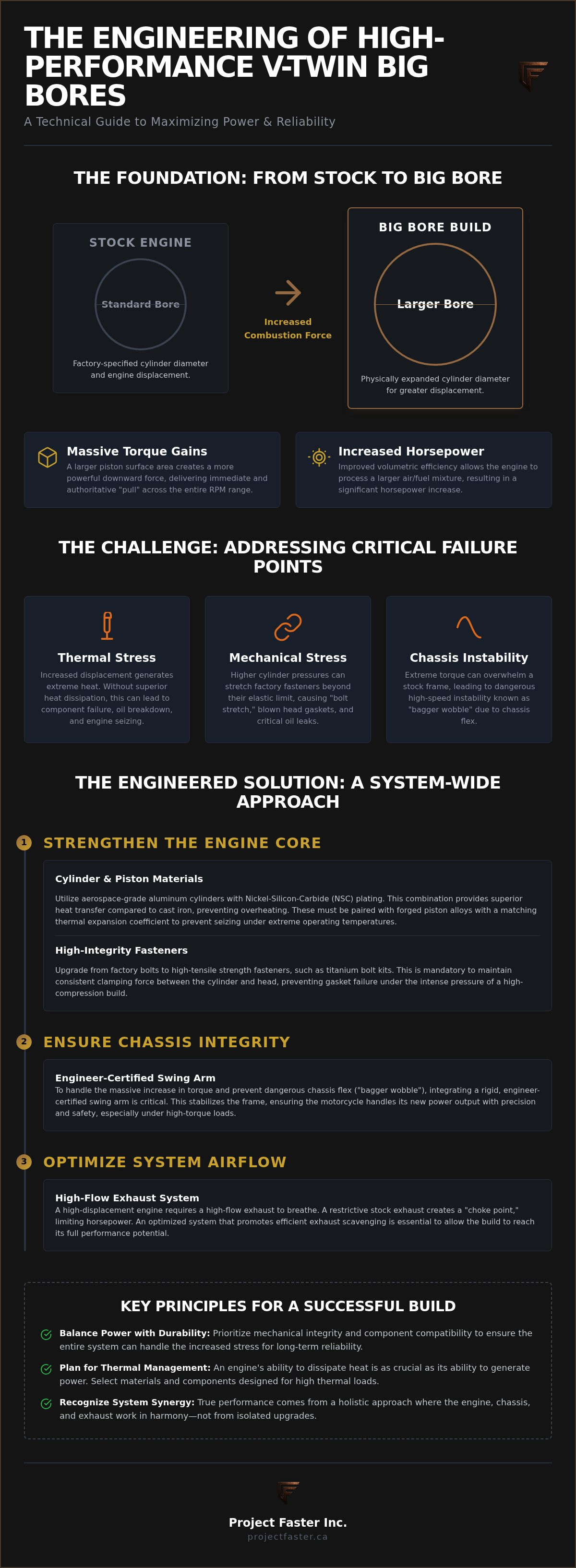
A big bore kit represents the most direct method of increasing a motorcycle’s volumetric efficiency by physically expanding the cylinder diameter. This modification alters the core geometry of the engine, allowing for a larger intake of the air and fuel mixture. When you increase the bore, you effectively increase the total engine displacement without altering the crankshaft's stroke. This results in a higher combustion force that translates directly into immediate power gains. For riders seeking to push Vtwin big bores beyond factory limitations, this process is the foundation of high-performance engineering.
The primary benefits of these builds include massive torque gains and a significant increase in horsepower across the entire RPM range. Unlike smaller modifications that only offer peak-end improvements, a displacement increase provides a broader power band. Modern performance enthusiasts generally choose between "bolt-on" kits, which fit within the existing engine cases, and extreme displacement builds that require precise case boring to accommodate oversized cylinder spigots. Understanding the historical context of V-twin engine design helps clarify why these engines respond so aggressively to increased bore sizes; their inherent architecture is optimized for low-end grunt that only improves with added volume.
The Mechanics of Displacement and Torque
Increasing the bore size fundamentally shifts the engine's power profile. By expanding the piston surface area, the pressure generated during the combustion cycle acts upon a larger plane. This creates a more powerful downward force on the connecting rod and crankshaft. Torque is the defining characteristic of a successful V-Twin big bore build. It provides the "pull" required to move heavy touring bikes with authority. A larger bore allows the engine to breathe more efficiently, provided the intake and exhaust can keep pace. This mechanical advantage ensures that the motorcycle remains responsive even at lower speeds, reducing the need for constant downshifting during acceleration.
Thermal Efficiency in High-Displacement Engines
Heat dissipation is the most significant challenge when managing larger cylinders. As displacement increases, the engine generates more thermal energy, which must be moved away from the combustion chamber to prevent component failure. Material selection is critical here. High-performance kits often utilize aerospace-grade aluminum cylinders with nickel-silicon-carbide (NSC) plating. This combination offers superior heat transfer compared to traditional cast iron liners. Modern engineering ensures that these components can withstand the increased friction and pressure of a high-compression setup. Current 2026 engineering standards dictate that high-performance V-Twin cylinders utilizing aerospace-grade aluminum must maintain a thermal expansion coefficient that precisely aligns with forged piston alloys to prevent seizing under extreme operating temperatures.
The Engineering Requirements of Increased Displacement
Increasing engine volume without addressing structural weaknesses is a recipe for mechanical failure. When you install Vtwin big bores, the cylinder pressure rises significantly. This surge in energy tests every internal component, from the base gaskets to the head bolts. Understanding motorcycle engine principles reveals that higher displacement increases the load on the reciprocating assembly. Without a methodical approach to these engineering demands, the potential for catastrophic failure increases. Performance is a product of synergy, not just displacement.
Fastener Integrity and Stress Management
Factory bolts are designed for stock compression ratios and standard thermal cycles. Under the extreme loads of a big bore build, these fasteners can experience "bolt stretch," where the material reaches its elastic limit. This leads to a loss of clamping force, often resulting in blown head gaskets or oil leaks. Upgrading to titanium bolt kits offers a critical engineering advantage. Titanium provides an exceptional strength-to-weight ratio and remains stable under high-stress applications. Consistent clamping force is mandatory to maintain the seal between the cylinder and the head, especially when combustion pressures exceed factory specifications.
Valvetrain and Airflow Synchronization
A larger cylinder is useless if it cannot be filled and emptied efficiently. High-performance cams must be matched to the specific bore and stroke to optimize the timing of the intake and exhaust valves. If the cam profile is too conservative, it will choke the engine's potential. Conversely, an overly aggressive profile can lead to valve float at higher RPMs if the valve springs aren't sufficiently rated. High-flow cylinder heads are often necessary to realize the full benefits of Vtwin big bores, ensuring that the increased volume of air moves without turbulence. Precise timing prevents the pistons from making contact with the valves, a risk that increases as tolerances tighten in performance builds.
Fuel delivery must also scale with displacement. Stock injectors often reach their duty cycle limit long before a 128" build hits its peak, leading to lean conditions that cause excessive heat. Similarly, stock gaskets and seals are rarely rated for the increased internal pressures found in high-compression engines. Multi-layer steel (MLS) gaskets are the standard for these applications because they resist the shearing forces created by thermal expansion. If you are unsure which components will best support your specific performance goals, you should consult with an engineering specialist to ensure a balanced build.
Chassis Integrity: Stabilizing High-Torque V-Twin Big Bore Builds
Raw output is a liability if the chassis fails to translate energy into forward motion. When building Vtwin big bores, riders often neglect the structural limitations of the factory frame. A stock swing arm is designed for factory specifications; it is not engineered to withstand the torsional forces of a 131" motor. Understanding the relationship between engine power and performance requires looking beyond the combustion chamber. If the chassis flexes under load, the rear wheel loses alignment, leading to the dangerous phenomenon known as "bagger wobble." Maintaining mechanical integrity requires a rigid conduit for power that prevents the frame from twisting under the weight of massive torque gains. Aligning the chassis at the centre of your build strategy is the only way to ensure safety at high speeds.
The Billet Advantage: Mako and Vector Swing Arms
The PF Mako Billet Swing Arm is an essential upgrade for high-displacement touring builds. CNC-machined from 6061 or 7075-series aluminum, these components offer a superior strength-to-weight ratio compared to stamped steel. While weight savings improve suspension response, the primary goal is absolute rigidity. For Softail riders, the Vector Billet Swing Arm provides the necessary torsional resistance to prevent lateral movement. 7075 aluminum is specifically chosen for its fatigue resistance and tensile strength, ensuring the component does not deform over thousands of high-stress launches. This engineering choice ensures the rear wheel stays planted, neutralizing the flex that compromises handling in high-torque applications.
Braking and Control for High-Output Motorcycles
Doubling your engine's output necessitates a proportional increase in stopping power. Standard axial-mount calipers often lack the stiffness required for consistent performance under heavy thermal loads. The PF Vector 108mm Radial Mount Brake Arm addresses this by providing a rigid mounting platform for modern radial calipers. This setup reduces caliper flex, ensuring that brake lever feel remains precise and predictable even during aggressive deceleration. High-output motorcycles demand this level of engineering to maintain safety on Canadian roads. When Vtwin big bores deliver peak torque, your ability to control that energy determines the success of the build. Predictable handling isn't an aesthetic choice; it's a functional requirement for any serious performance machine.
Optimized Airflow: Why Exhaust is Critical for Big Bore Performance
Volumetric efficiency depends entirely on how effectively you can clear the combustion chamber after each power stroke. For Vtwin big bores, the exhaust system often becomes a literal bottleneck that prevents the engine from breathing. Standard pipes or aesthetic-focused aftermarket systems lack the internal volume to handle the increased gas mass generated by a 128" or 131" build. This creates a "choke point" where excessive backpressure builds up, forcing the engine to work against its own exhaust. High-performance engineering focuses on exhaust scavenging, which uses the kinetic energy of a departing exhaust pulse to create a low-pressure area that helps pull the next intake charge into the cylinder. Without this synchronization, you cannot realize the full torque potential of your displacement increase.
The PF Liberator: Engineering for High-HP
The PF Liberator High-HP Exhaust is designed specifically for engines that exceed factory airflow thresholds. Unlike generic 2-into-1 systems, the Liberator utilizes stepped header diameters to maintain high gas velocity while providing the necessary volume for high-displacement motors. The transition from the header to the collector is a critical engineering junction where gas flow must remain laminar rather than turbulent. Construction from high-grade stainless steel provides superior thermal management, ensuring that heat is radiated away from the engine cases efficiently. This durability is essential for Canadian riders who demand consistent performance across varying environmental conditions, allowing the engine to reach its maximum dyno potential without heat soak.
Sound vs. Performance: The Technical Balance
A common misconception in the V-Twin community is that a louder exhaust is inherently a higher-performing one. The reality is governed by the physics of sound waves and gas velocity within the exhaust tract. If the header pipes are too large in diameter, the exhaust gas cools and slows down, which destroys the scavenging effect and kills low-end torque. Conversely, a restricted system will choke the engine at high RPMs. Achieving an authoritative exhaust note requires a precision-engineered internal baffle and collector structure that manages sound waves without obstructing gas flow. For Vtwin big bores, the goal is to maintain high gas velocity to preserve that signature low-end grunt while allowing for unrestricted flow at peak horsepower.
Selecting an exhaust system that is mathematically matched to your engine's displacement and cam profile is the only way to ensure your build performs as intended. If you are planning a high-output project and need to verify component compatibility, you can contact our engineering team for technical guidance on your specific application.
Executing Your Performance Build: Selection and Integration
Success with Vtwin big bores requires a shift from part-swapping to total system integration. A methodical approach starts with a clear performance objective and a realistic assessment of your motorcycle's current limitations. You must evaluate every component between the air intake and the rear tyre to ensure they can sustain the increased mechanical load. High-performance engineering isn't about a single "hero" part; it's about the synergy between the reciprocating assembly, the drivetrain, and the chassis. Integrating high performance Harley parts into a cohesive system prevents the premature failure often seen in haphazard builds. When you increase displacement, you increase the demands on every supporting system.
Component Compatibility and Build Synergy
A common oversight in high-displacement projects is the primary drive. Increasing displacement to 128" or 131" often results in torque figures that exceed the holding capacity of a stock clutch. This leads to slippage and excessive heat, which can warp plates and contaminate your primary oil. Your build sheet must prioritize mechanical integrity by including components designed for these extreme loads. Consider the following essentials for your integration plan:
- Heavy-duty clutch springs or variable-pressure plates to manage torque transfer.
- Compensator upgrades to handle aggressive power spikes during acceleration.
- High-strength titanium fasteners to maintain clamping force and prevent oil leaks under pressure.
- Reinforced primary chains and tensioners to ensure drivetrain stability.
As established in previous sections, fastener choice is non-negotiable. Using titanium hardware for high-stress connections ensures that the engine stays sealed under the increased pressures of high-compression cycles. A balanced build recognizes that every bolt and seal is a potential point of failure if not matched to the engine's new output.
Consulting the Performance Experts
Off-the-shelf kits provide a foundation, but elite-level performance often requires professional customization. Factors like Canadian fuel quality, local altitude, and specific riding styles influence how an engine should be assembled and calibrated. Consulting with engineers who specialize in V-Twin physics allows you to avoid costly compatibility errors before you turn a single wrench. They can help you realize the difference between a collection of parts and a precision-engineered machine. Professional tuning on a dynamometer is the final, critical step. It ensures the air-fuel ratio is optimized across the entire map, protecting your investment from lean-condition damage during the initial break-in period. Adhering to a strict heat-cycle and oil-change schedule during the first 1,000 kilometres is mandatory for maximum longevity.
Ready to engineer a faster machine? Contact the Project Faster team for a technical consultation to ensure your next build is rooted in engineering excellence and functional superiority.
Engineering the Ultimate High-Performance Build
Building a high-output machine requires a commitment to mechanical integrity that extends far beyond the cylinder heads. You've learned that Vtwin big bores demand a holistic approach where every component is rated for the extreme torque generated by increased displacement. Success is found in the synergy between the PF Liberator high-HP exhaust technology and a stabilized chassis. Without engineer-certified Mako swing arms or precision-machined 7075 aluminum components, raw power remains a liability rather than an asset. It's the difference between a collection of parts and a precision machine.
Mechanical excellence is achieved through meticulous planning and the selection of hardware designed to withstand the physics of performance. Don't leave your build to chance by ignoring the structural requirements of your motorcycle's frame and drivetrain. By prioritizing stability and optimized airflow, you ensure that your investment delivers reliable results on every ride. Consult with our engineering team for your V-Twin build to ensure your project is rooted in functional superiority. We're ready to help you push the limits of performance safely.
Frequently Asked Questions
Does a V-Twin big bore kit reduce the lifespan of my engine?
Engine longevity depends entirely on the quality of the supporting components and the precision of the assembly. Increasing displacement without upgrading head bolts or managing thermal loads will accelerate wear. However, using high-strength fasteners and ensuring proper oil cooling can maintain factory-level reliability. A balanced build that respects mechanical limits often outlasts a poorly executed stock repair.
Can I install a big bore kit on a stock Harley-Davidson chassis without upgrades?
A stock chassis is not engineered to handle the massive torque loads produced by Vtwin big bores. While the engine will physically fit, the factory swing arm and motor mounts will likely flex under heavy acceleration. This leads to unpredictable handling and the notorious "bagger wobble." We recommend stabilizing the frame with a rigid, engineer-certified swing arm to ensure the motorcycle remains safe.
What is the difference between a bolt-on big bore and a case-bore kit?
Bolt-on kits utilize the existing engine case bore, while case-bore kits require precision machining of the crankcase to accept larger cylinder spigots. Bolt-on options are more accessible and typically reach displacements like 128 inches for Milwaukee-Eight motors. Case-boring is necessary for extreme builds that push displacement beyond those limits, though it requires a complete engine teardown and specialized machining services.
Do I need a new exhaust system for a big bore build?
Upgrading your exhaust is essential to prevent the "choke point" effect that limits high-displacement performance. A larger engine generates a higher volume of exhaust gas that a stock system cannot clear efficiently. A dedicated high-HP exhaust like the PF Liberator optimizes scavenging, pulling more air into the cylinders. Without this, you'll sacrifice significant torque and risk increasing engine operating temperatures.
How much horsepower can I realistically expect from a V-Twin big bore?
Real-world output for Vtwin big bores typically ranges from 120 to over 150 horsepower depending on the specific configuration. A 128-inch kit paired with a high-performance cam and unrestricted exhaust can easily surpass the 140-horsepower threshold. Your results will depend on the synergy of your components and the quality of the final dynamometer tune. Professional calibration is mandatory to reach these peak figures.
Is a billet swing arm necessary for a big bore bagger?
A billet swing arm is a critical safety upgrade for any high-torque bagger build. Factory stamped-steel arms lack the torsional rigidity required to keep the rear wheel aligned when torque exceeds 140 lb-ft. Billet aluminum components, such as the Mako or Vector, eliminate lateral flex and improve power delivery. This ensures the motorcycle tracks straight and remains stable during aggressive cornering or high-speed runs.
What type of fuel is required for high-compression big bore engines?
High-compression builds require premium high-octane fuel to prevent pre-ignition and engine knock. In Canada, this generally means using 91 or 94 octane fuel at every fill-up. Because these engines often run compression ratios of 11:1 or higher, lower-grade fuels will cause detonation that can destroy pistons and rings. Always consult your tuner to confirm the minimum octane rating required for your specific map.
How long is the break-in period for a new big bore kit?
The standard break-in period for a performance engine build is approximately 1,000 kilometres. This process involves a series of controlled heat cycles and early oil changes to remove assembly lubricants and seating debris. You must avoid holding a constant RPM for long durations during this time. Proper ring seating is essential for long-term oil control and maintaining the high-compression seal required for maximum power.