

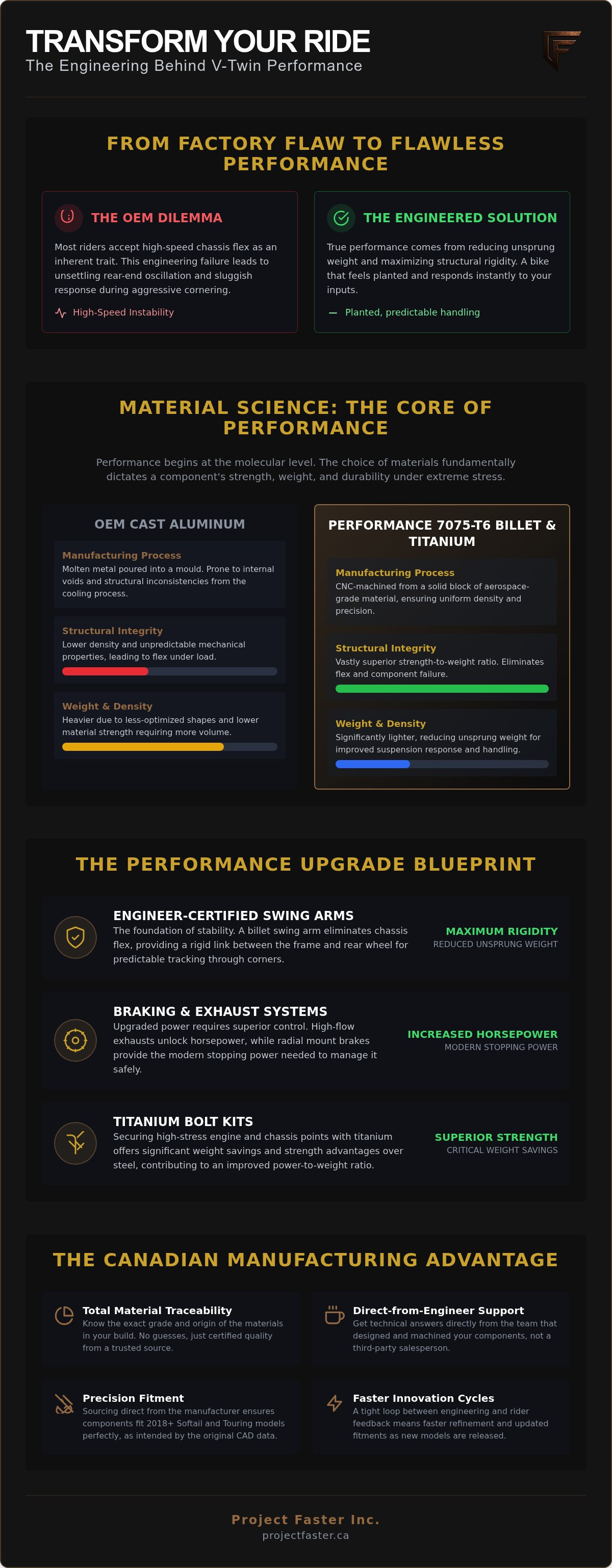
Most riders accept high-speed chassis flex as an inherent V-Twin trait, yet it's actually a preventable engineering failure. You've likely experienced the unsettling rear-end oscillation or the sluggish response of heavy OEM components during aggressive cornering. It's a common frustration for those who demand more than just aesthetic upgrades from an aftermarket Harley parts manufacturer. You want a bike that feels planted, not one that fights your inputs when you open the throttle.
We realize that true performance comes from reducing unsprung weight and maximizing structural rigidity through precision manufacturing. This guide explores how engineering-first components, such as 7075-T6 billet swing arms and titanium hardware, can fundamentally change your Harley-Davidson's handling profile. We'll break down the technical criteria for 2026, from engineer-certified fitment to the impact of material science on power-to-weight ratios. You'll learn how to select components that eliminate mechanical weaknesses and provide a professional, performance-driven centre of gravity for your 2018+ Softail or Touring model.
Key Takeaways
- Learn why transitioning from cast OEM components to CNC-machined 7075-T6 billet aluminum is critical for achieving superior structural integrity.
- Discover how an engineer-certified aftermarket Harley parts manufacturer eliminates chassis flex and high-speed instability through advanced swing arm architecture.
- Understand the mechanical necessity of high-flow exhaust systems and radial mount brakes for managing increased horsepower and modern stopping requirements.
- Realize the significant weight savings and strength advantages provided by titanium bolt kits when securing high-stress engine and chassis points.
- Identify the strategic benefits of sourcing performance hardware directly from a Canadian manufacturer to ensure long-term durability and precision fitment.
What Defines a High-Performance Aftermarket Harley Parts Manufacturer?
A high-performance aftermarket Harley parts manufacturer isn't just a warehouse with a shipping department. It's a facility where components are designed, prototyped, and tested under real-world stresses before they ever reach a customer's bike. In the 2026 market, the distinction between a distributor and a specialized engineering firm has become the defining factor for riders seeking actual performance gains. While mass-market catalogs often focus on aftermarket motorcycle accessories that prioritize aesthetics, a performance-led manufacturer develops hardware that addresses mechanical deficiencies. This shift from simple bolt-on upgrades to performance-critical hardware reflects a growing demand for mechanical integrity.
Specialized firms prioritize engineer certification. For high-stress components like swing arms and brake mounts, having a structural engineer's stamp isn't a luxury; it's a safety requirement. It ensures the part can handle the torque and lateral forces of a heavy V-Twin at speed. Distributors sell parts; manufacturers solve problems. When you choose a dedicated aftermarket Harley parts manufacturer, you're investing in a design philosophy that understands the physics of a 900-pound machine moving at 120 kilometres per hour.
Direct-to-Rider Engineering Benefits
Buying direct from an engineering firm ensures total material traceability. You don't have to guess about the grade of aluminum used or the origin of the hardware. You have direct access to technical support from the people who actually designed and machined the component. This eliminates the technical disconnect often found in general distribution chains where sales staff lack deep mechanical knowledge. If you have a question about the tolerances of the PF Vector Billet Swing Arm, you get an answer rooted in the original CAD data.
Direct manufacturing also allows for faster innovation cycles. As Harley-Davidson updates the 2018+ Softail series or the Touring platforms, a dedicated manufacturer can refine designs and release updated fitments without waiting for a third-party supply chain to catch up. It's about maintaining a tight loop between the engineering office and the rider's experience on the road.
The Performance-First Philosophy
True performance is rooted in the physics of the ride, not the shine of the metal. Many riders are now trading decorative chrome for structural rigidity and weight reduction. This philosophy focuses on eliminating the chassis flex that causes handling instability during aggressive cornering or high-speed runs. By utilizing high performance Harley parts designed with an engineering-first mindset, you solve foundational handling issues before they become safety concerns.
Components like the PF Mako Billet Swing Arm are engineered to maximize stability while reducing unsprung weight. This allows the suspension to react more precisely to the road surface, keeping the tyre in contact with the pavement. It's a methodical approach that prioritizes how the bike performs under pressure, ensuring every gram of material serves a functional purpose. You realize the difference the moment you lean into a corner and the bike tracks exactly where you point it.
Material Science: Why Billet Aluminum and Titanium Rule the Track
Performance begins at the molecular level. While OEM components often rely on cast aluminum for mass production efficiency, a specialized aftermarket Harley parts manufacturer prioritizes CNC-machined 7075-T6 billet. Cast parts are prone to internal voids and structural inconsistencies that occur during the cooling process. In contrast, billet starts as a solid block of aerospace-grade material, ensuring uniform density and predictable mechanical properties. This level of integrity is vital for maintaining motorcycle safety standards when upgrading critical chassis and braking systems that face extreme stress.
Precision machining eliminates the weaknesses inherent in cast metal. By removing material from a forged block, engineers can create complex geometries that maximize strength while shedding unnecessary weight. Hard-anodized finishes then provide a surface hardness that resists abrasion and corrosion, shielding the raw aluminum from road salt and debris. This is especially relevant for riders who refuse to store their bikes the moment the temperature drops. If you need assistance selecting the right material grade for your specific application, reach out to our engineering team for a technical consultation.
The Billet Advantage for V-Twin Engines
Precision machining allows for tolerances that casting simply cannot achieve. You see this exactness in components like the PF Vector 108mm Radial Mount Brake Arm. Billet components maintain their geometric integrity under extreme thermal and mechanical stress, preventing the "mushy" lever feel caused by component flex during hard deceleration. Beyond the technical superiority, these parts serve as a functional centre-piece for any high-performance build, signaling a commitment to mechanical excellence that mass-produced parts cannot match.
Titanium Bolt Kits: Beyond the Look
Reducing unsprung weight is one of the most effective ways to improve suspension response and overall agility. Replacing heavy steel fasteners with the hardware found in the titanium bolt kit motorcycle guide results in a significant reduction in mass at critical points like the axles and brake calipers. Titanium offers a superior strength-to-weight ratio compared to grade 8 steel, making it the preferred choice for high-stress fasteners. For Canadian riders, the inherent corrosion resistance of titanium is a major advantage. It won't rust or seize when exposed to harsh environments, providing a reliable, long-term solution for professional-grade builds.
Maximizing Stability with Engineer-Certified Swing Arms
High-speed stability is often the first casualty of an under-engineered chassis. For Touring riders, the "Bagger Wobble" is a notorious phenomenon where the rear of the motorcycle oscillates under load or at high velocity. This instability isn't a mystery of the road; it's the direct result of lateral flex in the factory-stamped steel swing arm. A specialized aftermarket Harley parts manufacturer solves this by replacing flexible OEM components with a rigid, CAD-designed structure that resists twisting forces. When the rear axle is held in perfect alignment, the entire motorcycle feels more planted and predictable.
The PF Mako Billet Swing Arm was developed specifically for 2009+ Touring models to counteract these handling deficiencies. While the Mako addresses the unique stresses of heavy baggers, the PF Vector Billet Swing Arm provides similar structural advantages for the 2018+ Softail series. Both designs carry the "Engineer Certified" designation. This isn't a marketing label; it means a professional structural engineer has reviewed and stamped the design for safety and mechanical integrity. This certification ensures the component can withstand the massive torque of high-performance engines without compromising the bike's longevity.
Engineering Maximum Rigidity
Rigidity serves as the foundation for modern V-Twin handling. The Mako swing arm utilizes strategic internal bracing to eliminate the side-to-side movement that causes high-speed oscillation. When the rear section remains rigid, the tyre contact patch stays consistent during aggressive lean angles, providing the rider with significantly more feedback. This engineering approach transforms the bike's character from a loose, wandering machine into a precision instrument. For a detailed analysis of how these principles apply to the Softail platform, refer to The Engineering of Performance: A Guide to the Vector Billet Swing Arm.
Weight Savings and Suspension Tuning
Replacing a stock steel arm with a billet alternative results in a substantial reduction in unsprung weight. Physics dictates that less mass below the springs allows shock absorbers to react more quickly to road imperfections. If a swing arm is excessively heavy, the suspension struggles to control its momentum, which leads to a harsh and unrefined ride quality. A lighter, more rigid arm enables finer suspension tuning, ensuring the rear wheel tracks straight on uneven surfaces. You'll realize the benefits immediately through improved traction and a more composed chassis during rapid transitions.
The Performance Upgrade Path: Exhaust and Braking Systems
Acceleration is only half of the performance equation. As you increase engine output, the mechanical demands on your stopping power grow exponentially. Choosing a specialized aftermarket Harley parts manufacturer allows you to treat these upgrades as a cohesive system rather than isolated parts. You need an exhaust that breathes and brakes that don't fade under the thermal load of high-speed deceleration. True V-Twin excellence is found in the balance between high-velocity flow and rigid clamping force.
Thermal management is the silent partner of performance. High-horsepower builds generate immense heat, both in the cylinder heads and at the brake rotors. If your exhaust can't scavenge gases efficiently, heat builds up in the engine, leading to power loss. Similarly, if your braking system lacks structural rigidity, it won't dissipate heat properly, resulting in brake fade. You realize the importance of this synergy the first time you pull the lever after a long, high-speed pull and the bike responds with immediate, predictable bite.
PF Liberator: High-HP Exhaust Engineering
V-Twin engines require precise backpressure management to maximize torque across the rev range. The PF Liberator High-HP Exhaust is engineered with specific flow characteristics that facilitate exhaust gas scavenging. This process uses the velocity of exiting gases to help pull the next combustion cycle's waste out of the cylinder more effectively. High-performance stainless steel construction ensures long-term durability in Canadian environments, outperforming typical chrome-plated alternatives that often yellow or flake under thermal stress. Understanding V-twin performance exhaust benefits is essential for any rider looking to break the 120-horsepower barrier without compromising engine longevity.
Radial Braking Conversion
The shift toward radial mount brakes represents the most significant advancement in V-Twin stopping power for 2026. Standard axial mounts often flex under extreme pressure, leading to inconsistent lever feel and reduced clamping force. The 108mm radial mounting system has become the gold standard because it secures the caliper at both ends, drastically increasing structural rigidity. Integrating the PF Vector 108mm Radial Mount Brake Arm provides the stiffness required to handle modern high-friction brake pads. This setup improves heat dissipation, allowing for consistent performance even during repeated high-speed stops. You should pair this hardware with a high-volume master cylinder to realize the full hydraulic potential of a radial conversion. Contact our engineering specialists to determine the optimal braking and exhaust configuration for your specific performance goals.
Why Sourcing Direct from a Canadian Manufacturer Matters
Choosing a domestic aftermarket Harley parts manufacturer provides a level of transparency and accountability that overseas distributors cannot match. Canadian made motorcycle parts are recognized globally for their ability to withstand extreme thermal cycles and corrosive environments. This reputation is built on a foundation of independent engineering and a refusal to compromise on material standards. When you buy direct, you support a culture of innovation that keeps performance-centric hardware development within the V-Twin community. You aren't just buying a part; you are investing in a design philosophy that prioritizes mechanical integrity over mass-market convenience.
Project Faster Inc. maintains a precision-first culture in every component produced. This direct relationship between the manufacturer and the rider ensures that feedback from the road is integrated into future design iterations. It allows for a level of material traceability that is essential for high-stress applications. You know exactly where your 7075-T6 aluminum was sourced and that every titanium fastener meets the required tensile strength. This transparency is the hallmark of a manufacturer that values physics as much as the rider does.
Quality Control and Testing Standards
High-speed components require more than just a visual inspection. Every titanium bolt and billet arm must meet exact material specifications before it leaves the facility. We maintain a rigorous testing environment where engineer certification is the baseline for all structural components. This ensures that parts intended for 2018+ Softail or Touring models maintain their structural integrity under the harshest conditions. "Made in Canada" serves as a badge of mechanical reliability because it represents a commitment to traceable materials and professional-grade machining. You can realize the difference in quality through the consistent fitment and long-term durability of the hardware.
Building Your Performance Legacy
Investing in parts that perform better than they look creates a long-term value proposition for your build. While the engineering remains the priority, the lifestyle often reflects that same commitment to quality. Many riders choose to complement their performance hardware with Canadian motorcycle brand apparel to reflect a cohesive brand experience. Whether it is a PF Men's T-Shirt or a Project Faster | Odin Mfg Hoodie, the gear signals an alignment with a performance-first philosophy. It is about building a bike, and a brand, that stands for uncompromising mechanical excellence.
The path to a professional-grade Harley-Davidson build starts with a conversation about physics and engineering. You don't have to navigate these technical choices alone. Explore the full shop-all-parts collection to see the results of our precision manufacturing. If you are ready to address specific handling or power objectives, contact our engineering team for a technical consultation. We are here to ensure your machine performs at its absolute limit.
Engineering Your Ride for 2026 and Beyond
The transition toward elite-level V-Twin builds requires a fundamental shift from decorative accessories to precision-grade hardware. You realize that true handling gains are won through material science and structural rigidity, specifically by utilizing 7075-T6 billet aluminum and titanium fasteners. By selecting a specialized aftermarket Harley parts manufacturer that prioritizes engineering over mere aesthetics, you eliminate the mechanical weaknesses that compromise high-speed stability and braking response.
Our engineer-certified Mako and Vector swing arms are precision CNC-machined in Canada, designed specifically to meet 2026 performance standards. These components provide the foundational strength necessary for high-horsepower engines and aggressive cornering. Whether you're addressing chassis flex on a Touring model or seeking maximum caliper stiffness for a Softail, the results are measured in rider confidence and mechanical control. Every gram of unsprung weight removed and every degree of flex eliminated brings you closer to a professional-grade riding experience.
Shop the Full Performance Collection at Project Faster Inc. and consult with our engineering team to define your bike's performance profile. We look forward to helping you build a machine that tracks as straight as it pulls.
Frequently Asked Questions
What are the benefits of buying Harley parts direct from the manufacturer?
Buying direct provides you with immediate access to technical support and total material traceability. When you communicate with a specialized aftermarket Harley parts manufacturer, you're speaking with the engineers who designed the CAD models and understand the exact tolerances of the hardware. This eliminates the technical disconnect common at mass-market distributors and ensures you receive components that meet original design specifications.
Is a billet swing arm worth the investment for a street-ridden Harley?
A billet swing arm is a vital upgrade for street riders who value stability and predictable handling. While stock stamped steel arms are prone to lateral flex, a CNC-machined billet unit provides the structural rigidity needed to eliminate high-speed oscillation. This creates a more planted feel during cornering and improves the bike's ability to track straight on uneven road surfaces, regardless of your riding style.
What is the difference between 6061 and 7075 aluminum for motorcycle parts?
7075-T6 aluminum offers nearly double the tensile strength of 6061, making it the superior choice for high-stress structural components. While 6061 is a reliable aerospace grade for many accessories, 7075 is required for parts like swing arms that must withstand massive torque and lateral loads. Using this higher-grade material ensures that the component maintains its geometric integrity over years of hard use.
Why should I upgrade to a radial mount brake arm on my V-Twin?
Radial mounting provides significantly more caliper stiffness than traditional axial mounts, which translates to better stopping power and lever feel. By securing the caliper at both ends, the PF Vector 108mm Radial Mount Brake Arm eliminates the flex that causes inconsistent braking under heavy thermal loads. It's a professional-grade solution for riders who demand modern sportbike deceleration on a heavy V-Twin platform.
How much weight can I save with a titanium bolt kit?
You can reduce unsprung weight by nearly fifty percent at critical fastener points compared to standard steel hardware. Titanium offers an exceptional strength-to-weight ratio, allowing you to shed mass from axles, calipers, and engine mounts without sacrificing structural integrity. This reduction in mass enables your suspension to react more precisely to road imperfections, which improves overall agility and ride quality.
Do Project Faster parts come with engineer certification?
Our primary structural components, including the Mako and Vector swing arms, are engineer-certified. This means a professional structural engineer has reviewed and stamped the design for safety and mechanical integrity. As a dedicated aftermarket Harley parts manufacturer, we provide this certification to ensure our hardware meets the rigorous stresses of high-horsepower applications and high-speed operation.
Can I install these high-performance parts myself or do I need a shop?
Professional installation is recommended for all performance-critical hardware to ensure perfect alignment and torque fitment. While some riders have the technical proficiency to handle the installation, a professional shop has the specialized equipment to verify that components like swing arms and radial brakes are tuned correctly. Proper installation is essential to realize the full handling benefits and safety of the engineering.
What makes Canadian-made motorcycle parts different from imported options?
Canadian-made parts are defined by a precision-first manufacturing culture and the ability to withstand harsh environmental cycles. Domestically produced components rely on traceable, high-grade materials and are designed for riders who prioritize mechanical reliability over low-cost mass production. Sourcing locally also ensures you have a direct line of accountability and technical expertise that is often unavailable with imported distribution chains.