

Your factory bolts are the silent failure point in your high-horsepower V-Twin build. While you've likely focused on maximizing torque and displacement, the structural integrity of your bike often remains tethered to standard-grade fasteners that weren't designed for extreme mechanical stress. Investing in high performance motorcycle hardware isn't about aesthetic appeal. It's about ensuring your machine doesn't compromise its stability when you're pushing the limits of a performance-tuned engine.
Most riders assume that heavy duty always means better, but unnecessary weight gain can actually degrade your bike's handling and response. We'll show you the engineering reality behind aftermarket components and why stock hardware fails to support high-output builds. By the end of this guide, you'll realize the critical differences between materials like 6061 and 7075-T6 aluminum. We're debunking five pervasive myths to help you identify which hardware upgrades offer the best return on investment for both safety and real-world performance.
Key Takeaways
- Understand why standard fasteners become mechanical bottlenecks and why upgrading to high performance motorcycle hardware is essential for high-torque V-Twin builds.
- Learn the structural differences between cast parts and CNC-machined billet aluminum to ensure your components withstand extreme mechanical stress.
- Realize how reducing unsprung weight with titanium hardware exponentially improves suspension response and overall bike handling.
- Identify how precision-engineered mounts and hardware eliminate performance killers like caliper flex and exhaust leaks.
- Master a chassis-first philosophy to build a platform capable of safely supporting and managing significant horsepower gains.
The Myth of "Good Enough": Why Stock Hardware Fails High-HP Builds
High performance motorcycle hardware represents a category of components specifically engineered to withstand stress loads that exceed factory design parameters. For many V-Twin riders, the term "hardware" implies simple fasteners or secondary brackets. This perspective is a dangerous oversimplification. When you modify an engine to produce torque figures significantly higher than the original specification, you create mechanical bottlenecks throughout the entire chassis. Power is only as effective as the assembly's ability to contain and transfer it to the pavement.
Original Equipment Manufacturers (OEMs) operate under the constraints of mass production and cost-efficiency. Their goal is to produce a reliable machine for the average consumer, which often results in the use of components that are merely sufficient for stock power levels. In contrast, the performance aftermarket prioritizes uncompromising strength and fatigue resistance. Every additional foot-pound of torque generated by a modified engine places exponential stress on the frame and drivetrain. Without upgrading the underlying high performance motorcycle hardware, you risk structural failure that no amount of engine tuning can compensate for.
The Engineering Reality of Factory Fasteners
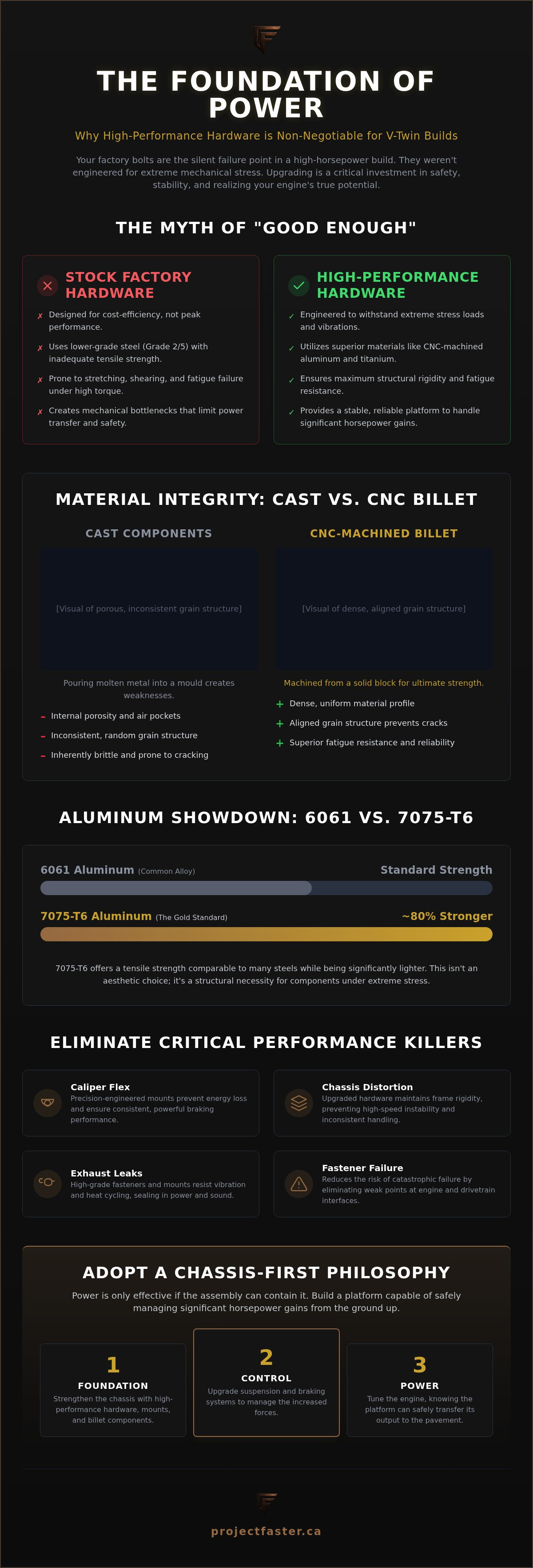
Standard factory builds typically rely on Grade 2 or Grade 5 steel fasteners. While these materials are adequate for a showroom-floor Harley, they lack the tensile strength required for high-output applications. Manufacturers frequently use zinc-plated hardware because it's inexpensive and provides basic corrosion resistance. However, in the high-vibration environment of a large-displacement V-Twin, these fasteners are prone to hydrogen embrittlement and fatigue. A build is only as strong as its weakest connection. Critical failure points often emerge at engine mounts and drivetrain interfaces where stock bolts begin to stretch under the relentless rhythmic pulses of a performance-tuned motor.
When "Stock" Becomes a Safety Risk
A modern V-Twin build consists of various motorcycle components that must work in unison to maintain structural stability. When horsepower increases, the physics of the machine change. Increased acceleration forces lead to bolt shear and significant chassis distortion. This is particularly evident in modified Harleys where stock swing arms may flex under heavy load, causing the rear wheel to track inconsistently. This flex isn't just a performance thief; it's a safety hazard that compromises the bike's handling at high speeds. To maintain control and ensure the longevity of your build, you must transition to engineer-certified components that are designed to manage these extreme forces. Utilizing high performance motorcycle hardware ensures that your chassis remains rigid and your fasteners stay centred, even when the engine is pushed to its absolute limit.
Billet Aluminum vs. Cast Components: Debunking the Aesthetic Myth
Many riders view billet parts as purely cosmetic upgrades designed for the showroom floor. This assumption ignores the fundamental physics of high performance motorcycle hardware. Casting involves pouring molten metal into a pre-formed mould, a process that frequently introduces internal porosity and structural inconsistencies. CNC machining from a solid billet block ensures a dense, uniform material profile that can withstand the violent torque of a built V-Twin. Precision machining is the only way to achieve the exact fitment required to eliminate mechanical "slop" in the chassis.
7075-T6 aluminum stands as the gold standard for these high-stress applications. Unlike the more common 6061 alloy, 7075-T6 offers a tensile strength comparable to many steels while maintaining a significantly lower weight profile. This material choice isn't about visual appeal. It's about the structural necessity of maintaining integrity when the engine's output exceeds factory limits. Choosing machined components over cast alternatives is a deliberate decision to prioritize strength and exactness over mass-production convenience.
Grain Structure and Fatigue Resistance
The internal grain structure of a billet component is aligned and continuous, which effectively prevents crack propagation under high-stress cycles. Cast components are inherently more brittle due to their random molecular arrangement and potential for microscopic air pockets. These engineering advantages translate directly to a longer service life and superior reliability for critical parts like the PF Vector Billet Swing Arm. When you're putting down significant horsepower, the density of your components determines whether your chassis survives the season or succumbs to metal fatigue.
Rigidity and Handling Precision
A rigid chassis is the foundation of predictable handling. Standard cast components often exhibit subtle flex that manifests as rear-wheel tracking issues during aggressive cornering or heavy acceleration. This lack of rigidity is a primary contributor to "high-speed wobble," a dangerous oscillation that occurs when the frame cannot manage the forces being applied to it. Utilizing lightweight materials for performance allows for a stronger, more rigid structure without adding the rotational mass that hampers acceleration. Organizing your chassis with precision-machined high performance motorcycle hardware ensures that every input results in a direct, controlled response. If you have specific questions regarding the structural requirements of your build, you can consult with our engineering team for technical guidance.
The Unsprung Weight Paradox: Does Titanium Really Matter?
Unsprung weight is the mass of every component not supported by the motorcycle's suspension springs. This includes the wheels, tires, braking systems, and a significant portion of the swing arm assembly. While many riders dismiss small weight reductions as negligible, the physics of suspension movement tells a different story. Every gram of high performance motorcycle hardware removed from these areas yields a disproportionate improvement in handling. When the wheel assembly is lighter, it possesses less inertia, allowing the suspension to manage road irregularities with far greater precision.
The myth that a few grams won't make a difference ignores how physics multiplies weight during wheel travel. As the suspension cycles, the force required to move and stop a heavy assembly increases exponentially with speed. Grade 5 Titanium is the definitive material for these high-stress zones. It provides the necessary strength without the penalty of mass. For a detailed technical breakdown, you can refer to our Engineering Guide to Titanium Bolt Kits to understand how these fasteners transform machine dynamics.
Suspension Response and Road Contact
Reducing the mass of the wheel and brake assembly allows the shock absorbers to react with greater velocity. When the tire hits a bump, a lighter assembly is accelerated upward more easily and is pushed back down to the road surface faster. This creates a more consistent tire contact patch, which is vital for maintaining traction during aggressive cornering. Learning how to reduce unsprung weight on a Harley-Davidson is a critical step for riders who want to eliminate the skittish feeling often associated with heavy factory components. It's about keeping the rubber on the pavement, not bouncing over it.
Strength-to-Weight Ratio Comparison
Grade 5 Titanium (Ti-6Al-4V) offers a strength-to-weight ratio that far exceeds both stainless steel and chromoly. It's approximately 45% lighter than steel while maintaining equivalent tensile strength. In the diverse Canadian climate, titanium's natural resistance to corrosion is a massive benefit. It won't seize or degrade when exposed to road salt and moisture. This makes it the superior choice for high performance motorcycle hardware, especially for rotating mass and unsprung components like axle nuts and caliper bolts. By choosing titanium, you're investing in a material that is as durable as it is lightweight, ensuring your build remains both fast and reliable over the long term.
Braking and Exhaust Hardware: The Overlooked Performance Bottlenecks
Many riders believe that braking efficiency and exhaust flow are solely the result of internal components or canister design. This is a misconception that overlooks the role of structural fasteners and mounting systems. In reality, flex and leaks are silent performance killers that undermine even the most expensive engine builds. Utilizing high performance motorcycle hardware in these areas is essential to ensure that your bike's output isn't wasted through mechanical inefficiency. When components shift or gaskets fail to seal, you lose the precision and power you've worked to build.
V-Twin engines subject their chassis to extreme heat cycles and violent vibrations. Standard grade fasteners often fail to maintain their torque specifications under these conditions, leading to thermal expansion issues and eventual hardware failure. High-output builds require specific metallurgy that can handle these stresses without stretching or backing out. Reliability in these critical zones ensures that your braking remains consistent and your exhaust scavenging stays optimized for maximum torque.
Eliminating Caliper Flex for Better Feel
Standard axial-mount brakes often suffer from caliper twist during aggressive deceleration. This distortion occurs because the mounting bolts are positioned at an angle that allows the caliper to flex away from the rotor under pressure. Transitioning to a radial mount system, such as the PF Vector 108mm, aligns the fasteners with the direction of the rotational force. This shift in geometry provides superior rigidity, ensuring that hydraulic pressure is converted directly into stopping power rather than mechanical flex. A more rigid mounting system results in a consistent lever feel that allows for much better modulation. For a deep dive into the physics of braking stability, consult our PF Vector 108mm Radial Mount Brake Arm Guide.
Exhaust Integrity and Power Loss
Exhaust leaks at the cylinder head are a primary cause of lost backpressure and erratic idling in modified Harleys. These leaks often stem from inferior hardware that cannot maintain a seal during the extreme thermal expansion of a high-HP run. Precision-engineered systems like the PF Liberator High-HP Exhaust rely on high-tensile fasteners to maintain a perfect interface between the header and the head. Without this integrity, scavenging is compromised, which directly reduces the engine's ability to pull fresh air into the combustion chamber. High-vibration V-Twins require locking hardware or fasteners with superior fatigue resistance to prevent the exhaust from vibrating loose over time. If you need assistance selecting the correct fasteners for your specific configuration, reach out to our technical team for an engineering consultation.
Building for Performance: How to Prioritize Your Hardware Upgrades
Building a high-output V-Twin requires more than just an aggressive engine tune. It demands a "Chassis-First" philosophy. If you increase displacement and torque without reinforcing the frame, you're merely creating a machine that is faster than its own structural limits. Prioritizing your upgrades ensures that every dollar spent translates into measurable performance and safety. The most effective strategy focuses on the "Big Three" of high performance motorcycle hardware: the swing arm, braking mounts, and critical fasteners.
Selecting engineer-certified parts provides long-term reliability that generic aftermarket components cannot match. It also protects the resale value of your build, as discerning buyers recognize the merit of high-end materials like 7075-T6 aluminum and Grade 5 titanium. A cohesive build is realized by matching these material types across the machine, ensuring that no single component becomes a weak link under stress. When the metallurgy of your fasteners matches the quality of your machined components, you eliminate the risk of galvanic corrosion and mechanical mismatch.
The Swing Arm: The Backbone of Handling
The swing arm is the primary structural interface between your engine's power and the road. It should be the first major chassis upgrade for any high-torque build. Standard touring arms are often made from thin-walled steel or inferior castings that flex under heavy acceleration. Replacing these with the PF Mako Billet Swing Arm provides a level of rigidity that stock options simply can't provide. This precision-engineered rear section eliminates the lateral movement that causes instability during aggressive cornering, allowing the bike to track straight and true even under full throttle.
Final Steps: The Details That Matter
Once the primary structural components are in place, the focus shifts to the finer details. Titanium bolt kits serve as the functional finishing touch for an elite build. These fasteners provide the high strength-to-weight ratio required to secure your high performance motorcycle hardware while further reducing unsprung mass. Organizing a performance build is a complex process that benefits from an engineering-first perspective. It's often helpful to consult with specialists who understand the physics of V-Twin dynamics to ensure your component choices are compatible and optimized for your specific riding style. If you're ready to transition from a standard build to a precision machine, contact the Project Faster team for engineering advice on your next build.
Engineering Your Build for Maximum Stability
A high-horsepower V-Twin is an engineering challenge that requires uncompromising structural integrity. You've seen how stock fasteners create mechanical bottlenecks and why the transition to billet components is essential for maintaining chassis rigidity. Reducing unsprung weight through Grade 5 Titanium Performance Kits isn't just for the track. It's a functional necessity for consistent tire contact and superior suspension response. By adopting a chassis-first philosophy, you ensure that every engine modification contributes to a safer, more predictable machine.
Project Faster Inc. provides the technical foundation for your performance objectives. Our Engineer-Certified Billet Swing Arms and hardware kits are proudly Canadian-designed and manufactured to withstand the extreme torque of modified builds. Don't let standard components compromise the potential of your bike or your safety on the road. When you're ready to optimize your machine's handling with high performance motorcycle hardware, our team is ready to help you realize your goals. Shop Precision-Engineered V-Twin Hardware and begin your next build with total confidence.
Frequently Asked Questions
Is titanium hardware really stronger than steel for motorcycles?
Grade 5 titanium provides a tensile strength comparable to 10.9 grade steel while being approximately 45% lighter. It isn't necessarily "stronger" in every application, but its superior strength-to-weight ratio makes it the ideal choice for high performance motorcycle hardware. This material resists the fatigue and corrosion that often plague standard steel fasteners in high-vibration V-Twin environments.
Will high performance hardware improve my bike’s resale value?
Engineer-certified components significantly improve resale value by demonstrating a commitment to structural integrity. Discerning buyers realize that these upgrades solve known mechanical weaknesses rather than just providing aesthetic changes. When you document the use of premium materials like 7075-T6 aluminum, you're proving the bike was built to handle its power safely and reliably.
What is the difference between 6061 and 7075 aluminum in motorcycle parts?
7075-T6 aluminum is a high-strength alloy that offers nearly double the tensile strength of the more common 6061 variant. While 6061 is suitable for non-structural accessories, 7075-T6 is the gold standard for critical high performance motorcycle hardware like swing arms and brake mounts. It provides the rigidity required to manage the extreme torque loads generated by modified V-Twin engines.
Do I need to be a professional racer to feel the difference in a billet swing arm?
You don't need a racing license to notice the immediate improvement in chassis stability. Any rider will feel the reduction in lateral flex and the improved rear-wheel tracking during highway-speed cornering or heavy acceleration. The machine feels more "planted" because the rear section is no longer oscillating under the stress of the drivetrain's output.
Why is unsprung weight so important for V-Twin motorcycles?
Unsprung weight directly dictates how quickly your suspension can react to road irregularities. By reducing the mass of components like wheels and fasteners, you allow the shocks to move with greater velocity and precision. This keeps your tire contact patch consistent, which is vital for maintaining traction and comfort on unpredictable Canadian road surfaces.
Can I install high performance bolt kits myself or do I need a shop?
Experienced riders can often perform these installations if they have a factory service manual and calibrated torque wrenches. It's critical to realize that performance fasteners require exact torque specifications and specific thread-locking compounds to function correctly. If you're uncomfortable managing critical engine or chassis mounting points, seeking a professional technician is the safest route.
How do I know if my stock swing arm is flexing?
Chassis flex typically manifests as a swaying or "wagging" sensation during high-speed cornering or under hard acceleration. If the rear of the bike feels disconnected from the front during aggressive manoeuvres, your stock arm is likely reaching its mechanical limit. This instability is a clear indicator that the factory components can't support the increased torque of your build.
Are these performance parts legal for street use in Canada?
Structural chassis components and high-strength hardware kits are generally legal for street use across all Canadian provinces. These parts are designed to exceed OEM safety standards, making them a reliable choice for road-going machines. You should always check local noise bylaws when installing high-flow exhaust systems to ensure your bike remains compliant with regional regulations.