

A factory touring frame is engineered for highway comfort, but it's fundamentally ill-equipped for the violent forces of high-performance riding. When you're leaning into a high-speed corner and feel that unsettling rear-end wobble, it's a clear signal that stock harley performance bagger parts have reached their mechanical limit. You deserve a bike that feels planted and responsive, yet the sheer weight and flex of standard components often compromise your confidence on the road.
This guide demonstrates how precision-engineered components transform a lumbering touring machine into a high-stability, high-horsepower performer. By focusing on the physics of the ride rather than just the look, you can achieve a power-to-weight ratio and chassis rigidity that were previously unthinkable for a bagger. We'll examine the critical role of billet swing arms in stabilizing the rear end, the impact of titanium hardware on unsprung weight, and the engineering behind radial-mount braking systems that provide absolute control during aggressive manoeuvres.
Key Takeaways
- Identify why a rigid billet aluminum swing arm is the essential foundation for eliminating the unstable rear-end wobble common in stock touring frames.
- Discover how to maximize your power-to-weight ratio using precision-engineered harley performance bagger parts designed to reduce unsprung weight and improve suspension response.
- Learn the mechanical advantages of radial mount braking systems and how they provide the stopping power required for aggressive, high-speed riding.
- Understand the engineering transition from standard cruising to high-performance handling by focusing on chassis geometry and structural integrity.
- Gain a strategic roadmap for your build, prioritizing the components that offer the most significant impact on your bike's flickability and cornering confidence.
Defining the Modern Performance Bagger: Beyond Aesthetics
The traditional touring Harley-Davidson was designed for the open highway, prioritizing straight-line comfort and luggage capacity over cornering precision. However, a fundamental shift has occurred in the V-Twin community. Riders are now demanding "canyon carving" capabilities from their heavy-duty touring frames, pushing these machines far beyond their original design parameters. A true performance build requires high-quality harley performance bagger parts that address the inherent limitations of the factory chassis. We aren't just talking about aesthetic upgrades or chrome accessories. We're talking about the mechanical integrity required to handle aggressive lean angles and high-torque output safely.
The Evolution of the V-Twin Touring Platform
The performance bagger movement found its footing on the race track, specifically through professional series that proved an 800lb machine could be agile and fast. This racing technology has rapidly transitioned to street-legal touring bikes. By 2026, the standard for an FLH or FLT frame has evolved significantly. Owners no longer accept the sluggish response or vague feedback of a stock setup. They want the stability found in professional racing, adapted for the reliability needed on public roads. Achieving this requires a shift in perspective, viewing the motorcycle as a cohesive mechanical system rather than a collection of bolt-on parts.
Identifying the Weak Points of Stock Baggers
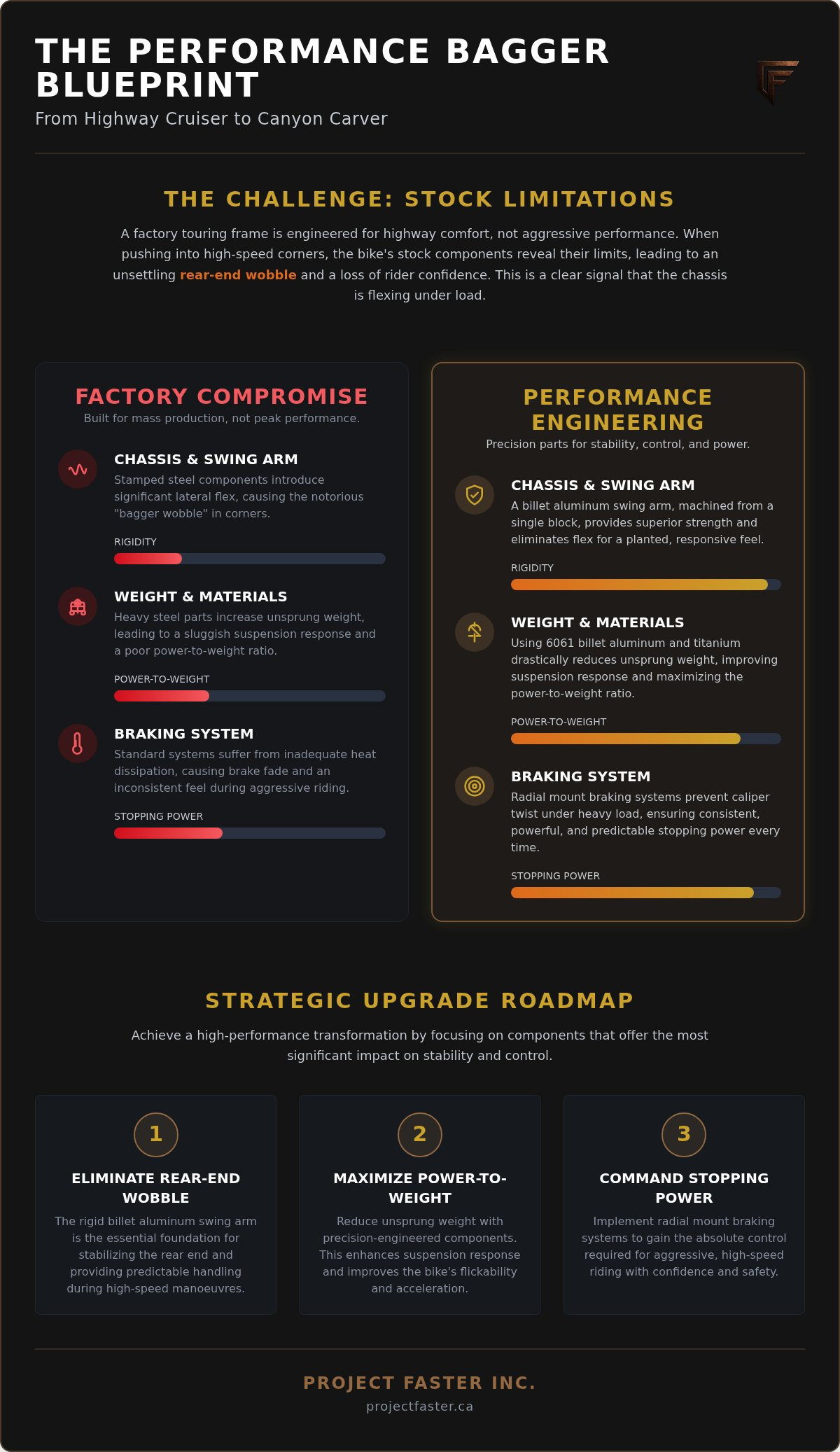
Factory components are often compromised by mass-production requirements and cost-saving measures. Stamped steel swing arms, while functional for casual cruising, introduce significant lateral flex under heavy loads. This flexibility is the primary cause of the notorious "bagger wobble" during high-speed cornering. Standard braking systems also frequently suffer from inadequate heat dissipation during aggressive riding, leading to brake fade and a loss of lever confidence. To correct these factory geometry compromises, we focus on three critical metrics:
- Rigidity: Eliminating lateral flex to ensure the rear wheel tracks perfectly with the front during high-speed manoeuvres.
- Weight Reduction: Swapping heavy steel for 6061 billet aluminum and titanium to improve the power-to-weight ratio and suspension response.
- Stopping Power: Utilizing radial mount systems to prevent caliper twist and ensure consistent braking force.
By replacing stock components with precision-engineered harley performance bagger parts, such as the Mako billet swing arm, riders can finally eliminate the mechanical weaknesses that limit their bike's potential. This engineering-first approach ensures that every modification contributes to a more stable, responsive, and predictable machine. It's about building a bike that responds to your inputs with absolute precision, regardless of its size or weight.
The Core of Stability: High-Performance Billet Swing Arms
The swing arm functions as the mechanical foundation for the entire rear suspension system. On a heavy touring bike, this component must withstand immense torsional stress during acceleration and cornering. Stock units are typically manufactured from stamped steel, a material choice driven by production volume rather than peak performance. These factory arms are prone to lateral flex, which directly leads to rear-end steer and a vague feeling through the chassis. Upgrading to high-quality harley performance bagger parts, specifically a billet aluminum swing arm, provides the rigidity required to keep the rear wheel tracking perfectly in line with the front.
Transitioning to 6061 or 7075 billet aluminum isn't just about weight reduction. It's about structural integrity. Billet components are machined from a single solid block of metal, ensuring uniform grain structure and superior strength compared to welded steel. This rigidity ensures that your suspension works as intended, as the shocks are no longer trying to compensate for a twisting chassis. When the swing arm remains stable, the tire contact patch stays consistent, providing predictable grip when you need it most.
Mako vs. Vector: Choosing the Right Foundation
The PF Mako Billet Swing Arm is engineered specifically for 2009 and newer touring models, offering a drastic increase in stiffness over stock. For those on the newer monoshock platform, the Vector Billet Swing Arm provides the same level of precision for 2018+ Softail models. These are not merely decorative pieces; they are engineer-certified designs that have undergone rigorous structural validation to handle high-horsepower applications. Choosing the right foundation depends on your specific frame and performance goals.
Eliminating the Infamous Bagger Wobble
The "bagger wobble" is a byproduct of lateral flex where the rear wheel moves independently of the frame's centre line. This oscillation often occurs during high-speed cornering or when encountering mid-corner bumps. By installing a rigid billet arm, you effectively lock down the rear geometry. The result is a bike that feels significantly more planted and flickable, despite its massive footprint. For a deeper dive into the physics, you can read more about the engineering of performance and how it dictates handling. If you're unsure which setup fits your specific riding style, consult with our engineering team to discuss your build requirements.
Optimizing Power-to-Weight with Titanium and Billet
Reducing the total mass of an 800lb touring machine is a significant undertaking. While shedding weight from the frame is beneficial, the most impactful changes occur when you target unsprung weight. Unsprung weight refers to any component not supported by the suspension, such as wheels, tires, and brake assemblies. When these parts are heavy, the suspension must work harder to control their movement over road imperfections. By integrating lightweight harley performance bagger parts, you allow the suspension to react with greater speed and precision, making the entire bike feel more flickable during rapid transitions.
Every gram removed from the rotating and unsprung mass has a compounding effect on performance. A lighter wheel and brake setup requires less energy to accelerate and less force to stop. This reduction in inertia directly translates to improved throttle response and shorter braking distances. When you realize that the suspension is no longer struggling to manage excess mass, the chassis stability improves across all speeds.
The Engineering Value of Titanium Bolt Kits
Grade 5 titanium is the gold standard for high-performance hardware. It offers a strength-to-weight ratio that is roughly 45 percent lighter than standard steel while maintaining equivalent tensile strength. In the high-vibration environment of a V-Twin engine, titanium's natural resistance to corrosion and fatigue is a critical safety advantage. Replacing heavy steel fasteners with titanium doesn't just reduce weight. It ensures that critical joints remain secure under extreme stress. For a deeper technical breakdown, you can explore our engineering guide to titanium bolt kits for motorcycles.
Billet Aluminum: Strength Without the Bulk
Mass-produced factory parts are often cast, a process that can leave internal voids and results in looser tolerances. Precision-machined billet aluminum, specifically 7075-T6, provides a much denser and more reliable material for high-stress areas. Components like brake arms and swing arm blocks benefit immensely from this material's durability. Billet parts allow for tighter fitment, which eliminates the mechanical "slop" often found in stock assemblies. By choosing harley performance bagger parts machined from solid billet, you ensure that your bike's controls and chassis remain rigid, providing the feedback necessary for aggressive riding.
Precision Braking and Exhaust Dynamics
High-speed stability is useless without the ability to decelerate with absolute precision. When building a machine with elite handling, the braking system must match the structural rigidity of the chassis. Stock axial-mount calipers often flex under extreme thermal stress. This leads to a spongy lever feel and inconsistent bite during aggressive manoeuvres. Upgrading to advanced harley performance bagger parts like radial-mount systems eliminates this mechanical weakness by securing the caliper at both ends, preventing the torsional twist that plagues standard factory setups.
Radial Mount Brakes: The Performance Standard
Radial mounting has become the performance standard because it ensures the caliper remains perfectly centred over the rotor. This alignment provides uniform pad pressure and superior heat dissipation. The PF Vector 108mm Radial Mount Brake Arm Guide explains how these components maintain maximum rigidity during high-load deceleration. This structural integrity allows for finer lever modulation, giving the rider total confidence when trail braking into a tight corner.
The PF Liberator: Engineering High-Horsepower Sound
Performance isn't just about chassis geometry; it's about the efficient management of exhaust gases to maximize the V-Twin torque curve. The PF Liberator High-HP Exhaust utilizes a 2-into-1 header geometry designed to optimize scavenging. This process uses the pressure pulse from one cylinder to help pull spent gases out of the other, significantly increasing low-end grunt. Balancing backpressure and flow is a complex engineering task. Too much flow kills torque, while too much backpressure stifles high-RPM horsepower.
A well-engineered exhaust system does more than change the acoustic profile. It fundamentally alters how the engine delivers power to the rear wheel. By choosing harley performance bagger parts that prioritize fluid dynamics and collector efficiency, you ensure that the engine's output is both linear and predictable. For a deeper technical analysis of how header design impacts your build, read more on V-Twin performance exhaust benefits. If you need assistance selecting the right components for your specific horsepower goals, contact our engineering team for a direct consultation.
Building Your Performance Bagger with Project Faster
Constructing a high-performance machine requires more than just a collection of expensive components. It demands a cohesive engineering strategy where every part is designed to complement the next. Integrating the right harley performance bagger parts into your build ensures that the final result is a bike that handles with the precision of a sportbike despite its touring heritage. By choosing a manufacturer that prioritizes mechanical integrity over cosmetic trends, you ensure that your investment translates into real-world speed and stability.
Prioritizing your build is essential for achieving the best results. We recommend starting with the chassis to establish a rigid foundation. A bike with immense power is useless if the frame cannot track straight under load. Once the chassis is stabilized with Engineer-Certified performance parts, you can then focus on optimizing the power-to-weight ratio and stopping power. This methodical approach prevents you from chasing handling issues caused by a flexible factory frame.
The Project Faster Advantage
Our commitment to excellence is rooted in our Canadian manufacturing process. Every component undergoes rigorous in-house design and testing to ensure it can withstand the demanding conditions of high-performance riding. We utilize premium 7075 and 6061 billet aluminum to achieve maximum strength while minimizing weight. This engineering-first perspective allows us to maintain strict quality control that mass-market retailers simply cannot match. Even our lifestyle gear, such as the Project Faster | Odin Mfg Hoodie, is selected to reflect this focus on durability and functional style.
Next Steps for Your Performance Build
A successful build relies on precision and compatibility. Before you begin swapping components, it is vital to consult with experts who understand the physics of the V-Twin platform. Our team provides direct access to engineering expertise to help you navigate the complexities of part fitment and performance goals. Whether you're aiming for a track-ready canyon carver or a high-speed long-distance tourer, we can help you select the components that offer the most significant impact. You can contact Project Faster for technical support and join a growing community of riders who realize that performance is the only metric that truly matters.
Elevate Your Riding Dynamics with Engineering Precision
Building an elite machine isn't about following trends; it's about mastering the physics of a heavy touring platform. You've seen how engineer-certified Mako and Vector swing arms eliminate unstable rear-end wobble by providing a rigid chassis foundation. We've explored how reducing unsprung mass through titanium hardware and billet aluminum components allows your suspension to track with surgical precision. These high-performance harley performance bagger parts aren't just upgrades. They are essential corrections to factory geometry compromises that transform how your bike handles high-speed corners.
By choosing components that are precision CNC-machined in North America, you're investing in mechanical integrity trusted by elite builders across Canada. Every component we manufacture ensures your bike responds to every input with absolute confidence. It's time to stop settling for a compromised ride and start experiencing the full potential of your V-Twin touring frame. Shop the full collection of Project Faster performance parts and consult with our engineering team today to begin your transformation. Your journey toward elite handling starts with a commitment to functional excellence.
Frequently Asked Questions
What is the most important part for a performance bagger build?
The swing arm is the most critical component for any performance bagger build because it serves as the structural foundation for the entire rear suspension. A rigid billet aluminum arm eliminates the lateral flex found in stock stamped steel units. This flex is the primary cause of high-speed instability. By stabilizing the chassis first, you ensure that every subsequent upgrade with harley performance bagger parts operates on a predictable and secure platform.
How much weight can I save by switching to a billet swing arm?
Switching to a billet aluminum swing arm typically results in a weight reduction of several kilograms compared to the factory steel assembly. This reduction in unsprung mass allows your rear suspension to react more quickly to road surface changes, improving both traction and rider comfort. While exact savings depend on your specific model year, the combination of increased rigidity and lower weight fundamentally alters the flickability and acceleration of a heavy touring machine.
Do I need to modify my frame to install a Mako swing arm?
You don't need to modify your frame to install a Mako swing arm on 2009 and newer touring models. It's engineered as a precision-fit replacement that utilizes factory mounting points while providing vastly superior mechanical integrity. This direct-replacement design ensures that you can achieve elite-level handling without compromising the structural integrity of your original frame. It's a straightforward yet transformative upgrade for riders who prioritize engineering excellence and real-world performance.
Why is Grade 5 titanium better than stainless steel for motorcycle bolts?
Grade 5 titanium is superior because it provides equivalent tensile strength to high-grade steel while being approximately 45 percent lighter. In the high-vibration environment of a V-Twin engine, titanium's natural resistance to fatigue and corrosion ensures that critical fasteners remain secure over time. Using titanium bolt kits reduces the overall mass of your build and provides a cleaner, professional aesthetic that stainless steel or chrome-plated alternatives simply cannot match.
What are the benefits of radial mount brakes on a heavy touring bike?
The primary benefit of radial mount brakes is the elimination of caliper twist during hard deceleration. By securing the caliper at both ends, the system ensures that brake pads maintain perfectly uniform contact with the rotor. This leads to more consistent stopping power and finer lever modulation. Such control is essential for safely managing the momentum of a heavy touring bike during aggressive canyon carving or emergency braking manoeuvres.
Will a high-HP exhaust system require a new engine tune?
A new engine tune is mandatory when installing a high-HP exhaust system like the PF Liberator. High-performance 2-into-1 systems fundamentally change the air-flow characteristics and scavenging efficiency of your engine. Without a proper recalibration of the air-fuel ratio and ignition timing, you risk poor throttle response, excessive heat, and potential engine damage. A professional tune ensures you realize the full horsepower and torque gains intended by the exhaust's engineering.
Are Project Faster parts compatible with all Harley-Davidson touring models?
Compatibility depends on the specific product line to ensure a precision fit for different chassis types. For example, our Mako swing arm is engineered for 2009 and newer touring frames, while the Vector line includes applications for 2018 and newer Softail models. We recommend verifying your specific model year before purchase. Utilizing model-specific harley performance bagger parts ensures that tolerances remain tight and the mechanical advantages of our engineering are fully realized.
Why should I choose billet aluminum over chrome-plated steel?
Billet aluminum is superior to chrome-plated steel because it's machined from a solid block of high-grade alloy, ensuring a uniform grain structure without internal voids. This process allows for much tighter manufacturing tolerances and greater rigidity. While chrome-plated steel focuses on aesthetic appeal, billet components prioritize mechanical performance and durability. This provides a level of precision that's essential for high-stability riding and long-term reliability on high-horsepower builds.