

The notorious "bagger wobble" isn't an inherent character trait of your motorcycle; it's a measurable engineering deficit in the factory chassis. When you subject a heavy touring frame to high torque or aggressive cornering, the stock rubber-mounted swing arm often fails to maintain alignment, leading to a vague and dangerous oscillation. If you've felt that unsettling flex during a high-speed sweeper, you realize that standard components aren't designed for elite performance. Investing in precision Harley stability upgrades is the only way to bridge the gap between a standard cruiser and a true performance bagger that remains rock-solid at speed.
We understand the frustration of a machine that feels disconnected from the pavement when you need feedback the most. This guide explores the physics of chassis rigidity and the critical role of reducing unsprung weight to transform your handling. You'll learn how to eliminate mechanical weaknesses by upgrading to high-strength 6061 or 7075 aluminum components. We will preview the technical advantages of the Mako and Vector billet swing arms, showing you how a focused approach to engineering can create a chassis capable of managing high-horsepower upgrades while providing the precise feedback you demand.
Key Takeaways
- Identify the engineering deficits behind bagger wobble and how stock chassis flex undermines high-speed stability.
- Learn why 6061-T6 billet aluminum provides the structural integrity needed to eliminate mechanical twisting under high torque.
- Evaluate the technical specifications of Mako and Vector billet swing arms to determine the best Harley stability upgrades for your specific Touring or Softail frame.
- Master the selection process for matching chassis rigidity with premium suspension to achieve a balanced, performance-driven handling profile.
- Discover how Canadian-engineered components prioritize mechanical precision to support the extreme stress of high-horsepower engine builds.
Understanding the Science of Harley Stability and Chassis Flex
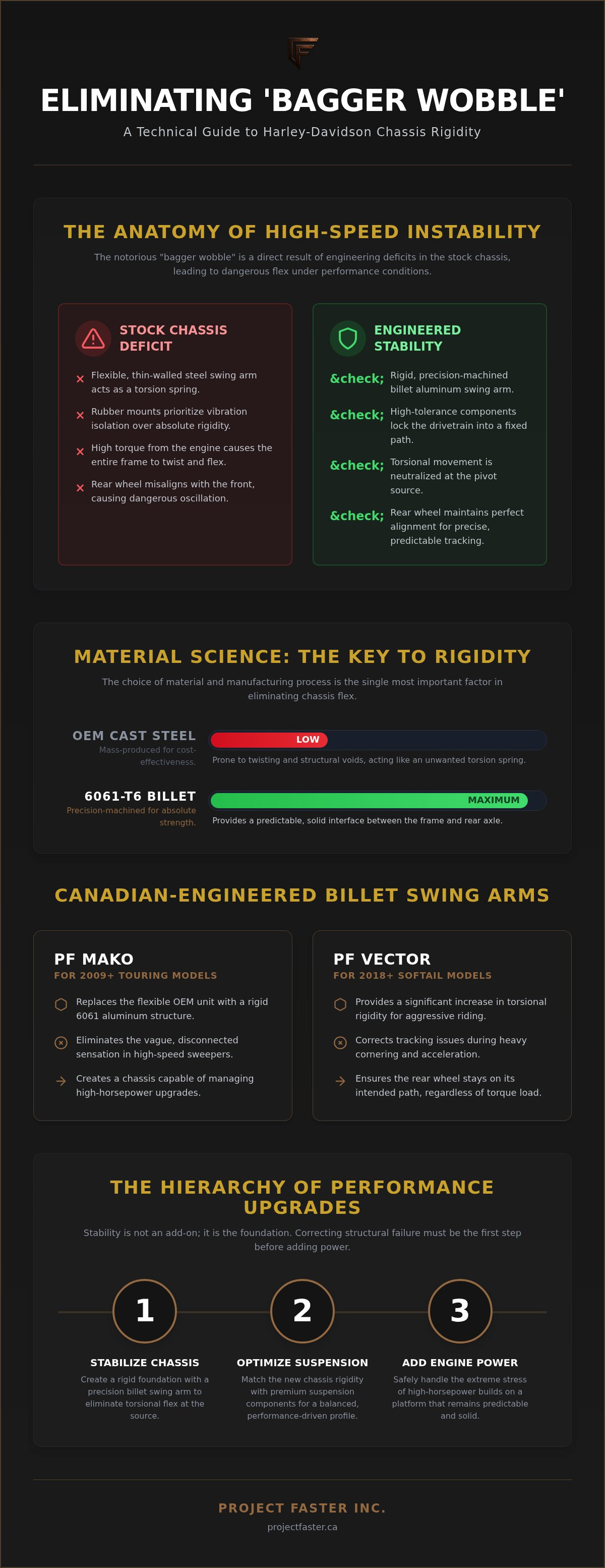
The phenomenon known as "bagger wobble" is a physical consequence of structural insufficiency, not a mysterious quirk of the V-Twin platform. Stock Harley-Davidson frames are designed for mass-market comfort, utilizing rubber engine mounts and thin-walled steel swing arms that prioritize vibration isolation over absolute tracking. When you increase engine output without addressing these foundational components, you create a mechanical mismatch. High-horsepower upgrades exert immense twisting forces on the chassis, causing the rear section to flex independently of the front. True Harley stability upgrades focus on neutralizing this torsional movement at the source.
Stabilizing the rear section is a critical prerequisite for any performance build. If the chassis cannot handle the torque, the engine's power becomes a liability that compromises safety and cornering precision. A frame that twists under load forces the rear wheel out of alignment with the front, leading to the vague, disconnected sensation that many riders experience in high-speed sweepers. This structural failure must be corrected before adding engine power to ensure the motorcycle remains predictable under extreme stress.
The Physics of High-Speed Oscillation
The Science of motorcycle dynamics dictates that any lateral force at the rear wheel must be resisted by the swing arm pivot to maintain stability. On a stock bagger, the swing arm acts as a lever that amplifies these forces, allowing the rear wheel to oscillate. This oscillation translates through the frame and eventually reaches the handlebars as a violent shake. Many riders attempt to fix this with bolt-on linkage stabilizers, but these are often just band-aids for structural flex. They don't address the core issue: the material density and geometry of the swing arm itself. If the fulcrum of your rear suspension can move laterally, your wheel alignment is effectively lost.
Identifying Stability Weak Points in Touring and Softail Models
The primary weak point in both 2009+ Touring and 2018+ Softail models is the stock swing arm's inability to resist twisting under cornering loads. Cast steel components lack the rigidity found in precision-engineered billet alternatives. On 2009+ Touring models, the PF Mako Billet Swing Arm is designed to replace the flexible OEM unit with a rigid 6061 aluminum structure. Similarly, Softail riders often realize that the factory arm struggles to maintain tracking during aggressive street riding. The PF Vector Billet Swing Arm addresses this by providing a significant increase in torsional rigidity. Over time, worn rubber bushings further exacerbate these issues, allowing the entire drivetrain to move within the frame. Effective Harley stability upgrades replace these flexible interfaces with high-tolerance components that lock the rear wheel into a fixed, predictable path.
Maximizing Rigidity: The Role of Billet Swing Arms in Handling
The swing arm serves as the structural foundation for the entire rear suspension system. When you demand performance from a V-Twin, the stock cast steel arm often becomes the weakest link, acting as a torsion spring that stores and releases energy at the wrong moments. This elastic deformation is what riders feel as a twist under hard acceleration or heavy cornering. High-performance Harley stability upgrades replace this compromised component with a rigid, billet-machined alternative that ensures the rear wheel stays exactly where the rider intends, regardless of the torque applied.
Engineering a chassis for stability requires a shift from mass-market manufacturing to precision machining. While cast parts are cost-effective for production, they lack the grain structure and density required to resist high-stress loads. A billet swing arm provides a predictable and solid interface between the frame and the rear axle. This eliminates the lateral movement that causes the rear end to hunt for a line, providing the rider with a sense of uncompromising control.
Material Science: Billet Aluminum vs. OEM Steel
Cast steel components are manufactured through a process that can introduce internal voids and structural inconsistencies. In contrast, 6061-T6 billet aluminum is an aerospace-grade material that offers a superior strength-to-weight ratio. Machining a swing arm from a solid block of aluminum eliminates the unpredictable flex associated with cast parts. This material also provides exceptional thermal stability; it maintains its structural integrity even during long-distance touring where heat and mechanical stress are constant. By utilizing 6061 or 7075 alloys, we can achieve a level of rigidity that cast steel simply cannot match, providing a stable platform for high-torque engines.
The Impact of Reduced Unsprung Mass
Unsprung mass refers to the weight of components not supported by the suspension springs, such as the wheels, brakes, and the swing arm itself, which directly influences how quickly the shocks can react to road irregularities. Reducing this mass is a fundamental principle of performance engineering. A lighter swing arm allows the rear shocks to cycle faster and with more precision. This results in a more consistent tire contact patch, significantly reducing the pogo effect often felt on rough pavement. Riders will notice sharper turn-in and a motorcycle that feels more agile, as the suspension is no longer fighting the inertia of heavy steel parts.
Precision fitment at the pivot and axle blocks is equally vital. OEM components often have generous tolerances to simplify mass production, but these gaps allow for micro-movements that degrade handling. A billet swing arm allows for much tighter tolerances, ensuring the axle remains perfectly perpendicular to the frame. This alignment is critical for preventing belt or chain walk and maintaining a straight track through corners. If you are ready to discuss the specific technical requirements of your build, you can consult with our engineering team to find the right solution for your chassis.
Comparing Harley Stability Upgrades: Vector vs. Mako Engineering
Precision engineering requires different solutions for Touring and Softail frames. While the objective of reducing unsprung weight and increasing rigidity remains constant, the mechanical loads experienced by each chassis architecture are unique. Project Faster Inc. addresses these specific requirements through two distinct billet designs. These Harley stability upgrades are not generic accessories; they are engineer-certified components that redefine how a V-Twin interacts with the road under extreme stress. By moving away from cast steel, we eliminate the structural inconsistencies that lead to vague handling and high-speed instability.
Both platforms benefit from integrated axle adjusters and radial brake mount compatibility. These features ensure that the rear wheel remains perfectly aligned while providing a rigid mounting point for high-performance braking systems. The result is a chassis that can handle the increased torque of modern engine builds without the risk of component flex or axle slip.
The Mako Swing Arm: The Touring Stability Standard
Addressing the specific needs of heavy-laden baggers at highway speeds requires a massive increase in torsional strength. The stock swing arm on 2009+ Touring models is often the primary source of the "bagger wobble" when subjected to high-speed sweepers or heavy luggage loads. The PF Mako Billet Swing Arm - 2009+ Touring replaces this flexible unit with a 6061-T6 billet aluminum structure. This upgrade significantly reduces unsprung mass, allowing the dual shocks to respond with greater precision. For riders seeking a complete performance package, the Mako is fully compatible with the PF Vector 108mm Radial Mount Brake Arm, which provides the rigid foundation necessary for elite-level stopping power.
The Vector Billet Swing Arm: Softail Precision
The modern monoshock chassis of the 2018+ Softail demands extreme lateral stiffness to maintain tracking during aggressive street riding. Unlike the Touring platform, the Softail's geometry places different stresses on the swing arm pivot. The PF Vector Billet Swing Arm - 2018+ Softail transforms this platform by providing a streamlined, high-density design that minimizes flex. By utilizing aerospace-grade aluminum, the Vector arm sheds critical weight, enabling the monoshock to react faster to road irregularities. This reduction in inertia results in a motorcycle that feels more agile and predictable, especially when transitioning through tight corners. The precision-machined axle blocks ensure that your wheel alignment remains fixed, even under the violent acceleration of a high-horsepower build.
Choosing between these components depends entirely on your chassis and intended use. Whether you are stabilizing a long-haul bagger or sharpening the response of a performance Softail, the focus remains on eliminating the mechanical weaknesses of the factory design. These upgrades provide the structural gains necessary to transform your Harley's handling into a rock-solid, performance-driven experience.
Selection Criteria: Matching Stability Components to Your Riding Style
Selecting the correct Harley stability upgrades requires a realistic assessment of your riding environment and performance goals. A motorcycle built for long-haul touring across provinces has different structural requirements than a machine destined for aggressive canyon carving or track use. The objective is to create a chassis that remains predictable under your specific load conditions. Prioritizing mechanical integrity over aesthetic chrome ensures that your investment translates into tangible handling improvements rather than just visual appeal.
Rigidity must be balanced with the rest of your setup. A precision-engineered swing arm exposes the limitations of inferior suspension, meaning you should plan to match your chassis upgrades with high-quality shocks. When the swing arm no longer acts as a secondary spring, the damping components are forced to manage all road forces. This synergy is what creates a truly stable platform capable of handling future high-horsepower builds.
The Performance Bagger Checklist
Stability is the foundational requirement for any High Performance Harley Parts build. Before you increase engine displacement or add a forced induction system, the chassis must be verified. A frame that twists under 100 foot-pounds of torque will become dangerous at 150. Consider the following technical requirements for your build:
- Chassis Alignment: Verify that the front and rear wheels are perfectly tracked on the same vertical and horizontal planes.
- Weight Reduction: Integrate titanium hardware kits to shed unsprung mass without sacrificing tensile strength.
- Mechanical Tolerances: Inspect pivot points and axle blocks for any signs of play that could lead to oscillation.
Daily Cruising vs. Aggressive Canyon Carving
For the daily cruiser, the primary benefit of increased rigidity is highway predictability. Even at moderate speeds, a billet swing arm reduces the unsettling "float" felt when crossing bridge expansion joints or encountering rain grooves. You don't need to be a racer to appreciate a motorcycle that tracks straight without constant micro-corrections at the handlebars. The increased confidence allows for a more relaxed and safer long-distance experience.
Aggressive riders require a different level of feedback. When you are pushing a heavy bagger through deep lean angles, you need to know exactly what the rear tire is doing. Billet components eliminate the vague, disconnected sensation of stock cast parts, providing sharp turn-in and mid-corner stability. By selecting the appropriate components from our Suspension Collection, you can tune your chassis to provide the exact level of response your riding style demands. If you are planning a high-output engine upgrade and need to ensure your chassis is prepared for the load, contact our engineering team to discuss a tailored stability solution.
Elevating Your Ride with Project Faster Precision Suspension Upgrades
Project Faster Inc. operates on a fundamental principle: performance is a product of engineering, not aesthetics. While the aftermarket is saturated with components designed for visual appeal, we focus exclusively on functional superiority. Our approach treats the motorcycle as a complete mechanical system where every component must contribute to structural integrity. By choosing Canadian-made Harley stability upgrades, you are investing in parts that have been meticulously designed to withstand the extreme stresses of high-performance riding. We don't just sell parts; we provide engineered solutions for riders who realize that real-world results matter more than industry trends.
A truly elite build requires more than just a rigid chassis. To maximize the potential of a stabilized frame, you must integrate components that complement your new-found handling precision. The PF Liberator High-HP Exhaust is designed to provide the ground clearance necessary for deep lean angles, while the PF Vector 108mm Radial Mount Brake Arm ensures your stopping power matches your acceleration. When these elements work in unison, the motorcycle ceases to be a collection of parts and becomes a precision instrument. This holistic focus on the physics of performance is what sets a Project Faster build apart from a standard custom bike.
The Project Faster Advantage: Engineering Excellence
The Vector Billet Swing Arm design philosophy centers on the elimination of mechanical variables. By utilizing high-density 6061 and 7075 aluminum, we create a component that remains dimensionally stable under loads that would cause cast steel to fail. This meticulous manufacturing process results in uncompromising road confidence, allowing you to push the limits of your machine without fear of chassis oscillation. If you have specific questions regarding the compatibility of our components with your current build, you should Contact Project Faster for technical fitment advice from our performance specialists.
Ready to Transform Your Handling?
The transition from a standard cruiser to a performance bagger begins with a commitment to mechanical integrity. You must prioritize the foundational elements of your chassis before focusing on cosmetic enhancements. A stable, rigid, and lightweight rear end is the single most effective way to improve your riding experience and safety at high speeds. We invite you to explore our full range of precision-machined components and take the first step toward a more responsive motorcycle. You can Shop the Project Faster Suspension Collection today to find the specific upgrades required to master your Harley's handling.
Mastering the Physics of High-Performance Handling
Achieving a rock-solid ride requires a fundamental shift from aesthetic modifications to structural engineering. By replacing flexible cast components with engineer-certified billet swing arms, you eliminate the mechanical pivot point failures that lead to high-speed oscillation. Utilizing aerospace-grade 6061-T6 aluminum construction provides the necessary rigidity to handle the extreme torque of modern high-horsepower V-Twin applications. These Harley stability upgrades don't just mask the symptoms of chassis flex; they solve the problem at the source, ensuring your motorcycle remains predictable at every lean angle.
The transition to a true performance bagger is a deliberate process that prioritizes mechanical integrity above all else. Whether you are stabilizing a 2009+ Touring frame or sharpening a late-model Softail, the objective remains the same: uncompromising road feedback and safety. If you are ready to eliminate the bagger wobble and transform your machine into a precision instrument, our team is prepared to assist with your technical requirements. Consult with a performance specialist today to finalize the engineering specifications for your build. Your journey toward a more stable and responsive ride starts with a chassis you can trust.
Frequently Asked Questions
What is the primary cause of Harley-Davidson high-speed wobble?
The primary cause of high-speed oscillation, often called "bagger wobble," is the structural flex inherent in factory rubber-mounted drivetrains and thin-walled steel swing arms. These components allow the rear wheel to move laterally under load, which disrupts the motorcycle's tracking. When the chassis twists, it creates a feedback loop that translates through the frame to the handlebars as an unsettling instability.
How does a billet swing arm improve motorcycle stability?
A billet swing arm improves stability by providing a rigid, torsionally strong foundation that resists twisting under high torque. Utilizing 6061-T6 aluminum ensures that the rear axle remains perfectly aligned with the frame during aggressive cornering. These Harley stability upgrades also reduce unsprung mass, which allows your rear shocks to react more precisely to road irregularities rather than fighting the inertia of heavy steel.
Will upgrading my suspension components void my Harley-Davidson warranty?
Upgrading your chassis components typically does not void your entire motorcycle warranty, though it may affect coverage for the specific systems you modify. In Canada, consumer protection principles generally prevent manufacturers from denying warranty claims unless the aftermarket part directly caused the mechanical failure. It is always advisable to consult with your local dealer regarding their specific policies on performance modifications before beginning a build.
What is the difference between 6061 and 7075 aluminum in motorcycle parts?
The difference lies in the alloy composition and tensile strength, with 7075 aluminum offering a higher strength-to-weight ratio than 6061. While 6061-T6 is the industry standard for its excellent durability and corrosion resistance, 7075 is often utilized for high-stress aerospace applications. Both materials provide a massive upgrade in rigidity over the OEM cast steel units found on stock Harley-Davidson models.
Do I need to upgrade my front suspension if I install a rear billet swing arm?
Upgrading the front suspension is highly recommended to maintain a balanced chassis after installing a rear billet swing arm. A rigid rear end often exposes the damping limitations and lateral flex of the factory front forks. To achieve a truly stable performance bagger, you should aim for a harmonious setup where both ends of the motorcycle offer consistent feedback and matched damping characteristics.
How much weight can I save by switching to a Vector billet swing arm?
Switching to a Vector billet swing arm results in a substantial reduction in unsprung weight compared to the heavy factory steel unit. This reduction in mass decreases the inertia the suspension must manage, leading to faster shock response and improved tire contact patch consistency. While exact savings vary by specific model year, the performance gain is immediately noticeable through sharper turn-in and more predictable handling.
Can I install a Mako swing arm on a stock Harley Touring model without other mods?
You can install a Mako swing arm on a stock 2009+ Touring model as a direct replacement without requiring additional modifications. It is engineered to integrate seamlessly with factory pivot hardware and axle components. However, pairing the Mako with high-performance shocks will allow you to fully realize the handling benefits of the increased chassis rigidity and reduced unsprung mass.
Are titanium bolt kits necessary for improved motorcycle stability?
Titanium bolt kits are not strictly required for stability, but they offer meaningful benefits in terms of weight reduction and fastener integrity. These kits reduce unsprung mass at critical points like the brake calipers and axle, which marginally improves suspension performance. Additionally, titanium's exceptional resistance to corrosion ensures that your critical chassis alignments remain secure and maintain their torque settings over the long term.