

Raw displacement is a secondary metric when your chassis cannot translate torque into forward momentum. You've likely experienced the unsettling sensation of chassis flex during high-speed cornering or the frustration of brake fade on a high-output build. Achieving elite results with performance vtwins requires a shift in focus from simple engine displacement to the synergy of structural rigidity and weight reduction. It's a matter of mechanical physics rather than industry trends. We understand that real-world performance is won through engineering excellence, not just aesthetic upgrades.
This article details the technical principles and precision-engineered components required to transform your V-Twin into a high-performance machine. You'll discover how to eliminate mechanical weaknesses by reducing unsprung weight for superior suspension response and increasing structural integrity in the swing arm. We will also examine the role of optimized exhaust flow in extracting maximum horsepower from your engine. We're going to break down the engineering logic behind elite builds, providing you with a roadmap to optimize your motorcycle's stability and power delivery.
Key Takeaways
- Understand why modern performance vtwins prioritize power-to-weight ratios over simple displacement to achieve superior acceleration and braking efficiency.
- Learn how engineer-certified billet aluminum components eliminate chassis flex to provide uncompromising stability during high-speed cornering.
- Discover the physics of exhaust scavenging and how specific pipe geometry is critical for optimizing torque curves in high-horsepower applications.
- Identify the benefits of reducing unsprung weight through titanium hardware to enhance suspension response and mechanical integrity.
- Gain insight into the engineering standards required to harmonize structural rigidity with high-output engine builds for a safer, more predictable ride.
Defining Performance V-Twins: Beyond the Chrome
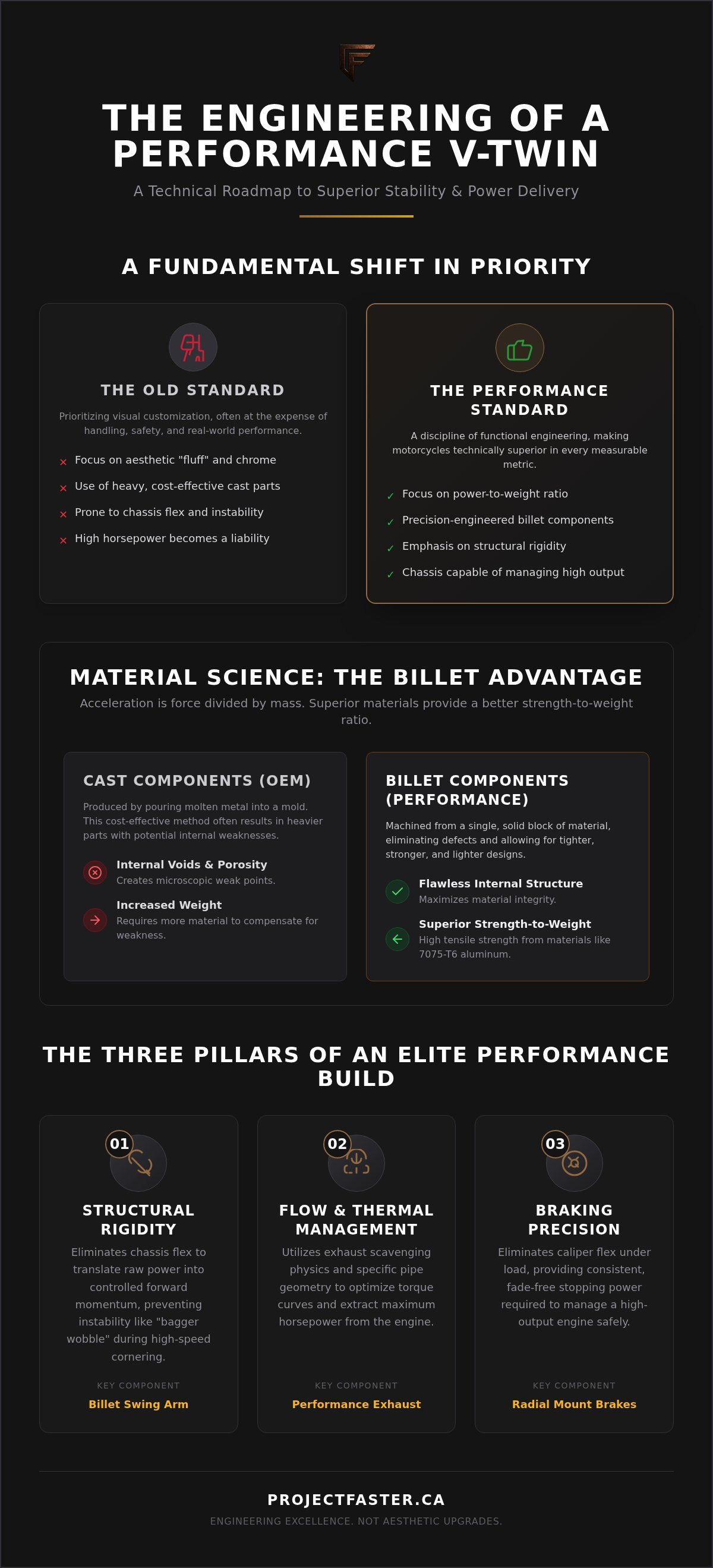
The era of prioritizing aesthetic "fluff" over mechanical integrity is ending. For decades, the V-Twin market focused on visual customization, often at the expense of handling and safety. Today, the standard for performance vtwins has evolved into a discipline of functional engineering. It's a shift from simply making a motorcycle look fast to making it technically superior in every measurable metric. This evolution demands a move away from chrome accessories toward precision components that stabilize the chassis and optimize power delivery.
The Shift Toward Performance Engineering
The rise of the Performance Bagger and Performance Softail movements represents a fundamental change in rider expectations. Enthusiasts now realize that high horsepower is a liability without a chassis capable of managing that output. Performance engineering focuses on the physics of the ride. Engineers prioritize reducing unsprung mass, which is the weight of components not supported by the motorcycle's suspension. Minimizing this mass allows the suspension to react faster to road irregularities. This ensures that your tire maintains a consistent contact patch, turning raw torque into predictable forward momentum rather than wheel hop or instability.
OEM V-Twin chassis components are often manufactured using cost-effective stamped steel or heavy castings. While adequate for casual cruising, these materials lack the structural rigidity required for high-output builds. Under heavy acceleration or aggressive cornering, a standard swing arm can flex. This flex causes the rear wheel to track inconsistently, leading to the dreaded "bagger wobble" or a general lack of confidence at speed. High-performance hardware eliminates these mechanical weaknesses by using superior materials and engineer-certified designs.
The Core Components of a Performance Build
Building a high-performance machine on the modern Milwaukee-Eight (M8) platform requires a strategic approach to upgrades. True performance is found in components designed to work in synergy rather than as isolated "bolt-on" parts. When you shop for performance components, you should focus on three primary pillars:
- Structural Rigidity: Replacing flexible OEM parts with rigid solutions like the Mako billet swing arm to stabilize the rear end.
- Thermal Management and Flow: Utilizing exhaust systems designed for scavenging efficiency to maximize horsepower.
- Braking Precision: Upgrading to radial mount systems to eliminate caliper flex and provide consistent stopping power under high-heat conditions.
Setting a baseline for your build involves understanding that every kilogram removed and every degree of flex eliminated contributes to a better power-to-weight ratio. This engineering-first perspective ensures that every Canadian dollar invested results in a motorcycle that is faster, safer, and more capable than anything found on a showroom floor.
The Physics of Power-to-Weight: Material Science in Performance V-Twins
Acceleration is a direct byproduct of force divided by mass. In the context of performance vtwins, every kilogram shed is a tangible gain in mechanical efficiency. Reducing the total vehicle weight allows the engine to work less to achieve the same velocity, while also decreasing the energy required to bring the machine to a halt. This is why material science is the foundation of any elite build. We don't just look for lighter parts; we look for materials that offer a superior strength-to-weight ratio to maintain structural integrity under extreme stress.
Billet Aluminum vs. Cast Components
Standard OEM components are typically produced through casting, a process that can leave internal voids and microscopic porosity within the metal. These inconsistencies create weak points that engineers must compensate for by adding more material, resulting in heavy, bulky parts. In contrast, billet components are machined from a single, solid block of material. This eliminates internal defects and allows for much tighter tolerances. When selecting materials, we prioritize 7075-T6 aluminum over the more common 6061 grade for high-stress applications. 7075-T6 offers a significantly higher tensile strength, which is crucial for parts like swing arms that must resist twisting forces.
This increased strength allows for more aggressive weight-shedding designs. Engineers can remove material where it isn't needed, creating a component that is both lighter and more rigid than its cast counterpart. The result is a chassis that responds instantly to rider input without the lag caused by material flex.
Titanium Bolt Kits: Every Gram Counts
High-performance hardware extends down to the smallest fasteners. Utilizing titanium bolt kits is a strategic move to reduce cumulative weight. Titanium is approximately 45 percent lighter than steel while maintaining comparable tensile strength. While a single bolt may seem insignificant, replacing the entire hardware suite on a motorcycle results in a substantial reduction in total mass. This is particularly effective when addressing unsprung weight.
- Density: Titanium provides the strength of steel at roughly half the weight.
- Durability: Excellent resistance to fatigue and environmental corrosion.
- Unsprung Mass: Lowering weight at the axles and calipers allows for faster suspension recovery.
Reducing mass at the wheels directly improves suspension tracking and minimizes brake fade. Titanium's natural corrosion resistance also ensures that these critical fasteners don't degrade over time, maintaining their torque specifications in harsh Canadian environments. If you're planning a comprehensive weight-reduction strategy, you can consult with our engineering team to identify the most impactful hardware upgrades for your specific model.
Optimizing Chassis Rigidity: Billet Swing Arms and Radial Braking
Chassis flex is the primary obstacle to achieving elite handling on high-output motorcycles. When you push performance vtwins into a corner, the lateral forces applied to the rear wheel can cause standard stamped-steel swing arms to twist. This deflection alters the wheel's alignment relative to the frame, resulting in a loss of tracking precision and reduced rider confidence. Stability is not an aesthetic choice; it's a structural requirement. A rigid chassis ensures that the power generated by the engine is efficiently transferred to the pavement rather than being absorbed by a flexing frame.
Engineering Maximum Rigidity: Mako vs. Vector
Project Faster addresses these structural deficiencies through engineer-certified designs that prioritize mechanical integrity. For Touring riders, the Mako swing arm is specifically engineered to eliminate the "rear-steer" effect common in heavy-duty applications. This component replaces the flexible OEM unit with a rigid billet structure that maintains perfect alignment under load. Meanwhile, the Vector billet swing arm provides Softail models with an equivalent level of uncompromising rigidity.
Both designs utilize high-grade billet aluminum to maximize strength while shedding significant weight compared to stock components. This structural upgrade allows modern high-performance tires to operate within their designed parameters. The chassis no longer introduces unpredictable variables into the suspension's geometry, allowing the tire's contact patch to remain stable and consistent through every transition. When the rear wheel tracks perfectly, the rider can apply throttle earlier and with greater precision.
Radial Mount Brake Arms and Stopping Power
Precision in motion must be matched by precision in deceleration. Standard axial-mount calipers often suffer from flex under heavy braking, which leads to a spongy lever feel and inconsistent stopping force. The PF Vector 108mm radial mount brake arm solves this by securing the caliper at both ends. This configuration significantly reduces lateral movement and ensures that the brake pads remain perfectly parallel to the rotor.
Radial mounting is the engineering standard for any build targeting high horsepower. It provides the thermal stability and mechanical leverage needed to manage the increased kinetic energy of a faster machine. By eliminating caliper flex, you gain a direct, linear connection between the brake lever and the rotor. This ensures that your stopping power is as reliable as your acceleration, providing the confidence to push your V-Twin to its absolute limits without compromising safety or control.
Maximizing Horsepower: The Role of Performance Exhaust Systems
Horsepower is fundamentally limited by how efficiently an engine can breathe. While high-displacement kits increase the potential for power, the exhaust system determines how much of that potential is actually realized. In the context of performance vtwins, the exhaust is not merely a conduit for sound; it is a critical component of the engine's gas exchange cycle. Elite builds require an exhaust system that manages pressure waves to optimize the cylinder filling process through precise engineering rather than guesswork.
The Scavenging Effect and Power Delivery
Achieving an efficient scavenging effect requires precise pipe geometry and calculated diameters. Scavenging utilizes the kinetic energy of exhaust pulses to create a vacuum that helps pull the next charge of air and fuel into the combustion chamber. Understanding V-twin performance exhaust benefits involves recognizing how 2-into-1 systems outperform traditional dual configurations. By merging pulses from both cylinders, a well-designed 2-into-1 system smooths out the torque curve and eliminates the performance "dips" often found in less efficient designs.
Exhaust gas velocity is another critical variable. If the pipe diameter is too large, gas velocity drops, which hurts low-end torque. If it's too small, the engine becomes choked at high RPM. High-horsepower builds demand a specific balance where the diameter is large enough to handle high flow rates without sacrificing the velocity needed for effective scavenging. Heat management also plays a role. Retaining heat within the pipes keeps gas velocity high, ensuring the scavenging effect remains consistent even under extreme thermal loads.
The PF Liberator: Engineered for High-HP
Engineering the PF Liberator involved meeting the specific demands of large-displacement Milwaukee-Eight and Twin Cam engines. It supports builds that exceed standard output levels, providing the flow capacity necessary for aggressive cam profiles and headwork. Every weld and transition is scrutinized to minimize turbulence. Key design features of the PF Liberator include:
- High-Flow Collectors: Merging exhaust pulses with minimal internal resistance to maintain gas velocity.
- Stepped Header Pipes: Gradually increasing diameter to optimize backpressure across the entire RPM range.
- Thermal Stability: Utilizing materials that resist fatigue and cracking under extreme heat.
Using premium materials is a non-negotiable standard for this system. High-output engines generate immense heat, which can cause inferior metals to fatigue over time. The Liberator is built to withstand these conditions, maintaining its structural integrity through thousands of heat cycles. This system is a critical partner to your engine management and intake upgrades. Without a high-flow exhaust like the Liberator, your intake and tuner cannot perform to their full potential. If you're ready to optimize your machine's output, contact our engineering team to discuss the best exhaust configuration for your build.
The Project Faster Standard: Building Your Performance V-Twin
True performance is an exercise in mechanical synergy. A collection of high-end parts doesn't guarantee a superior machine unless those parts are engineered to function as a unified system. We define the standard by prioritizing the intersection of materials science and real-world physics. This ensures that every upgrade contributes to a predictable, high-velocity riding experience. Achieving a complete transformation in performance vtwins requires a plan that addresses the motorcycle as a whole rather than a series of isolated engine modifications.
Selecting the Right Components
Your build should follow a logical progression based on your specific performance objectives. A rider with a preference for dynamic cornering has different requirements than one focused on straight-line acceleration. Investing in Project Faster parts allows you to replace compromised OEM components with engineer-certified billet solutions. These components offer the long-term durability needed to handle the increased stresses of a high-output engine. By realizing a complete transformation, you eliminate the weak links that typically hinder performance vtwins, such as chassis flex and excessive unsprung weight. Focus on the chassis first to ensure you have a stable platform before maximizing engine output.
Expert Consultation for High-Performance Builds
Compatibility is the most overlooked aspect of high-performance builds. Installing a high-HP exhaust without considering chassis rigidity or braking capacity creates an unbalanced and potentially dangerous machine. Our engineering team at Project Faster Inc. designs hardware specifically for the rigorous demands of the Canadian market. Choosing Canadian-engineered hardware ensures that you're receiving components that have undergone rigorous structural validation. Consulting with performance specialists helps you avoid costly fitment errors and ensures that your hardware suite is optimized for your engine's power profile. This methodical approach guarantees that your investment results in a machine that is as reliable as it is fast.
We invite you to reach out to our team for technical guidance on the specific requirements of your performance build.
Engineering Your Next Performance Milestone
Transforming a standard motorcycle into an elite machine requires moving beyond aesthetic modifications and embracing the physics of performance. You've learned that performance vtwins rely on the critical synergy between chassis rigidity and power-to-weight ratios. By replacing flexible OEM parts with engineer-certified billet swing arms and utilizing titanium hardware, you eliminate the mechanical weaknesses that hinder acceleration and cornering stability.
We specialize in precision manufacturing based in Canada, offering high-performance components designed specifically for Harley-Davidson platforms. Whether you're optimizing exhaust scavenging or stabilizing your chassis for high-speed tracking, our focus remains on functional superiority. You don't have to settle for factory limitations when engineering excellence is within reach. Contact the Project Faster engineering team to start your performance build and ensure your machine is technically optimized for every kilometre of the road ahead. We're ready to help you realize the full potential of your motorcycle.
Frequently Asked Questions
What are the main benefits of a billet swing arm for a V-Twin?
A billet swing arm provides maximum structural rigidity and significant weight savings compared to standard OEM steel units. This eliminates the chassis flex that often occurs during aggressive cornering or high-speed maneuvers. By reducing unsprung mass, the suspension reacts more efficiently to road surfaces. This ensures the rear tire maintains a consistent contact patch, which is vital for efficient power delivery and rider confidence.
Does replacing steel bolts with titanium actually improve performance?
Replacing steel hardware with titanium bolt kits directly improves performance by reducing the total mass of the motorcycle. Titanium is approximately 45 percent lighter than steel while maintaining equivalent tensile strength. These savings are most impactful when applied to unsprung components like axles and calipers. Reducing this weight allows the suspension to track road irregularities with greater precision and speed, resulting in a more responsive ride.
Why should I switch to a radial mount brake arm on my Harley?
Switching to a radial mount brake arm is essential for eliminating caliper flex under heavy braking loads. Unlike traditional axial mounts, radial systems secure the caliper at both ends to ensure the brake pads remain perfectly parallel to the rotor. This configuration results in a more consistent lever feel and superior stopping power. It is a critical upgrade for managing the increased kinetic energy of high-output performance vtwins.
What makes the PF Liberator exhaust different from other high-performance pipes?
The PF Liberator is specifically engineered to support high-displacement builds by optimizing exhaust gas velocity and scavenging efficiency. Its stepped header design and high-flow collectors minimize the internal turbulence that often chokes large engines at high RPM. While many aftermarket pipes focus primarily on sound, the Liberator prioritizes the torque curve and thermal stability required for elite-level builds. It is a functional tool for maximizing engine output.
Are these performance parts compatible with 2018+ Softail models?
Yes, many of our core components are designed specifically for the 2018+ Softail platform. The Vector Billet Swing Arm is an engineer-certified upgrade that provides the rigidity needed for modern Milwaukee-Eight Softails. We also manufacture titanium hardware and radial brake components that fit these models perfectly. These parts are designed to integrate seamlessly with the modern chassis while providing a significant upgrade over factory specifications.
How much weight can I save by switching to billet and titanium components?
Total weight savings depend on the specific components replaced, but switching to a billet swing arm and titanium hardware can remove several kilograms of mass. Titanium fasteners offer a 45 percent weight reduction over their steel counterparts. These cumulative savings significantly improve the power-to-weight ratio of the motorcycle. Reducing mass in this manner enhances acceleration, braking efficiency, and overall agility on the road.
Is it necessary to have engineer-certified parts for a street bike?
Engineer-certified components are vital for street bikes to ensure safety and long-term mechanical integrity. Street riding in Canada involves unpredictable surfaces and varied thermal cycles that stress hardware differently than a controlled track environment. Using certified parts guarantees that each component has undergone structural validation to handle the torque and weight of a heavy motorcycle. It provides peace of mind that your performance upgrades won't compromise reliability.
How do I know if my V-Twin needs a Mako or a Vector swing arm?
The choice between a Mako and a Vector swing arm is determined by your motorcycle's specific chassis type. The Mako is engineered for 2009+ Touring models to eliminate the "bagger wobble" and stabilize heavy-duty builds. The Vector is designed specifically for the Softail platform, offering a streamlined, high-rigidity solution for riders seeking elite handling on performance vtwins. Both options provide the same level of precision manufacturing and structural excellence.