

Most "high-performance" builds are actually just loud, expensive exercises in mechanical inefficiency. You've likely felt the frustration of spending thousands on a Stage 1 kit only to find your rear-wheel output barely budged while your reliability plummeted. It's a common trap in the Canadian market where marketing hype often outweighs real engineering. Identifying the best harley upgrades for max horsepower requires moving beyond the "bigger is better" fallacy and focusing on volumetric efficiency and chassis rigidity.
You deserve a machine that backs up its aggressive profile with documented technical superiority. We promise to provide the precise mechanical roadmap and material science required to unlock elite-level horsepower and torque from your V-Twin engine. This guide explores the engineering principles behind massive power gains, such as the 50% increase possible with a 2026 Screamin' Eagle Stage IV kit, while ensuring your drivetrain can actually handle the stress. We will preview the critical role of 7075-T6 billet aluminum and high-flow exhaust geometry in translating raw engine power into reliable rear-wheel performance. By the end, you will understand how to organize a build that prioritizes physics over fluff.
Key Takeaways
- Master the physics of volumetric efficiency by matching throttle body size to high-flow exhaust geometry to eliminate intake bottlenecks.
- Identify the best harley upgrades for max horsepower by balancing increased displacement with precise compression ratios for sustained mechanical integrity.
- Learn how to reduce parasitic loss through titanium weight savings, effectively increasing acceleration without adding internal engine stress.
- Understand why chassis rigidity is non-negotiable for high-torque builds, utilizing engineered swing arms to eliminate frame flex and rear-steer.
- Realize the performance limitations of canned ECU maps and why custom dyno-tuning is the final requirement for a synchronized, elite-level build.
Optimizing Volumetric Efficiency: Airflow and Exhaust Dynamics
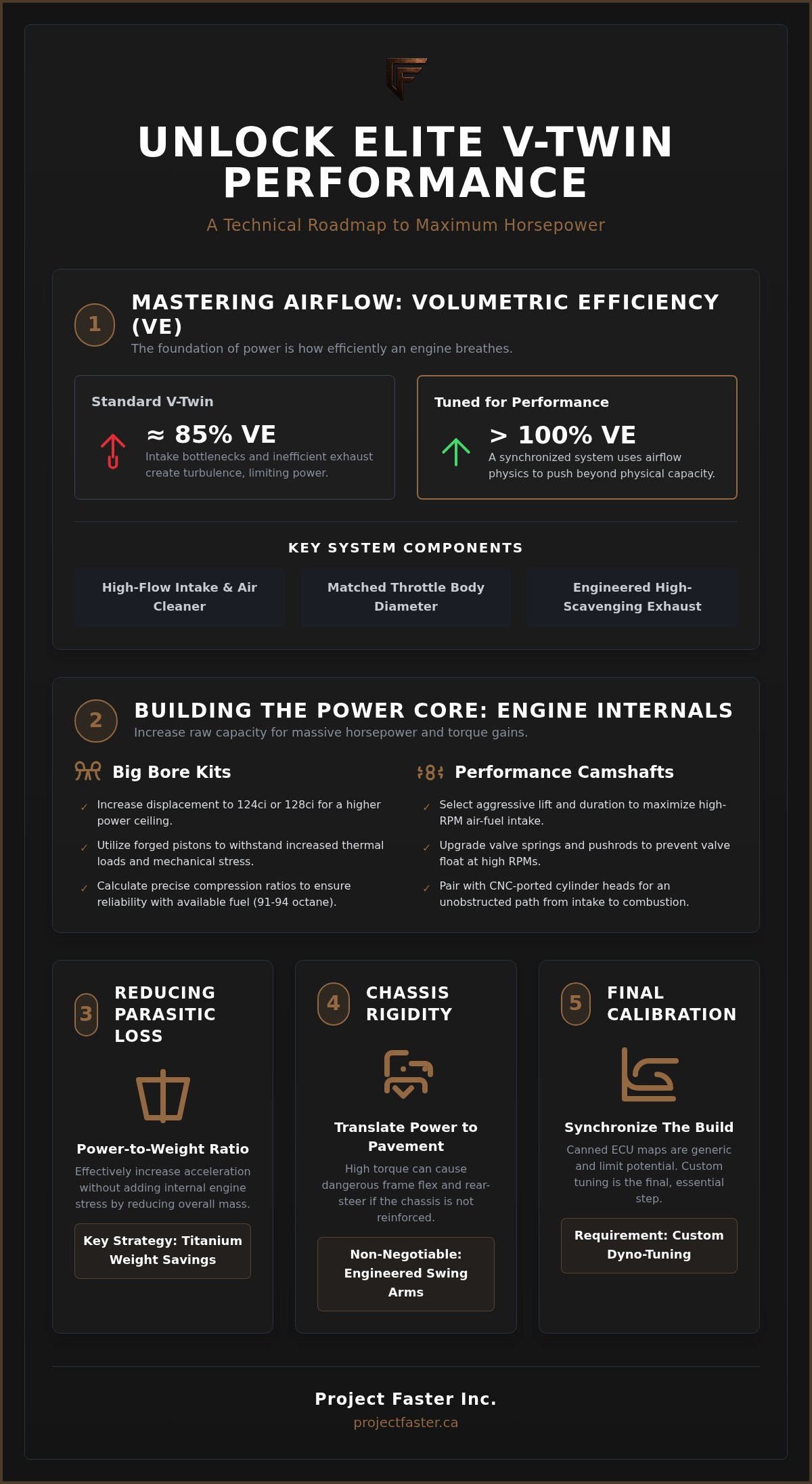
Maximum power begins with mastering the physics of airflow. Volumetric efficiency (VE) represents the ratio of the actual volume of air-fuel mixture drawn into the cylinder compared to the cylinder's static displacement. In a standard V-Twin, VE often hovers around 85 percent; however, the engine tuning principles required for elite performance aim to push this figure beyond 100 percent through inertia charging and resonance. Achieving this requires a synchronized system where the intake, throttle body, and exhaust function as a single pneumatic circuit rather than a collection of disjointed bolt-on parts.
Many riders mistake decibel levels for performance, yet "loud" pipes often destroy horsepower by creating turbulence or excessive backpressure. True performance is found in scavenging, where the kinetic energy of exiting exhaust pulses creates a vacuum that pulls the next intake charge into the combustion chamber. Without this precise timing, the engine fights itself, leading to wasted fuel and increased operating temperatures. Selecting the best harley upgrades for max horsepower requires looking past the chrome and focusing on the internal diameter and flow characteristics of your components.
The Engineering of High-HP Exhaust Systems
The PF Liberator High-HP Exhaust is engineered specifically to exploit these fluid dynamics. Its geometry utilizes stepped headers that gradually increase in diameter, a design choice that prevents reversion pulses from disrupting the exhaust flow. By managing these pressure waves, the system maintains high gas velocity even at lower RPMs while providing the massive flow capacity needed at the redline. The collector design is equally critical; it must merge pulses without causing a bottleneck, ensuring that the exhaust scavenges effectively across the entire powerband. You can find these high-performance systems in our full performance collection.
High-Flow Intake Requirements
An exhaust is only as effective as the intake that feeds it. High-performance builds require an intake manifold and air cleaner assembly that can satisfy the Cubic Feet per Minute (CFM) demands of a high-lift cam and increased displacement. If the intake diameter is smaller than the throttle body, you create a high-pressure restriction that kills top-end power. Incorporating velocity stacks can further refine this by smoothing the air as it enters the venturi, improving throttle response. When choosing the best harley upgrades for max horsepower, ensuring the air filter surface area is large enough to prevent vacuum spikes during heavy acceleration is a mandatory engineering step.
Internal Engine Modifications: Cams and Displacement
Displacement serves as the physical limit of an engine's potential. While the airflow optimizations discussed previously are vital, internal modifications provide the raw capacity required for triple-digit gains. Increasing displacement through big bore kits creates the volume necessary for massive output, effectively raising the ceiling for every other component in the system.
Big Bore Kits and Compression Strategy
A 124-cubic-inch or 128-cubic-inch big bore kit transforms the Milwaukee-Eight platform. Forged pistons are essential in these high-output scenarios to withstand the increased thermal loads and mechanical stress. Calculating the relationship between static and dynamic compression is critical for long-term reliability. In Canada, where fuel quality varies by province, targeting a compression ratio that remains compatible with 91 or 94 octane is a necessary safeguard against detonation. This technical precision ensures the engine survives the demanding conditions of extended summer tours or high-speed highway stretches across the country.
Camshaft Profiles for Maximum Top-End Power
Selecting the best harley upgrades for max horsepower requires a deep understanding of valvetrain geometry. Camshaft selection is where you define the powerband. High-HP cams utilize aggressive lift and extended duration to keep the valves open longer, allowing more air-fuel mixture to enter at high RPM. This overlap is what creates the distinct lope and top-end rush. However, aggressive lobes require upgraded valve springs and high-strength pushrods to prevent valve float. Understanding these engine performance characteristics ensures you don't over-cam the engine, which can lead to a sluggish bottom end and poor low-speed rideability.
Cylinder head porting is the final bridge between displacement and cam profile. Without CNC-machined or hand-ported heads, even the most aggressive cam will be choked by the stock casting's limitations. The best harley upgrades for max horsepower always involve a holistic approach where the heads are matched to the cam's lift. This synergy allows the engine to breathe efficiently right up to the rev limiter. If you are planning a high-output build, you should discuss your specific build parameters with an engineering specialist to ensure your components are perfectly matched.
Balancing these modifications for Canadian road conditions is a matter of practical engineering. While peak horsepower looks impressive on a dyno sheet, a build that sacrifices all low-end torque will be difficult to ride through mountain passes or in heavy urban traffic. The goal is a linear power delivery that rewards the rider across the entire usable range. Realizing this balance is what separates a professional build from a collection of mismatched parts.
The Power-to-Weight Ratio: Reducing Parasitic Loss
Acceleration is a pure calculation of force divided by mass. While increasing displacement adds force, reducing the weight of the machine provides an equivalent improvement in performance without increasing internal engine stress. For riders seeking the best harley upgrades for max horsepower, weight reduction is the most overlooked variable. This is particularly true when addressing parasitic loss, which is the energy wasted moving heavy, inefficient components instead of driving the rear tyre.
Reducing rotating mass allows the engine to rev faster. When the crankshaft and primary drive don't have to overcome the inertia of heavy steel hardware, the power reaches the ground with less resistance. This translates into sharper throttle response and improved acceleration. Identifying the low hanging fruit for weight reduction starts with the fasteners and structural components that are over-engineered in weight but under-engineered in material quality. Static weight reduction is helpful, but removing unsprung and rotating mass provides a transformative effect on the bike's agility and speed.
Titanium Bolt Kits and Hardware Engineering
Titanium offers a 45 percent weight reduction over standard steel fasteners while maintaining superior tensile strength. This isn't just about total bike weight; it's about where that weight is removed. Replacing steel bolts in the primary or brake calipers reduces rotating and unsprung mass, respectively. By replacing standard grade-8 bolts with titanium equivalents, you're not just shedding grams; you're improving the mechanical integrity of the assembly. You can read more in our Engineering Guide to Titanium Bolt Kits to understand the specific torque and fitment advantages of this aerospace-grade material.
Billet Aluminum vs. Cast Components
Precision-engineered billet hardware represents the intersection of aesthetic superiority and functional excellence. 7075-T6 billet aluminum provides a strength-to-weight ratio that cast parts simply cannot match. Cast components are often made from lower-grade alloys and require more mass to achieve necessary strength, which adds bulk without adding benefit. CNC machining allows us to remove every unnecessary gram while maintaining the structural rigidity required for high-torque applications. This is why the best harley upgrades for max horsepower often include a transition to billet swing arms and engine covers. These components ensure that every bit of energy produced by the engine is used for forward motion rather than being absorbed by heavy, flexing parts.
Translating Power to the Pavement: Chassis Rigidity
Engine output is only one half of the performance equation. High horsepower becomes a liability if the motorcycle's frame and swing arm flex under the massive torque loads generated by a modified V-Twin. This structural instability often manifests as "rear-steer," a phenomenon where the rear wheel shifts out of alignment during hard acceleration. This not only compromises safety but also results in significant power loss as the chassis absorbs energy that should be driving the tire forward. To truly capitalize on the best harley upgrades for max horsepower, you must ensure your chassis is engineered to remain rigid under extreme stress.
A rigid chassis improves traction by maintaining a consistent contact patch between the tire and the road. For builds exceeding 100 horsepower, the stock stamped-steel swing arm is no longer a viable component. It lacks the torsional stiffness required to prevent lateral deflection. Upgrading to an engineer-certified performance swing arm is a fundamental requirement for any serious high-output build, providing the stability needed to deliver power predictably out of corners and down the straightaway.
The Role of the Billet Swing Arm
Transitioning to a billet aluminum swing arm is the definitive solution for frame flex. The PF Vector Billet Swing Arm for Softail models is machined from 7075-T6 aluminum, providing a massive increase in rigidity compared to the factory unit. For those on heavier platforms, the PF Mako Billet Swing Arm eliminates the wallowing sensation common in high-torque Touring builds. These components are engineer-certified, ensuring they meet the specific mechanical requirements of elite-level performance applications where structural failure is not an option.
Braking Rigidity and Power Control
Stopping power must always scale in proportion to horsepower. As you implement the best harley upgrades for max horsepower, your braking system requires a corresponding increase in rigidity to manage higher entry speeds. Integrating the PF Vector 108mm Radial Mount Brake Arm provides the maximum bite and precision necessary for high-performance riding. Unlike cast arms that can flex under heavy load, these billet components offer superior thermal management, significantly reducing brake fade during aggressive use. If you are ready to stabilize your high-HP build, contact our engineering team to discuss the right chassis components for your specific goals.
Final Calibration: Tuning for Maximum Output
Software is the final arbiter of performance. Even the best harley upgrades for max horsepower are limited by the factory ECU's restrictive parameters. The ECU map coordinates ignition timing, fuel delivery, and throttle response, acting as the centralized brain for all mechanical components. Without precise recalibration, your investments in displacement and high-flow geometry remain significantly underutilized. It's the difference between a collection of expensive parts and a synchronized racing machine.
High-displacement builds demand a fuel volume that stock components simply cannot deliver. When you move to a 124-cubic-inch or larger platform, upgrading the fuel pump and injectors is a mandatory engineering step. This ensures that the system can maintain optimal Air-Fuel Ratios (AFR) under heavy load. Monitoring these ratios prevents lean conditions that cause excessive heat and potential piston seizure. Every combustion cycle must be perfectly timed to translate fuel energy into rear-wheel torque without compromising the mechanical integrity of the engine.
Dyno Tuning and Fuel Management
Canned maps are designed for broad averages and conservative safety margins. They are insufficient for elite-level builds. A custom dyno-tuning session allows a technician to calibrate the engine to its specific atmospheric conditions and component tolerances. By monitoring real-time data through wide-band sensors, the tuner can adjust ignition timing to find the precise intersection of maximum power and engine safety. Modern tuning interfaces provide the flexibility to manage multi-map setups, allowing the rider to toggle between aggressive performance profiles and more manageable touring maps based on the immediate requirement.
The Power Application Checklist
Building a world-class V-Twin requires a methodical sequence of upgrades. Skipping a single step in this hierarchy creates a bottleneck that limits the effectiveness of every other part. Use this checklist to ensure your build is synchronized for maximum output:
- 1. Verify intake and exhaust flow synergy: Ensure your exhaust geometry matches your throttle body CFM.
- 2. Confirm cam profile matches displacement: Match lift and duration to the volume of your cylinders.
- 3. Ensure chassis rigidity: Install a billet swing arm to prevent frame flex under high torque loads.
- 4. Finalize with a custom dyno-tune: Synchronize all mechanical components with a professional ECU calibration.
Ready to build a machine that redefines performance? Contact our engineering team for a consultation to begin your high-HP journey.
Engineering Your Path to Elite Performance
Achieving triple-digit gains requires a shift from superficial bolt-ons to integrated mechanical engineering. We've established that the best harley upgrades for max horsepower are those that prioritize volumetric efficiency while ensuring the chassis can actually handle the resulting torque. Displacement increases and aggressive cam profiles are only effective when matched with high-flow exhaust geometry and a rigid drivetrain. Without structural integrity, your engine's output simply becomes a catalyst for frame flex and parasitic loss.
Project Faster Inc. components are designed and tested for high-horsepower Canadian V-Twins, providing the stability required for uncompromising builds. Our engineer-certified Mako and Vector swing arms, machined from 7075-T6 billet aluminum, eliminate the rear-steer common in high-torque applications. By addressing both the source of power and the method of its delivery, you ensure your machine remains reliable under extreme stress. If you're ready to translate these engineering principles into a real-world build, consult with our engineers to plan your high-performance build. Your machine has more potential; it's time to realize it.
Frequently Asked Questions
What is the single best upgrade for Harley horsepower?
A high-lift camshaft paired with a precise EFI recalibration is the most impactful individual modification. This combination dictates the engine's breathing cycle and ignition timing. While identifying the best harley upgrades for max horsepower, riders must realize that a cam provides the most significant shift in the power curve. It transforms the engine's character by extending the RPM range where peak torque occurs, effectively raising the total horsepower output.
Do I need a big bore kit to reach 100 horsepower?
You don't strictly require a big bore kit to hit the 100-horsepower mark, but it provides the most reliable foundation for those gains. Many Milwaukee-Eight 114 and 117 engines reach this threshold with a simple Stage 2 cam upgrade and a high-flow exhaust. However, increasing displacement to 124 or 128 cubic inches makes reaching 120 plus horsepower much easier while maintaining lower stress levels on internal components.
How much does a high-performance exhaust like the PF Liberator actually help?
A dedicated high-performance exhaust like the PF Liberator provides a documented increase in volumetric efficiency by utilizing stepped header geometry. This design creates a scavenging effect that pulls spent gases out of the cylinder more effectively than standard systems. By reducing backpressure and preventing reversion, the system allows the engine to draw in a larger intake charge, directly increasing rear-wheel horsepower across the entire RPM range.
Why should I upgrade my swing arm if I'm only increasing engine power?
Upgrading to a billet swing arm is necessary to ensure that engine power is translated into forward motion instead of being absorbed by chassis flex. Stock swing arms are made of stamped steel and often twist under the high torque loads of a modified V-Twin. This flex causes rear-steer and instability. An engineer-certified billet component provides the torsional rigidity required to keep the rear wheel aligned during aggressive acceleration.
Is titanium really worth the cost for a street-ridden Harley?
Titanium hardware is a justified investment for street riders because it reduces parasitic loss through a 45 percent weight reduction over steel. This is particularly effective when used on rotating parts like the primary or unsprung components like brake calipers. By lowering the mass the engine must move, you improve throttle response and acceleration. It's a method of increasing performance without adding heat or mechanical stress to the engine.
Can I achieve max horsepower while keeping the bike reliable for long trips?
Reliability and maximum output are achievable through a balanced compression strategy and high-quality cooling components. Achieving the best harley upgrades for max horsepower doesn't mean building a fragile racing engine. By selecting forged pistons and a cam profile that doesn't require excessive RPMs, you can maintain a machine that's comfortable for long-distance Canadian touring. Proper oil cooling and a custom dyno tune are essential for managing increased thermal loads.
What is the difference between torque and horsepower in a V-Twin build?
Torque represents the instantaneous rotational force that launches the bike, whereas horsepower is the mathematical product of torque and RPM. In a performance V-Twin build, torque provides the pull felt at low speeds, while horsepower defines the bike's ability to maintain high speeds. Engineering for max horsepower typically involves shifting the torque peak higher into the RPM range where the engine's airflow capacity is most efficient and consistent.
Do I need to upgrade my clutch for a high-horsepower build?
Upgrading the clutch is a mandatory requirement once your build exceeds the factory torque limits, which typically occurs around 110 to 120 lb-ft. Stock clutch packs will slip under the increased pressure of a high-HP engine, wasting power and creating excessive heat. Installing heavy-duty springs or a complete centrifugal lock-up clutch ensures that all the power generated by your modifications actually reaches the transmission and the rear tyre without loss.