

Why would you trust a high-output powertrain to fasteners that were designed for cost-efficiency rather than ultimate mechanical integrity? Most performance-minded riders eventually realize that factory steel bolts are a weak link, often succumbing to heat stress or becoming an eyesore due to oxidation. It's a common frustration to find rounded-off heads and surface rust on a machine that otherwise represents the pinnacle of V-Twin engineering. Integrating a titanium engine bolt kit harley riders can rely on isn't just about aesthetics; it's a strategic upgrade that addresses these fundamental mechanical compromises.
We understand that every gram and every foot-pound of torque matters when you're pushing a build to its limit. This article explores how Grade 5 titanium hardware optimizes your Harley-Davidson by offering superior tensile strength and permanent corrosion resistance. You'll discover the physics behind the weight savings and how these components provide a forever hardware solution that eliminates the risk of fastener failure under extreme conditions. We'll break down the specific technical benefits of transitioning from OEM steel to aerospace-grade titanium for a more robust, streamlined powertrain.
Key Takeaways
- Understand why Grade 5 titanium (Ti-6Al-4V) is the engineered solution for replacing compromised OEM steel fasteners in high-stress engine environments.
- Discover how a titanium engine bolt kit harley performance enthusiasts use can lower the powertrain's centre of gravity while providing measurable weight savings.
- Learn the technical requirements for a successful installation, specifically the use of anti-seize and the recalibration of factory torque specifications.
- Identify how to achieve permanent corrosion resistance and prevent the mechanical failure of low-grade fasteners under intense thermal cycles.
- Realize the compounding performance benefits of integrating titanium hardware alongside other precision components like the Vector billet swing arm.
Understanding Titanium Engine Bolt Kits for Harley-Davidson V-Twins
A comprehensive titanium engine bolt kit harley owners select for their builds is a precision-engineered collection of fasteners designed to replace standard factory hardware. This is not merely a cosmetic upgrade; it is a structural enhancement for the most critical areas of the powertrain. These kits typically include specialized hardware for the cam cover, primary housing, transmission side covers, and rocker boxes. By replacing the generic fasteners used during mass production, riders can ensure their engine is secured with materials that match the high-performance nature of their machine.
The industry is currently shifting away from aesthetic customization toward performance-driven engineering. In the past, chrome-plated steel was the standard for those seeking a premium look, but this often added unnecessary weight and introduced new maintenance challenges. Modern high-horsepower builds require hardware that can withstand extreme thermal cycles while maintaining exact torque values. Choosing a titanium engine bolt kit harley enthusiasts recommend represents a commitment to mechanical integrity over simple visual flair.
The Problem with Factory Steel Bolts
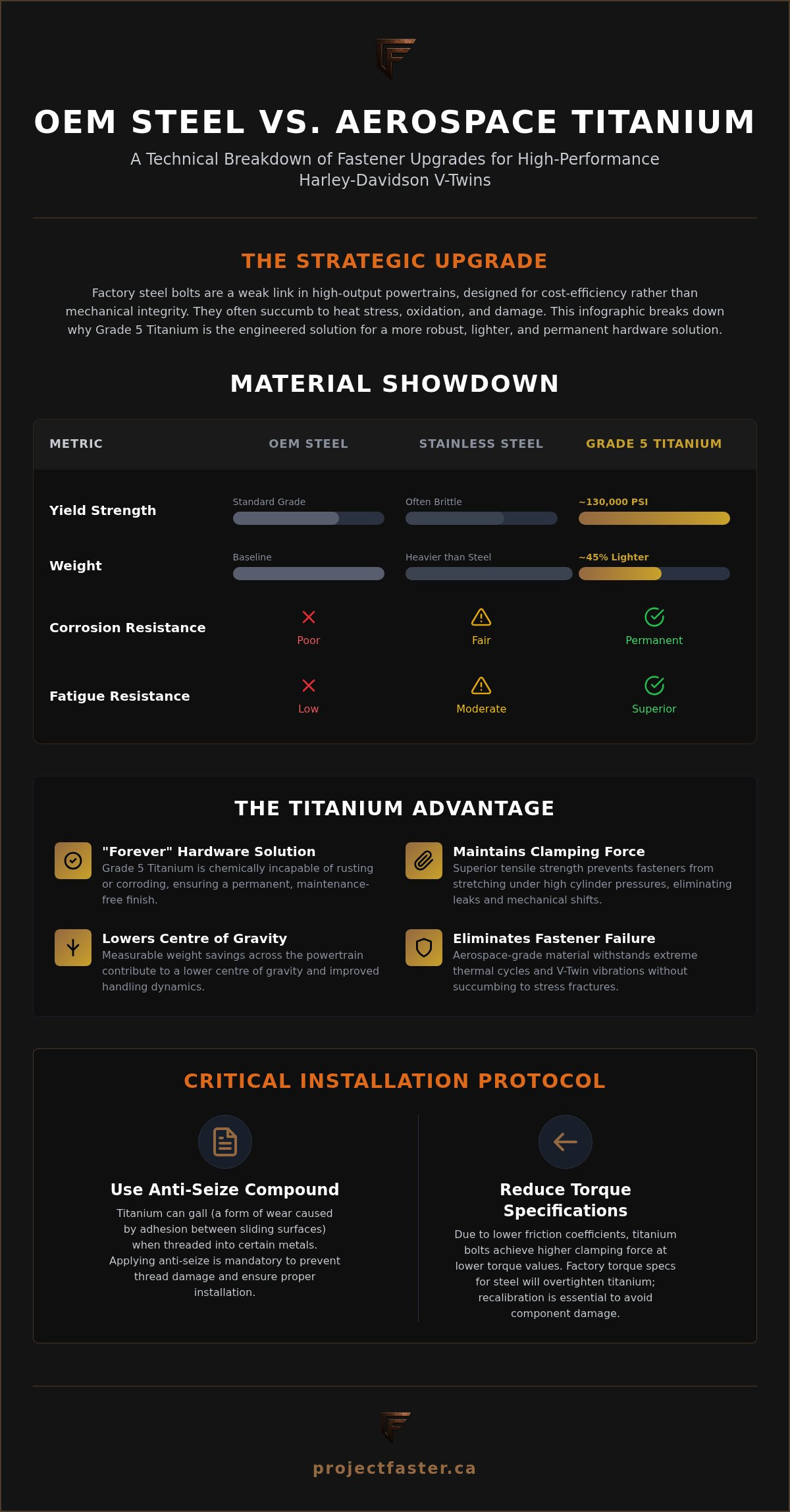
OEM steel fasteners are frequently the weak link in a factory Harley-Davidson assembly. These bolts are chosen by manufacturers primarily for cost-efficiency rather than ultimate durability. One of the most prevalent issues is surface oxidation, commonly known as "tea staining," which occurs when moisture and road grime react with the low-grade steel. Beyond the loss of visual appeal, factory hardware carries a significant weight penalty that accumulates across the engine. Additionally, the relatively soft nature of OEM steel means bolt heads are prone to rounding off during routine maintenance, especially in high-torque applications where repeated heat cycles have caused the threads to bind.
Titanium vs. Stainless Steel: The Performance Gap
While stainless steel is often presented as a solution to corrosion, it presents its own set of compromises. Stainless steel is significantly heavier than titanium and can be surprisingly brittle under the high-vibration conditions typical of a V-Twin engine. In contrast, Titanium alloys offer a superior strength-to-weight ratio that ensures the hardware remains secure without adding mass. Titanium is a "forever" solution; it is chemically incapable of rusting and maintains its structural properties across a wider temperature range than steel. Grade 5 Titanium is the aerospace standard for V-Twin hardware. This material provides the necessary tensile strength to handle high-compression engine builds while reducing the rotational and static mass of the powertrain.
The Materials Science: Why Grade 5 Titanium Outperforms OEM Steel
Grade 5 titanium, technically classified as Ti-6Al-4V, is an alpha-beta alloy that serves as the benchmark for high-performance hardware. It integrates 6% aluminum and 4% vanadium to achieve a mechanical profile that far exceeds standard industrial fasteners. While OEM steel is chosen for its low manufacturing cost, it lacks the specific strength-to-density ratio required for elite-level builds. A titanium engine bolt kit harley riders install provides a significant upgrade in fatigue resistance. This allows the hardware to endure the intense, high-frequency vibrations inherent to the V-Twin platform without succumbing to stress fractures.
Maintaining consistent clamping force is vital in a high-vibration environment. Unlike 304 or 316 stainless steel, which can be prone to work-hardening and brittleness, Grade 5 titanium maintains its ductility and structural integrity. This material is often cited in NASA fastener standards as a preferred choice for critical aerospace applications where mechanical failure is not an option. It represents a level of engineering that prioritizes long-term stability over mass-market convenience.
Tensile Strength and Yield Points
Precision titanium hardware typically demonstrates a yield strength of approximately 130,000 PSI. This represents the point at which a bolt begins to permanently deform. In high-compression engines, cylinder pressures exert immense force on the assembly, often causing lower-grade fasteners to stretch. When a bolt stretches, it loses its ability to maintain the necessary tension. This leads to gasket leaks or mechanical shifts. Choosing a titanium engine bolt kit harley performance builders prefer ensures that the hardware possesses a higher yield point than standard Grade 5 steel. It effectively prevents "bolt creep" and ensures the powertrain remains a rigid, cohesive unit.
Heat Dissipation and Thermal Stability
V-Twin engines operate under extreme thermal conditions. Temperatures fluctuate rapidly from cold starts to peak performance. Titanium possesses a lower coefficient of thermal expansion than steel. It expands and contracts less as the engine heats up. This stability ensures that clamping force remains constant. It prevents the hardware from loosening or over-tightening against aluminum cases. Titanium is naturally impervious to the corrosive effects of road salt and moisture. This is particularly advantageous in Canadian riding conditions, where fluctuating humidity and winter road treatments can quickly degrade inferior metals. If you have questions about specific fitment for your drivetrain, you can reach out to our engineering team for technical support.
Performance Benefits: Beyond Aesthetic Appeal
The physics of performance requires a holistic approach to mass reduction. While many riders focus on high-visibility components, the cumulative effect of optimizing smaller hardware is often overlooked. Installing a titanium engine bolt kit harley performance enthusiasts rely on facilitates a measurable reduction in static weight directly at the heart of the machine. This isn't just about shedding grams for the sake of a spec sheet; it's about the strategic elimination of unnecessary mass to improve power-to-weight ratios and overall vehicle dynamics. Every component replaced contributes to a more responsive and efficient powertrain.
Reducing weight in the engine area is particularly effective because of its location. Engine fasteners are positioned centrally within the frame, and minimizing mass here helps maintain a lower centre of gravity. This contributes to more predictable handling, especially during rapid transitions or under heavy braking. When paired with other high performance Harley parts, such as a Mako or Vector billet swing arm, the result is a machine that feels significantly more agile than its stock counterpart. It's a comprehensive engineering strategy that treats the motorcycle as a unified system rather than a collection of separate parts.
Reducing Powertrain Mass
A standard 130-piece steel engine kit carries a surprising amount of weight. Transitioning to titanium results in an approximate 45% reduction in fastener mass. For competitive drag racing or aggressive performance bagger builds, these savings are vital. In these high-stakes environments, the difference between victory and second place is often found in the marginal gains of material selection. The use of Grade 5 titanium, which meets SAE International's AMS4911S standard, ensures that this weight reduction does not come at the expense of structural safety. It's the elite choice for riders who realize that performance is won through meticulous attention to detail.
Corrosion-Proof Engineering
Titanium is unique because it naturally forms a tenacious oxide layer when exposed to oxygen. This microscopic barrier provides permanent protection against atmospheric corrosion, road salt, and harsh cleaning chemicals. Unlike OEM steel bolts that require chrome plating or powder coating, titanium hardware is inherently resistant to environmental degradation. This eliminates the common cycle of replacing rusted or "tea-stained" fasteners every few seasons. You achieve a permanent, show-quality finish that requires zero maintenance beyond basic cleaning. It provides the psychological benefit of a "clean build" that stays pristine regardless of the riding conditions. This durability is essential for Canadian riders who face rapidly changing weather and high-humidity environments that quickly destroy lesser metals.
Installation and Torque Specifications for Titanium Hardware
Correct installation is where the performance potential of a titanium engine bolt kit harley builders invest in is either realized or squandered. Titanium's unique material properties demand a disciplined installation protocol that differs meaningfully from standard steel hardware procedures. Skipping these steps doesn't just risk the fasteners; it risks the aluminum engine cases they thread into.
The Anti-Seize Protocol
Dry installation of titanium into aluminum is a critical mistake. Without a lubricating barrier, titanium threads will gall against the softer aluminum case material under torque load. Galling is not simple surface scratching; it's a cold-welding phenomenon where material transfers between the two metals, seizing the fastener permanently and often destroying the threaded bore in the process.
Two compounds are appropriate for this application:
- Nickel-based anti-seize: The preferred choice for high-temperature zones such as rocker boxes and cylinder heads, where thermal cycling is most aggressive. Nickel compounds maintain their lubricating properties at elevated temperatures where copper-based alternatives can break down.
- Copper-based anti-seize: Acceptable for lower-heat areas like primary and transmission covers, and generally more accessible at the component level.
Because anti-seize acts as a lubricant, it fundamentally changes the friction coefficient at the thread interface; this means factory torque values must be reduced by 10 to 15% to achieve the same actual clamping force without over-stressing the fastener or the threaded aluminum bore.
Step-by-Step Bolt Replacement
The sequence of replacement is as important as the hardware itself. Follow this procedure to preserve gasket integrity and thread condition throughout the process:
- Replace one bolt at a time. Never remove an entire cover's worth of fasteners simultaneously. Releasing all clamping force at once allows gaskets to shift and distort, particularly on warm engines where the sealing compound has softened.
- Clean each threaded hole before installation. Use a thread chaser or appropriate tap to clear any corrosion, old thread-locker residue, or debris from the bore. Compressed air should be used to evacuate the hole completely. Installing into a contaminated bore produces false torque readings.
- Apply anti-seize to the first three to four threads of each fastener only. Excess compound migrating into a blind hole can create hydraulic pressure that cracks the case.
- Torque in a cross-pattern sequence to distribute clamping load evenly across the mating surfaces.
- Perform a heat-cycle re-torque. After the first full ride, allow the engine to cool completely, then verify torque values on all replaced fasteners. Thermal expansion and initial seating will often cause slight relaxation that requires a single corrective pass.
Regarding tooling: 12-point sockets are non-negotiable for titanium hardware. Six-point sockets concentrate load at fewer contact points and significantly increase the risk of rounding the head of a fastener that, unlike steel, cannot simply be replaced with a hardware-store substitute. Precision matters at every step of this process.
If you're uncertain about fitment specifications or torque values for your specific model year, contact the Project Faster engineering team for technical guidance before you begin.
Integrating Titanium Hardware into Your High-Performance Build
High-performance engineering isn't achieved through a single component but through the meticulous integration of parts that work in concert to eliminate mechanical weaknesses. A titanium engine bolt kit harley riders choose often serves as the final, critical detail in a ground-up performance transformation. While a high-horsepower engine or a Vector billet swing arm provides the foundation, the hardware used to secure these assemblies determines the ultimate reliability of the build. It's the difference between a machine that just looks fast and one that's engineered to endure.
The Project Faster approach focuses on components that offer measurable gains in both speed and structural integrity. Matching your engine kit with primary and transmission hardware creates a cohesive, engineered look that signals a commitment to technical excellence. It's about more than just visual appeal; it's about ensuring every fastener on the powertrain is capable of handling the increased stresses of a modified V-Twin. We suggest starting with high-stress and high-visibility areas like the cam cover and rocker boxes before expanding to the outer primary and transmission side covers to complete the transition.
The Engineering Synergy of Lightweight Parts
Significant performance gains are realized when weight reduction in the powertrain complements the structural rigidity of the chassis. For instance, the weight savings provided by titanium hardware work in synergy with the reduced mass and increased stiffness of a Mako swing arm. This combination results in a motorcycle that accelerates more efficiently and tracks more accurately through corners. Investing in high-tensile hardware isn't a temporary fix; it's a long-term value proposition that protects your investment from the corrosive environments and mechanical stresses that degrade standard components over time.
Finalizing Your Build Strategy
Developing a comprehensive build strategy requires a focus on both immediate needs and future performance goals. You can explore our full range of precision components in the Shop All Parts collection to find the hardware that matches your specific mechanical objectives. If you're building a high-compression motor or a dedicated track machine, consulting with experts can help you determine the exact kit configuration required for your application. Don't leave your mechanical integrity to chance; contact Project Faster for technical fitment advice to ensure your titanium upgrade is executed with engineering precision.
Securing the Future of Your Performance Build
Transitioning to aerospace-grade Ti-6Al-4V hardware is a decisive step toward eliminating mechanical vulnerabilities. By choosing a titanium engine bolt kit harley riders can realize permanent corrosion resistance and a significant reduction in powertrain mass without compromising structural integrity. These components are engineered specifically for Harley-Davidson fitment, ensuring that every fastener provides the maximum tensile strength required for high-output applications. Whether you're finishing a custom drivetrain or optimizing a high-performance bagger, this hardware represents a commitment to engineering excellence that standard steel simply cannot match.
Mechanical integrity is the foundation of speed. High-tensile titanium fasteners provide the stability needed to maintain clamping force through thousands of thermal cycles, protecting your gaskets and engine cases from the compromises of factory-grade hardware. If you're ready to finalize your build strategy with parts designed for the physics of performance, upgrade your V-Twin with high-performance titanium bolt kits from Project Faster Inc. today. Your machine deserves hardware that's as serious about performance as you are.
Frequently Asked Questions
Are titanium engine bolts stronger than the original Harley-Davidson steel bolts?
Yes, Grade 5 titanium fasteners are significantly stronger than the original Grade 5 steel bolts used in factory Harley-Davidson assemblies. With a tensile strength of approximately 130,000 PSI, titanium hardware matches the strength of Grade 8 steel while remaining 45% lighter. This increased yield point is vital for high-compression engines where bolt stretching can lead to gasket failure or mechanical instability. It provides a superior foundation for any high-performance build.
Do I need to use anti-seize when installing titanium bolts into aluminum engine cases?
Yes, the use of high-quality anti-seize is mandatory whenever you install titanium bolts into aluminum engine cases. Titanium threads are prone to galling, a cold-welding phenomenon that can permanently seize the fastener and destroy the aluminum threads in the case. Using a nickel-based or copper-based compound creates a necessary lubricating barrier. This step ensures that the hardware can be safely removed during future maintenance cycles without damaging the powertrain.
Will titanium bolts seize over time due to heat cycles?
No, titanium bolts won't seize over time due to heat cycles provided they're installed with the correct anti-seize compound. Titanium actually possesses a lower coefficient of thermal expansion than steel, meaning it expands and contracts less as the engine reaches operating temperature. This thermal stability helps maintain consistent clamping force and prevents the fastener from binding against the aluminum casing. It effectively eliminates the seizing issues common with lower-grade steel hardware.
How much weight can I actually save by switching to a full engine bolt kit?
Switching to a comprehensive titanium engine bolt kit harley riders use can reduce fastener weight by approximately 45% compared to OEM steel. While the individual savings on a single bolt seem small, the cumulative effect across a 130-piece kit is measurable. Reducing static mass centrally on the powertrain contributes to a lower centre of gravity and improved agility. These marginal gains are essential for competitive racing and high-performance bagger builds.
Can I use the factory torque specs found in the Harley service manual for titanium hardware?
No, you shouldn't use the dry factory torque specifications for titanium hardware because the required use of anti-seize acts as a lubricant. Lubricated threads reach the desired clamping force at lower torque values than dry threads. Project Faster recommends a 10% to 15% reduction from the factory service manual values to prevent over-stressing the aluminum bores. Always perform a final check after the first full heat cycle to ensure the fasteners remain properly seated.
What is the difference between Grade 2 and Grade 5 titanium for motorcycle use?
Grade 2 titanium is commercially pure and lacks the structural integrity required for engine applications, whereas Grade 5 (Ti-6Al-4V) is a high-strength alloy. Grade 5 incorporates aluminum and vanadium to achieve the tensile strength and fatigue resistance necessary for high-vibration V-Twin environments. Using Grade 2 hardware on an engine is a safety risk; only Grade 5 should be considered for structural components where mechanical failure is not an option.
Do titanium bolts require special tools for installation?
Yes, precision 12-point sockets are highly recommended for the installation of titanium hardware to prevent damage to the bolt heads. While some kits may fit standard tools, 12-point sockets provide more contact surface area and reduce the risk of rounding off the fastener. Titanium is harder than standard steel; using worn or low-quality 6-point tools can compromise the finish or the structural integrity of the head. Quality tooling is a non-negotiable requirement.
Will titanium hardware change colour over time like stainless steel does?
No, titanium hardware won't change colour or yellow over time like stainless steel often does when exposed to high heat. Titanium naturally forms a microscopic oxide layer that provides permanent protection against atmospheric corrosion and thermal discolouration. This oxide barrier ensures that cam covers and rocker box bolts maintain their original finish regardless of road salt exposure or intense engine temperatures. It remains the only "forever" aesthetic and mechanical solution for V-Twins.