

Spending thousands on premium shocks to fix a wallowing rear end is often a wasted investment if you ignore the underlying architecture of the bike. While many riders believe dampening is the sole solution to handling issues, the reality is that stock steel components frequently flex under the load of high-horsepower builds. This structural deficiency creates the notorious "hinge-in-the-middle" sensation that ruins confidence during aggressive lean angles. If your goal is a true harley high speed stability upgrade, you must look past the springs and toward the mechanical integrity of the swingarm itself.
You shouldn't have to fight your motorcycle to maintain a line through a high-speed sweeper. We recognize the frustration of vague feedback and the unsettling rear-end oscillation that occurs when factory components reach their physical limits. This guide explores how to eliminate rear-end flex and organize your chassis for maximum stability by upgrading the structural foundation of your Harley-Davidson. You will discover the engineering advantages of 7075-T6 billet aluminum and learn how reducing unsprung weight allows your rear tire to track the pavement with absolute precision.
Key Takeaways
- Understand why the "bagger wallow" originates in the chassis and why rigid structural components are the essential first step in any harley high speed stability upgrade.
- Compare the tensile strength of 7075-T6 billet aluminum to stock welded steel to see how material choice eliminates unwanted chassis movement.
- Learn how reducing unsprung weight improves the tracking of your rear tire, allowing shocks to react with greater precision to road imperfections.
- Discover how to organize your rear assembly using high-quality pivot points and titanium hardware to achieve a planted feel in every corner.
- Evaluate the specific engineering advantages of the Mako and Vector swing arms for stabilizing high-horsepower Touring and Softail builds.
The Foundation of Stability: Why Rear Upgrades Start with Rigidity
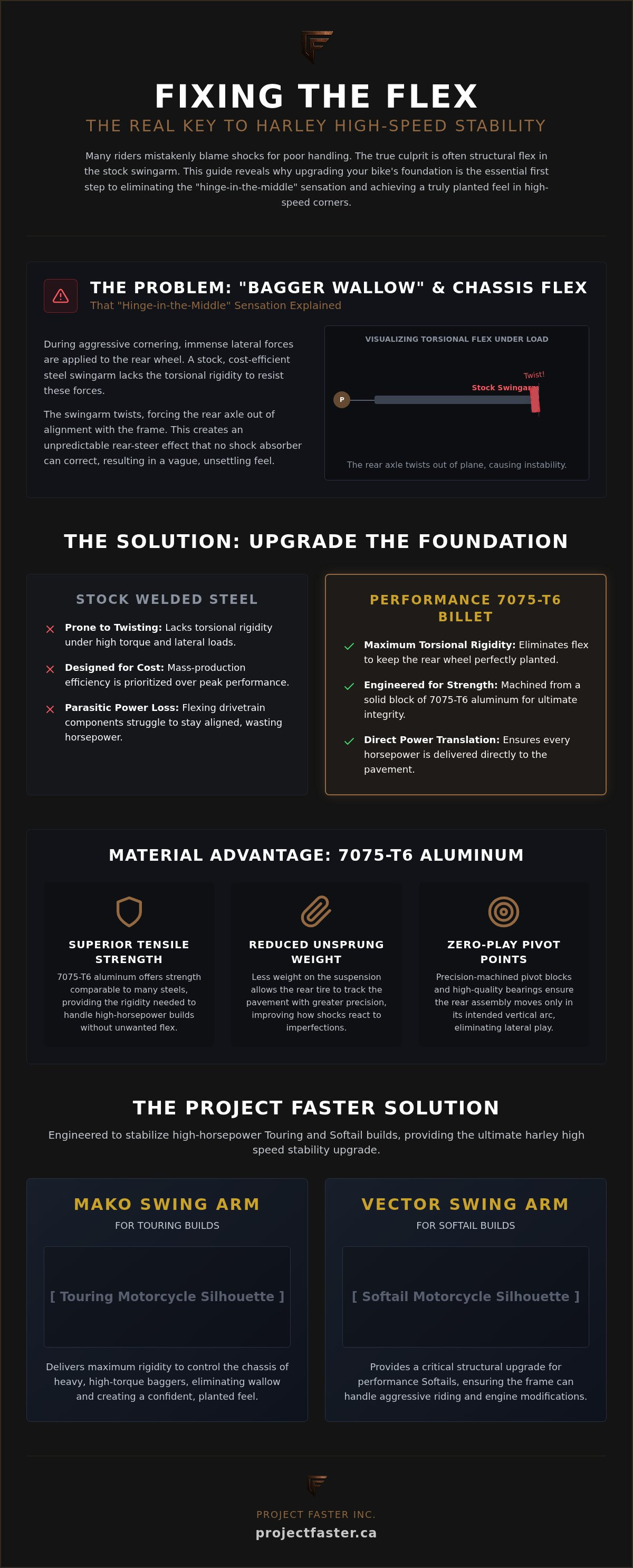
True chassis stability isn't a product of damping alone. Many riders invest heavily in high-end shocks only to find that the unsettling "bagger wallow" remains during high-speed cornering. This happens because the root cause isn't found in the suspension fluid or spring rates. It's a structural failure. When a heavy V-Twin enters a turn, the lateral loads exerted on the rear tire transfer directly into the swingarm. If that component lacks sufficient torsional rigidity, it twists. This movement forces the rear axle out of alignment with the rest of the frame, creating a rear-steer effect that no shock absorber can fix.
Achieving a meaningful harley high speed stability upgrade requires addressing this mechanical deflection. The science of bicycle and motorcycle dynamics dictates that the rear wheel must remain on a consistent plane relative to the front. When the swingarm flexes, it introduces a secondary, uncontrolled steering input. This is why a bike feels planted on a straightaway but vague and disconnected once leaned over. Structural rigidity is the baseline requirement for any performance build.
Identifying Mechanical Weak Points in V-Twin Chassis
Mass-produced welded steel swingarms are designed for cost-efficiency rather than extreme performance. These components are prone to twisting when subjected to the massive torque of a modified engine. As you accelerate out of a corner, the chain or belt pull applies immense pressure to one side of the axle. On a stock arm, this force often results in measurable torsional twist. You can visualize this as the rear axle trying to rotate around the pivot point independently of the frame. This interaction between engine torque and flexible geometry is the primary architect of instability.
The Hinge Effect: Why Your Bike Feels Loose
This phenomenon is often described as a "hinge-in-the-middle" sensation. Riders frequently misdiagnose this movement as poor shock damping, leading them to over-stiffen their suspension. While stiffer shocks might mask the symptom, they don't solve the problem. The instability persists because the swingarm continues to flex under load. To truly organize the chassis, you must replace the flexible link with a precision-engineered component. You can find the necessary hardware to begin this transition in our high performance Harley parts collection. By prioritizing structural rigidity, you ensure that your suspension can finally do its job without fighting a twisting frame.
Beyond the Shocks: The Engineering of Performance Billet Swing Arms
A performance swing arm is a precision-machined component engineered to eliminate the torsional flex inherent in factory welded steel units. While stock arms focus on manufacturing efficiency, a billet upgrade prioritizes mechanical integrity under extreme stress. This rigidity is essential for maintaining perfect belt and chain alignment when you're putting massive torque to the ground. A twisting rear end doesn't just cause instability; it creates parasitic power loss as the drivetrain components struggle to stay indexed. By stabilizing the rear axle, you ensure that every horsepower produced by the engine translates directly into forward momentum.
Engineering a comprehensive harley high speed stability upgrade requires a zero-tolerance approach to the swing arm pivot point. Factory bushings often allow for lateral play, which introduces unpredictability into the handling geometry. Precision-machined pivot blocks and high-quality bearings create a zero-play environment, ensuring the rear assembly moves only in its intended vertical arc. Academic motorcycle stability research highlights that controlling these structural oscillations is vital for preventing the onset of high-speed weave modes.
Torsional Rigidity vs. Vertical Compliance
Torsional rigidity is the mechanical resistance of the swing arm to twisting forces that attempt to rotate the rear axle out of parallel with the pivot shaft. You want maximum resistance to this twisting motion while maintaining the vertical compliance necessary for the shocks to function. Precision-machined axle blocks are critical here, as they provide a stable, repeatable mounting surface that prevents the axle from shifting under heavy acceleration. This combination of strength and accuracy allows the suspension to react to road imperfections without the chassis itself becoming an uncontrolled spring.
The Physics of the Rear Contact Patch
When a swing arm flexes, the rear tire no longer sits perpendicular to the road surface during cornering. This deflection reduces the effective contact patch, leading to tire scrub and a significant loss of grip. A rigid billet arm keeps the tire exactly where the engineer intended, providing consistent feedback through the footpegs. This is why the Vector Billet Swing Arm is a transformative modification for modern performance builds. It replaces vague feedback with a planted, predictable feel that allows you to push harder with confidence. If you're building for maximum output, you can speak with our technical team to find the right structural solution for your specific frame.
Material Science: 7075-T6 Aluminum vs. Stock Steel Components
Stock Harley swingarms are typically constructed from mild steel tubes, welded together to meet mass-production cost targets. While functional for cruising, these components fail to meet the demands of high-performance riding. Upgrading to 7075-T6 billet aluminum represents a fundamental shift in chassis engineering. This material offers a tensile strength comparable to many steels but at a fraction of the weight, providing the structural foundation required for a comprehensive harley high speed stability upgrade. CNC machining from a solid block eliminates the inherent weaknesses of weld points, resulting in a single, monolithic structure that resists deformation under extreme lateral loads.
Unsprung Weight and Suspension Tracking
Reducing unsprung mass is the most effective way to improve suspension tracking. Every pound removed from the swingarm reduces the inertia the shocks must overcome to keep the tire in contact with the pavement. A heavy steel arm has high mechanical inertia; when it hits a bump, it wants to keep moving upward, often causing the tire to lose contact momentarily. This reduction in weight is a critical component of a harley high speed stability upgrade, transforming the rear-end feel from sluggish to sharp. By switching to a lighter billet component, you allow the shocks to react with greater speed and precision. Lighter components ensure the tire follows the road contour instead of skipping over it.
The Strength-to-Weight Ratio Advantage
7075-T6 aluminum is the gold standard for high-stress applications, including aerospace airframes and competitive racing chassis. Its superior strength-to-weight ratio allows for a design that is significantly more rigid than stock steel without adding bulk. In high-horsepower V-Twin builds, engine torque can actually stress welded seams to the point of failure or permanent deformation. A billet arm removes this risk entirely by utilizing a grain structure that is continuous and uniform. Precision-machined billet structures provide superior fatigue resistance and geometric stability compared to the heat-affected zones of welded steel tubes. Beyond the mechanical benefits, the anodized finish provides superior corrosion resistance compared to factory powder coating, ensuring the component maintains its aesthetic and structural quality in harsh environments.
Optimizing Your Setup: Shocks, Pivot Points, and Titanium Hardware
Installing a billet swing arm provides the structural integrity required for a harley high speed stability upgrade, but the final performance depends on the precision of the assembly. Every connection point between the wheel and the frame must be optimized to ensure the chassis behaves as a single, organized unit. Selecting the correct shock length is the first variable to address. Increasing shock height can improve lean angle and sharpen steering response, though it must be balanced against the bike's centre of gravity to maintain high-speed tracking. After installation, verifying chassis alignment is non-negotiable. If the rear axle is even slightly out of index with the front wheel, the bike will exhibit a constant pull or uneven tire wear, undermining the benefits of the rigid arm.
Pivot points are the most overlooked aspect of rear-end stability. Factory rubber bushings allow for lateral deflection, which introduces a vague sensation during mid-corner corrections. Replacing these with high-quality pivot bearings ensures the swing arm moves only in a perfect vertical arc. This elimination of side-play is what allows the rider to feel exactly what the rear tire is doing, providing the feedback necessary for aggressive riding.
The Role of Titanium in High-Performance Suspension
Weight reduction shouldn't stop at the swing arm. Using titanium bolt kits allows you to further shed unsprung mass at the most critical locations. Titanium axle bolts and suspension hardware offer a superior strength-to-weight ratio compared to OEM steel. Because titanium has better fatigue resistance, these bolts can withstand the repetitive high-frequency vibrations of aggressive riding without stretching. Reducing the mass of the axle itself allows the suspension to react faster to road imperfections, keeping the contact patch stable and the tire planted.
Final Tuning: Integrating Shocks with a Rigid Arm
Once the structural flex is eliminated, your shock settings will likely need adjustment. On a stock setup, the flexing swing arm often acts as an uncontrolled secondary spring. With a rigid billet arm, the shocks are now doing 100% of the work. You may find that settings which felt comfortable before are now too soft or too bouncy. Setting proper sag and rebound becomes much more predictable on a rigid chassis. This synergy between the arm and shocks also improves braking performance, as the rear end remains stable under the heavy load of radial-mount calipers. If you're ready to refine your build, contact our engineering team for specific setup recommendations tailored to your riding style.
The Project Faster Solution: Engineering Maximum Rear-End Stability
Project Faster Inc. addresses the structural deficiencies of the factory Harley-Davidson chassis through uncompromising engineering. We don't settle for mass-produced components that prioritize manufacturing cost over rider safety and performance. Our Canadian-made billet swing arms are precision-machined from 7075-T6 aluminum, providing a level of rigidity that welded steel simply cannot provide. This represents the definitive harley high speed stability upgrade for riders who demand mechanical integrity. By prioritizing the physics of performance, we ensure that your chassis remains organized under the extreme stress of high-output engines.
The Mako: Dominating the Touring Chassis
The Mako Billet Swing Arm is specifically engineered to neutralize the flex points inherent in the 2009+ Harley-Davidson Touring frame. Heavy baggers generate immense lateral loads during high-speed cornering, often leading to the unsettling "wallow" that compromises rider confidence. The Mako eliminates this by providing a monolithic structural foundation that handles extreme torque without deflection. It integrates seamlessly with radial mount brakes, allowing for total control over rear-end dynamics during aggressive deceleration. This engineer-certified design ensures your Touring bike tracks with absolute precision, regardless of the load or speed.
The Vector: Precision for the Modern Softail
For the 2018+ Softail platform, the Vector Billet Swing Arm redefines the limits of the mono-shock suspension. While the factory Softail chassis is an improvement over previous generations, high-performance builds still suffer from swing arm flex that affects flickability in tight corners. The Vector sheds significant unsprung weight while dramatically increasing torsional rigidity. This results in a bike that feels lighter and more responsive, maintaining high-speed stability when pushing through technical sections. It's an essential component for riders looking to maximize the potential of their modern V-Twin.
Precision manufacturing in Canada ensures that every component meets our rigorous standards for fitment and durability. We understand that a stable chassis is the difference between fighting your bike and mastering it. If you're ready to transform your ride and eliminate rear-end oscillation once and for all, contact Project Faster to start your high-performance chassis build.
Mastering Chassis Dynamics with Precision Engineering
Achieving a planted feel in high-speed corners requires a shift in focus from damping settings to structural integrity. A true harley high speed stability upgrade begins by replacing flexible factory steel with precision-engineered billet components. By eliminating the torsional twist at the rear axle, you allow your suspension to track the pavement with absolute consistency. We've explored how aerospace-grade 7075-T6 aluminum and zero-play pivot points transform a vague, oscillating rear end into a rigid, predictable platform. It's about ensuring every mechanical link in your chassis supports the performance of your build.
Project Faster provides engineer-certified solutions specifically designed for high-horsepower applications. Our Mako and Vector swing arms are CNC machined from solid billet and proudly manufactured in Canada to ensure uncompromising quality. Don't settle for a chassis that fights your inputs or limits your lean angle. Take the definitive step in organizing your motorcycle by investing in components that prioritize mechanical excellence over manufacturing convenience. Contact Project Faster to Upgrade Your Chassis Stability and experience the confidence that comes with a truly stable foundation. Your ride is ready for the next level of performance.
Frequently Asked Questions
Will upgrading my swing arm really make a noticeable difference compared to just shocks?
Upgrading your swing arm provides a structural foundation that shocks alone cannot replicate. While premium shocks manage vertical movement, they cannot compensate for the lateral twisting of a factory steel arm. A billet upgrade eliminates this torsional flex, ensuring your rear wheel stays indexed with the frame. This results in a more predictable harley high speed stability upgrade, especially when navigating sweepers under heavy throttle where the "hinge effect" usually occurs.
Can I install a Project Faster swing arm on a stock Harley-Davidson frame?
Project Faster swing arms are engineered for direct bolt-on fitment to specific Harley-Davidson frames. The Mako is designed for 2009 and newer Touring models, while the Vector is optimized for 2018 and newer Softail chassis. We utilize precision CNC machining to ensure that all factory mounting points align perfectly. This allows riders to achieve an elite performance upgrade without the need for permanent frame modifications or specialized fabrication during the installation process.
Does a billet aluminum swing arm require more maintenance than a steel one?
Billet aluminum components actually require less maintenance than their steel counterparts. The 7075-T6 aluminum we use is naturally more resistant to corrosion, and our anodized finishes provide a durable layer of protection against road debris and moisture. Unlike factory steel arms that can develop surface rust or cracked welds over time, our billet arms are monolithic structures. We also utilize high-quality bearings that offer superior longevity compared to standard OEM rubber bushings.
How much weight can I expect to save by switching to a Mako or Vector swing arm?
Switching to a Mako or Vector swing arm can reduce unsprung weight by over 20% compared to the stock welded steel component. This reduction in mass is critical because it lowers the inertia of the rear assembly. Lighter components allow your shocks to react more rapidly to road imperfections, keeping the tire planted. This weight advantage is a core part of a harley high speed stability upgrade, improving both tracking and overall agility in technical sections.
Do I need to change my belt or chain length when upgrading rear suspension components?
Most installations don't require a change in belt or chain length if you are maintaining factory geometry. Our swing arms include precision-machined axle blocks that provide a wide range of adjustment for proper tensioning. However, if you are significantly increasing shock length or changing your sprocket sizes for a high-horsepower build, you should verify the slack. Ensuring correct drivetrain alignment is essential for maximizing the durability of your belt or chain over long distances.
Are Project Faster swing arms compatible with aftermarket shocks like Ohlins or Legend?
Project Faster swing arms are fully compatible with all major aftermarket suspension brands, including Ohlins, Legend, and Revo-A. We design our mounting points to accept standard hardware configurations used by high-performance shock manufacturers. This compatibility ensures that your structural upgrade works in perfect synergy with your chosen damping system. By combining a rigid billet arm with premium shocks, you eliminate the chassis flex that often masks the true performance of high-end suspension.
What is the benefit of using titanium bolts in my rear suspension assembly?
Titanium hardware provides a superior strength-to-weight ratio while significantly reducing unsprung mass. Our titanium bolt kits are engineered to replace heavy OEM steel fasteners at critical points like the axle and shock mounts. Titanium is also highly resistant to fatigue and corrosion, ensuring that your hardware won't stretch or degrade under the high-frequency vibrations of aggressive riding. This reduction in rotating and unsprung weight allows the rear tire to track the road with greater precision.
How does a rigid swing arm affect the ride comfort on long touring trips?
A rigid swing arm significantly improves ride comfort by reducing the mental and physical fatigue caused by constant chassis corrections. When a bike suffers from rear-end wallow, the rider must constantly adjust their line to compensate for the instability. By eliminating structural flex, the motorcycle tracks straighter and feels more planted on long highway stretches. This stability allows the suspension to absorb bumps more effectively, resulting in a smoother and more controlled touring experience over several hundred kilometres.