

True V-Twin performance isn't found in a chrome catalogue. It's engineered by stripping away the inherent mechanical failures of a stock chassis. You've likely felt the unsettling chassis flex during a high-speed corner or fought against the sluggish steering response that defines the factory experience. Many riders accept the notorious high-speed wobble as a character trait of the platform, but it's actually a solvable engineering problem. If you're seeking a Harley Davidson handling upgrade that delivers sportbike-level precision, you must look beyond simple bolt-on aesthetics and focus on the physics of the frame.
We realize that the stock setup often compromises stability for the sake of manufacturing efficiency. This guide provides the technical roadmap to systematically eliminate flex and reduce unsprung weight to transform your motorcycle's dynamics. We will analyze the impact of billet aluminium components, the role of titanium hardware in reducing mass, and how to stabilize the swingarm to achieve a truly rigid, responsive ride. By focusing on mechanical integrity over aesthetic fluff, you can finally align your bike's capabilities with your performance goals.
Key Takeaways
- Understand the physics of chassis oscillation and why factory frames struggle to maintain stability during high-stress cornering.
- Learn how to systematically execute a Harley Davidson handling upgrade by replacing flexible stock components with precision-engineered alternatives.
- Discover the material science of 7075-T6 billet aluminium and why it's the superior choice for maximizing rigidity while shedding unsprung weight.
- Identify the critical weak links in your current setup, from lateral swingarm movement to the braking instability caused by standard axial mounts.
- Gain a technical roadmap for reducing rotational mass and optimizing suspension performance to achieve sportbike-like precision on a V-Twin frame.
The Physics of V-Twin Dynamics: Why Stock Harley Handling Often Falls Short
A professional Harley Davidson handling upgrade isn't an exercise in aesthetics; it's a systematic replacement of stock components to reduce flex and parasitic weight. Factory motorcycles are designed for the average consumer, which means Original Equipment Manufacturer (OEM) parts prioritize manufacturing cost and assembly speed over absolute rigidity. This compromise becomes apparent when you push the machine into a high-stress corner. The chassis begins to protest under the load, revealing the limitations of mass-produced steel and cast iron.
The infamous "Harley Wobble" is actually a predictable result of chassis oscillation. When the frame and swingarm lack the necessary stiffness to resist lateral forces, they begin to twist. This creates a feedback loop where the rear wheel and front wheel lose their tracking alignment. Understanding The Physics of Motorcycle Dynamics reveals that a high centre of gravity on a heavy cruiser only amplifies these forces. Manoeuvrability becomes a constant battle against the bike's own mass, especially as the speed increases and the demands on the frame intensify.
The Role of Chassis Flex in Performance
Stock swingarms are often constructed from stamped steel or heavy castings that act as a secondary, uncontrolled spring under lateral load. This flex is compounded by rubber-mounted engines, which allow the entire drivetrain to move independently of the frame. While this setup reduces vibration for the rider, it destroys tracking accuracy. Eventually, you reach a point where even the most expensive shocks cannot compensate for the fact that the frame itself is bending. Rigidity is the only solution for precise tracking. For those on 2009+ Touring models, the Mako billet swingarm is engineered specifically to eliminate this lateral movement at the source.
Unsprung Weight: The Silent Performance Killer
Unsprung weight refers to any component not supported by the suspension, including wheels, tyres, and the swingarm itself. In the context of a heavy V-Twin, excessive unsprung mass creates massive inertia that the shocks must fight to control. Heavy wheels and factory swingarms slow down suspension reaction times, leading to a harsh ride and poor grip on uneven surfaces. Reducing unsprung mass allows tyres to track road imperfections more effectively. By replacing heavy factory components with lighter, engineer-certified alternatives, the suspension can react faster to the pavement, keeping the contact patch stable and the rider in total control.
Identifying the Weak Links: Swingarms, Brakes, and Hardware
A comprehensive Harley Davidson handling upgrade requires a forensic look at the chassis components that compromise stability. Identifying the weak links starts with the rear of the machine. If the rear end lacks rigidity, the front end feels vague and disconnected. This relationship is critical to performance. You cannot fix a wandering front end without first stabilizing the pivot point of the motorcycle. The stock swingarm is often the primary culprit. It acts as a massive source of lateral movement. While OEM designs have moved from stamped steel to cast aluminium, they still suffer from significant flex under the torque of a performance V-Twin. Standard steel hardware also adds unnecessary weight that accumulates across the entire chassis, slowing down the bike's ability to change direction.
The Evolution of the V-Twin Swingarm
Historical OEM improvements have been incremental at best. Early models relied on heavy stamped steel, which was eventually replaced by cast aluminium in newer iterations. However, mass-produced castings often contain internal porosities and thin wall sections that yield under high horsepower. This structural failure leads to the "bagger wobble" discussed previously. Understanding The Impact of Billet Swingarm Weight Savings on V-Twin Performance highlights how reducing this mass while increasing stiffness changes the entire character of the bike. Choosing high-grade materials provides The Billet Advantage, ensuring the chassis remains composed under extreme lateral loads. For riders on modern platforms, the Vector Billet Swing Arm for 2018+ Softail models offers the structural integrity required for high-performance riding.
Braking Rigidity and Radial Mounts
Braking instability is another overlooked factor in a Harley Davidson handling upgrade. Most stock setups use axial-mount calipers. These mounts are prone to twisting under heavy braking, which translates into fork twist and a loss of steering precision. Transitioning to a radial mount system, such as the PF Vector 108mm Radial Mount Brake Arm, provides a more rigid platform for deceleration. This design stabilizes the rear of the bike during aggressive braking, significantly reducing the "brake dive" and unsettled feeling that often precedes a corner entry. Replacing factory steel bolts with titanium bolt kits further refines this system by shedding unsprung mass. Every gram removed from the wheels and swingarm allows the suspension to react with greater speed. If you are unsure which components are limiting your bike's potential, you can speak with our engineering team for a technical assessment.
The Billet Advantage: How Material Science Transforms the Ride
The material composition of your chassis components dictates the physical limits of your motorcycle's performance. Most factory parts rely on cast iron or stamped steel. These materials are chosen for cost efficiency; they are not selected for their strength-to-weight ratio. Transitioning to 6061 aluminium offers a baseline improvement, but for a high-performance Harley Davidson handling upgrade, 7075-T6 billet is the necessary standard. This aerospace-grade alloy provides significantly higher tensile strength than standard aluminium, allowing for a component that is both lighter and substantially more rigid than its OEM counterpart.
Precision machining is the second half of this engineering equation. Mass-produced parts often carry loose tolerances, resulting in mechanical "slop" at critical pivot points. Billet components are CNC-machined from a single block of material, ensuring exact fitment and eliminating the play that leads to instability. Beyond structural integrity, high-quality billet actually refines the ride. It offers superior vibration damping compared to cast parts, reducing the high-frequency buzz that can fatigue a rider during long sessions. Every cut is purposeful, designed to maximize strength while removing every unnecessary gram of mass.
Engineering Maximum Rigidity
A high-torque V-Twin engine places immense stress on the rear of the motorcycle. Under hard acceleration, a flexible swingarm will "twist," causing the rear wheel to track poorly and unsettling the entire chassis. This is why engineer-certified designs are non-negotiable. While Harley-Davidson's factory suspension upgrades in recent years have improved damping characteristics, they don't address the underlying chassis flex inherent in a stock frame. The Vector Billet Swing Arm serves as the technical benchmark for rigidity in the Softail platform. It provides a solid foundation that allows the suspension to function as intended, rather than the frame acting as an uncontrolled spring.
Titanium: The Final Frontier of Weight Saving
Shaving weight from the chassis is beneficial, but removing weight from unsprung components is transformative. Titanium is the gold standard in motorsport for this exact reason. It possesses the strength of steel at nearly half the weight. Replacing heavy steel axles and pivot bolts with titanium bolt kits reduces the inertia the suspension must manage. This reduction in unsprung mass allows the wheels to react faster to road irregularities, keeping the tyre in contact with the pavement. Titanium also offers total corrosion resistance and various colour options, providing a functional upgrade that maintains its structural integrity and finish indefinitely. It's the final step in creating a truly responsive, high-performance machine.
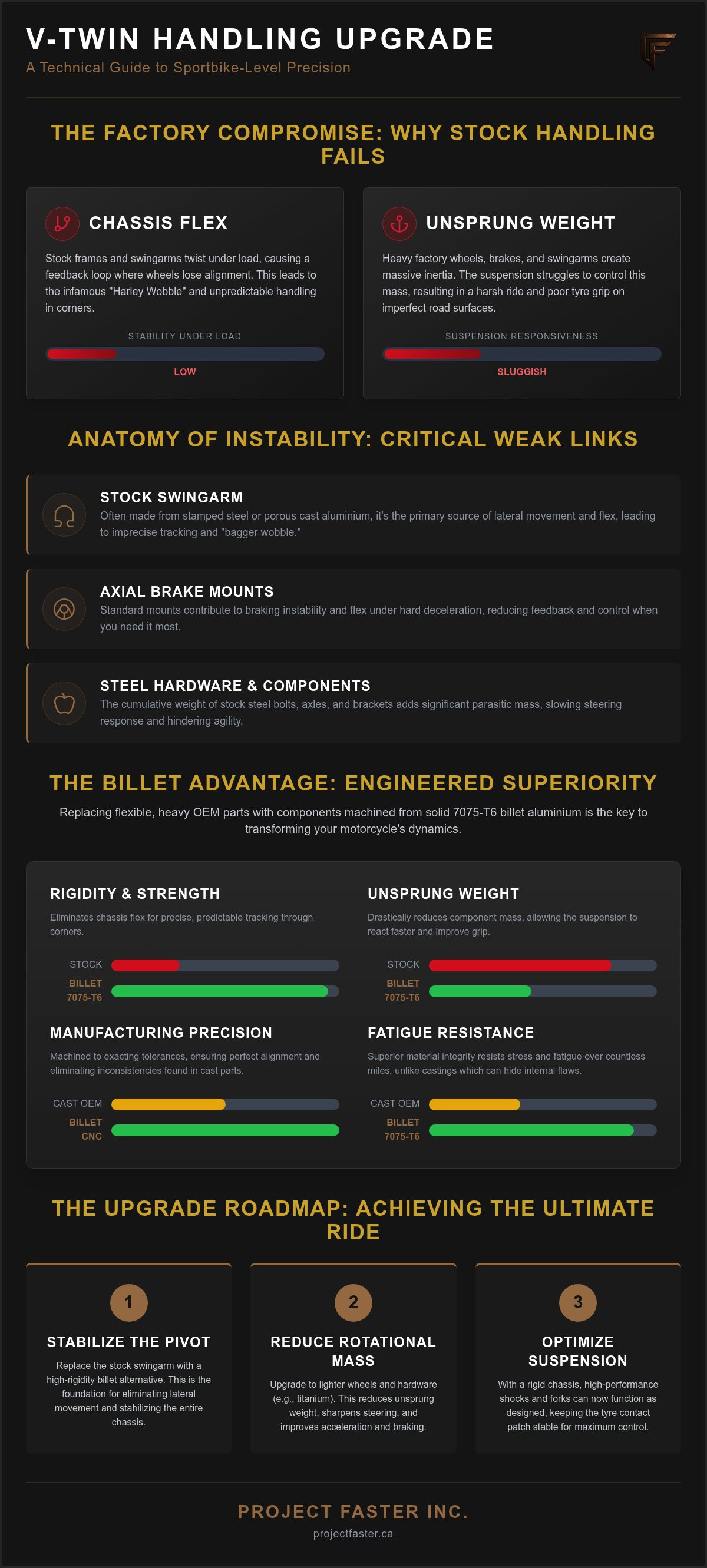
How to Execute a Comprehensive Harley Davidson Handling Upgrade
Executing a systematic Harley Davidson handling upgrade requires a logical progression from the ground up. You don't build a house on a weak foundation. The same principle applies to a high-output V-Twin chassis. While many riders attempt to solve handling issues by simply throwing expensive shocks at the rear, this often masks deeper structural problems rather than solving them. A truly engineered approach follows a five-step roadmap: establish grip, manage weight, eliminate flex, optimize braking, and reduce final unsprung mass. This sequence ensures that every new component works in harmony with the rest of the motorcycle.
Phase One: Establishing the Foundation
The technical journey begins where the machine meets the pavement. Choosing the right tyre compound is essential. Performance-oriented riders should prioritize sticky, dual-compound tyres that offer aggressive edge grip, whereas touring riders need a compound that maintains stability under heavy loads. Once the rubber is selected, you must address the suspension setup. Canadian road conditions, characterized by frost heaves and varied surfaces, require precise sag and preload settings. Aftermarket shocks are only as good as their calibration; if the sag isn't set for your specific weight, the suspension cannot operate within its optimal stroke. Before installing new hardware, always inspect the neck bearings and motor mounts. If these pivot points show signs of wear, they will introduce instability that even the finest billet parts cannot fully rectify.
Phase Two: Structural Reinforcement
Once the foundation is secure, you can move to structural upgrades. For those on 2009+ Touring models, the installation of a Mako billet swing arm is the single most effective way to eliminate the lateral movement that causes high-speed oscillation. During the installation process, precision is paramount. You must align the rear wheel with exacting standards to ensure perfectly straight tracking. Even a fraction of a millimetre of misalignment can lead to uneven tyre wear and a bike that "crabs" down the highway.
Performance isn't just about the chassis; it's about how the components interact. When selecting an exhaust, such as the PF Liberator High-HP Exhaust, engineering for lean angle is just as important as engineering for horsepower. A high-tuck design ensures that you don't scrape hard parts during aggressive cornering, allowing you to utilize the full potential of your reinforced chassis. To complete the transformation, integrate a radial mount braking system and a titanium bolt kit to minimize unsprung mass. If you are ready to begin your build, you can consult with our technical team to ensure your upgrade path is engineered for maximum results.
- Step 1: Install high-performance tyres to maximize the contact patch.
- Step 2: Upgrade rear shocks and calibrate sag for your specific riding weight.
- Step 3: Replace the flexible factory arm with a billet version to lock in rear-end tracking.
- Step 4: Transition to radial brake mounts for consistent, twist-free stopping power.
- Step 5: Swap steel hardware for titanium to allow the suspension to react with greater speed.
Engineering the Ultimate Ride: The Project Faster Standard
Project Faster Inc. approaches the Harley Davidson handling upgrade from a perspective of uncompromising mechanical integrity. We provide engineer-certified components designed and manufactured in Calgary, Alberta, specifically for riders who demand more than what a factory assembly line can offer. Our design philosophy dictates that form follows function in every billet cut. Every radius is calculated to maximize rigidity while shedding mass. This isn't just about individual parts; it's about providing a total handling solution that integrates the swingarm, radial brake arm, and titanium hardware into a cohesive system. By controlling the entire rear-end assembly, we eliminate the stack-up of tolerances that often plagues mixed-brand setups.
Combining a billet swingarm with a PF Vector 108mm Radial Mount Brake Arm and a titanium bolt kit creates a synergy that a single component cannot match. This integrated approach ensures that your braking, tracking, and suspension response are all elevated simultaneously. We realize that the Canadian performance community values real-world results over aesthetic trends. That's why our engineering process focuses on the physics of the ride, ensuring that every component contributes to a more stable, predictable, and responsive motorcycle.
The Mako and Vector Difference
The Vector Billet Swing Arm represents a significant leap for the 2018+ Softail platform, offering substantial weight savings compared to the stock unit. While the factory black-painted steel arm is functional for the average rider, the visual and structural impact of precision-machined 7075-T6 billet aluminium is undeniable. Every Project Faster component is tested to withstand high-horsepower V-Twin torque. This level of certification ensures that your chassis remains stable under the most demanding conditions. Similarly, the Mako swing arm serves as the definitive solution for Touring models, providing the stiffness needed to eliminate high-speed oscillation once and for all.
Next Steps for Your Handling Project
Riders seeking to realize their bike's true potential must look past factory limitations and embrace an engineering-first mindset. You can find the specific technical specs for all high performance Harley parts in our engineering archives. We support the Canadian performance community with national shipping and expertise rooted in manufacturing excellence. Our team understands the unique demands of Northern riders, from road surface quality to performance expectations. If you're ready to transform your machine, consult with our team to discuss your custom performance build. It's time to stop settling for the showroom standard and start riding a machine that is truly engineer-certified.
Realizing Your Machine's Engineering Potential
Achieving a superior ride requires moving beyond the limitations of factory-stamped steel and cast iron. You've learned that a true Harley Davidson handling upgrade is rooted in the elimination of chassis flex and the strategic reduction of unsprung weight. By replacing flexible stock components with our precision-machined 7075-T6 aluminium construction, you transform the bike's dynamics from a wandering cruiser into a rigid, responsive performance machine. The transition to engineer-certified Mako and Vector swingarms ensures that every ounce of torque is translated into forward motion rather than lateral oscillation.
Our commitment to technical excellence extends to our national Canadian shipping on all performance parts, ensuring you have access to elite-level hardware regardless of your location. Combining these structural reinforcements with titanium hardware and radial braking creates a chassis that finally matches the output of your engine. It's time to stop fighting the frame and start trusting the physics of your build. We realize that every rider has unique performance goals, and our components provide the necessary foundation to reach them.
If you're ready to engineer a better ride, shop the full collection of Project Faster performance components today. We look forward to helping you build the ultimate V-Twin.
Frequently Asked Questions
Will a billet swingarm really fix my Harley's high-speed wobble?
Yes, a billet swingarm addresses the structural root of the high-speed wobble by eliminating lateral flex. Stock arms are prone to twisting under torque, which creates a feedback loop of instability known as the bagger wobble. Replacing these with a rigid, 7075-T6 aluminium arm ensures the rear wheel tracks perfectly straight, even under the high-stress cornering loads that typically unsettle a factory chassis.
How much weight can I actually save with a Harley Davidson handling upgrade?
You can save a significant amount of mass by executing a comprehensive Harley Davidson handling upgrade. While exact figures depend on your specific model, replacing a factory steel or cast swingarm with a billet version and using titanium bolt kits often sheds several kilograms. This reduction in unsprung weight allows your suspension to react faster to road irregularities, providing a more composed and responsive ride.
Do I need to be a professional racer to feel the difference in a billet swingarm?
You don't need to be a professional racer to notice the immediate improvement in chassis composure. Even during standard highway cruising or navigating local backroads, the increased rigidity of a billet swingarm removes the vague or mushy feeling often associated with stock V-Twin frames. The bike feels more planted and predictable in every manoeuvre, regardless of your skill level or riding environment.
Are titanium bolt kits safe for high-stress areas like the axle or motor mounts?
High-grade titanium hardware is specifically engineered to handle the loads found in high-stress areas like axles and motor mounts. It provides the tensile strength of steel at nearly half the weight. This makes it an ideal choice for critical pivot points where reducing rotational and unsprung mass is a priority without compromising the mechanical safety or structural integrity of the motorcycle.
Can I install a Project Faster swingarm myself, or do I need a specialist shop?
Installation is feasible for an experienced mechanic with a comprehensive tool kit and a factory service manual. However, we recommend professional installation at a specialist shop to ensure perfect wheel alignment and torque specifications. Precise alignment is critical to maximizing the performance benefits of a high-rigidity chassis component and ensuring the bike tracks perfectly straight at high speeds.
How does reducing unsprung weight affect my bike's tyre life?
Reducing unsprung weight generally extends tyre life by improving the consistency of the contact patch. When the suspension can react faster to road imperfections, the tyre spends less time skipping or sliding over bumps. This leads to more even wear patterns and reduces the localized heat buildup that typically accelerates rubber degradation during aggressive riding or long-distance touring.
Is 7075 aluminium really better than the aluminium used in OEM parts?
7075-T6 aluminium is significantly superior to the lower-grade 6061 or cast alloys found in OEM parts. It is an aerospace-grade material with nearly double the tensile strength of standard aluminium. This allows for the engineering of components that are thinner and lighter while maintaining a level of rigidity that cast parts cannot match, effectively eliminating the flex that compromises handling.
Will these handling upgrades affect my Harley's factory warranty in Canada?
Aftermarket upgrades typically do not void your entire factory warranty in Canada due to existing consumer protection standards. A dealer must prove that the specific modification directly caused a failure to deny a warranty claim. We suggest consulting with your local service department to understand how they view performance chassis modifications regarding your specific coverage and maintenance schedule.