

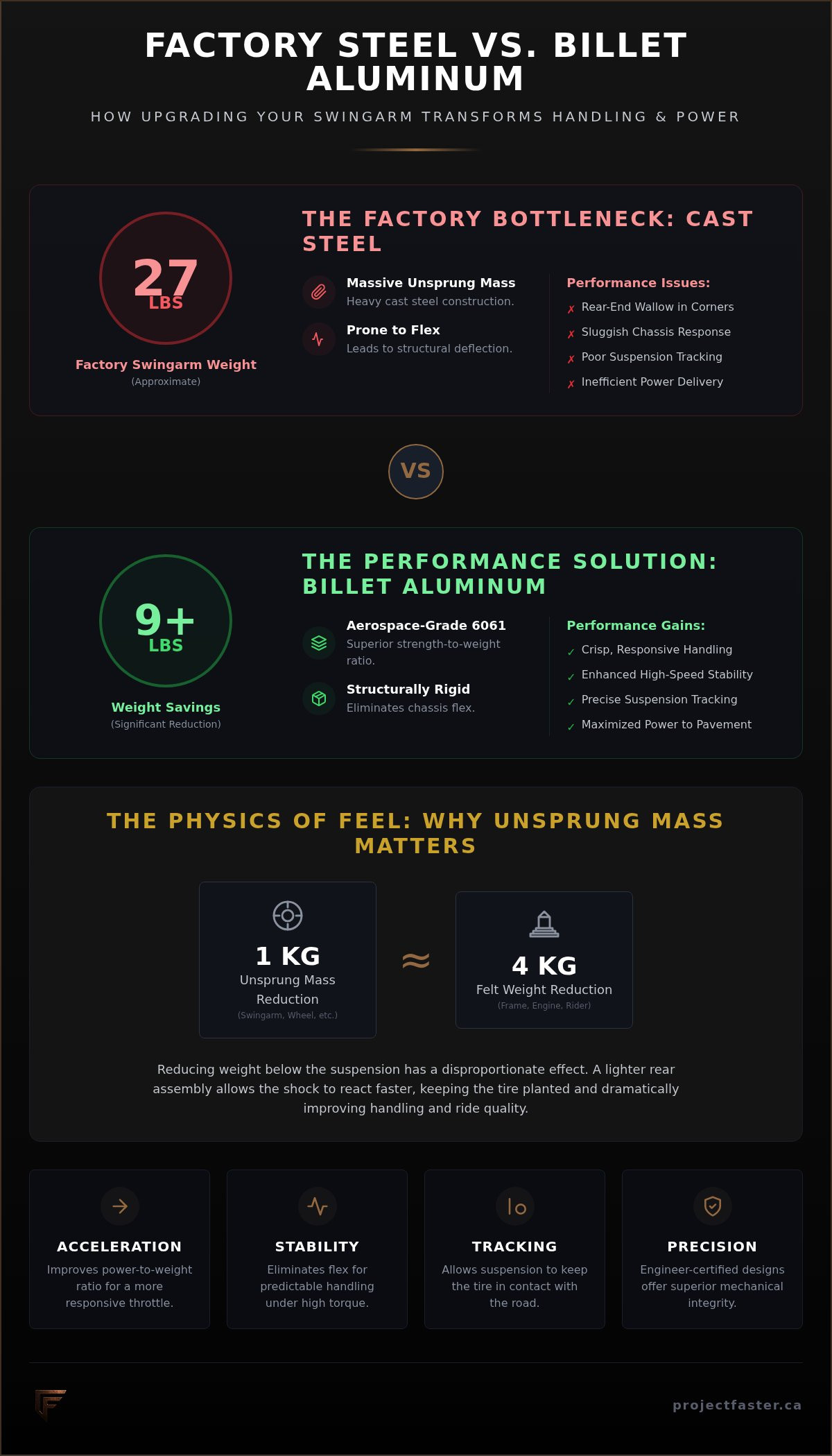
A factory steel swingarm on a modern bagger can weigh nearly 27 pounds, creating a massive amount of unsprung mass that your suspension must fight every time you hit a bump. Most riders accept rear-end wallow or a sluggish chassis as an unavoidable trade-off for the V-twin experience. You've likely felt that unsettling flex during an aggressive corner or noticed how slowly the rear wheel reacts to road irregularities. Realizing the physics behind billet swingarm weight savings is the first step toward reclaiming your bike's handling potential. Reducing this critical mass through precision engineering transforms how your motorcycle tracks, stabilizes, and delivers power to the pavement.
This article explores how replacing heavy cast components with aerospace-grade 6061 aluminum eliminates structural deflection and optimizes suspension frequency. You'll discover how a more rigid, lighter chassis allows for crisper handling and a superior power-to-weight ratio. We'll break down the engineering that turns a heavy, sluggish rear end into a high-performance system that organizes power more effectively and provides the stability required for high-torque applications.
Key Takeaways
- Learn why reducing unsprung mass is the critical factor in allowing your rear shock to track road irregularities with precision.
- Compare the mechanical properties of 6061 aluminum to factory steel to understand how to eliminate lateral chassis flex.
- Discover how billet swingarm weight savings directly improve your bike's power-to-weight ratio for more responsive acceleration.
- Identify the structural advantages of CNC-machined components in preventing the rear-end wallow common in high-torque V-twin applications.
- Learn to recognize the value of engineer-certified designs that maintain factory fitment while offering superior mechanical integrity.
The Evolution of the Performance Bagger: Why Weight Savings Matter
The V-twin landscape has undergone a fundamental transformation. For decades, the bagger market prioritized aesthetic flair and chrome-plated accessories above all else. Today, the focus has shifted toward performance-first engineering. This "Performance Bagger" movement, heavily influenced by professional racing series like King of the Baggers, demands components that survive high-speed stress and aggressive lean angles. At the centre of this evolution is the realization that factory components often limit the bike's potential. To build a machine that handles as well as it looks, riders are looking toward the chassis, specifically the swingarm, to find significant performance gains.
The swingarm is the primary link between the motorcycle's frame and the rear wheel. It's responsible for translating engine torque into forward motion while managing the lateral forces generated during cornering. When this component is too heavy or lacks rigidity, the entire handling dynamic suffers. Achieving billet swingarm weight savings is a critical step in optimizing this relationship. By reducing the mass of the largest moving part of the chassis, you improve the power-to-weight ratio and allow the bike to react to rider inputs with far greater precision.
The Problem with Factory Cast Steel
Factory swingarms are products of mass production efficiency. While functional for casual cruising, stamped or cast steel units lack the structural integrity required for high-performance riding. These components are prone to lateral flex and structural deflection, especially when subjected to the high torque of a modified M8 or Twin Cam engine. This deflection often manifests as a vague, unsettling sensation in the rear end during high-speed cornering, commonly known as "rear-end wallow." It's a mechanical bottleneck that prevents the suspension from tracking the road accurately, regardless of how expensive your rear shocks are.
Defining Billet Excellence
Transitioning to a billet component means moving from a cast part to one machined from a solid block of high-grade material. For the rider, this translates to unmatched precision. CNC machining allows for incredibly tight tolerances that mass-produced parts simply cannot achieve. By using aerospace-grade 6061 aluminum, manufacturers can create a part that is both stronger and significantly lighter than the factory equivalent. Realizing billet swingarm weight savings isn't just about the number on the scale; it's about shifting the bike's balance to favour agility and stability. For those looking to eliminate factory limitations, the Mako billet swingarm or the Vector billet swingarm provides the structural rigidity necessary for modern performance builds.
The Physics of Unsprung Mass: How Lighter Swingarms Transform Handling
Understanding the distinction between sprung and unsprung mass is fundamental to high-performance tuning. Sprung mass includes everything supported by the suspension, such as the frame, engine, and rider. Unsprung mass refers to the components below the springs, including the wheels, brakes, and the swingarm itself. In the world of V-twin dynamics, billet swingarm weight savings are uniquely impactful because unsprung weight has a disproportionate effect on handling. Engineering data suggests that reducing one kilogram of unsprung mass can feel equivalent to removing four kilograms from the frame. This occurs because the suspension doesn't have to work as hard to control the momentum of a lighter assembly.
When you hit a bump, the rear wheel must move upward and then return to the ground as quickly as possible. A heavy factory steel arm has significant inertia, meaning it resists these changes in direction. This resistance leads to suspension "chatter," where the wheel loses contact with the pavement because it cannot react fast enough to road irregularities. By trimming several pounds off the rear assembly, you improve the suspension frequency. The shock absorber can manage the wheel's movement with far greater precision, ensuring the tire stays planted rather than skipping across the surface.
Improving Suspension Frequency and Tracking
Reducing the weight of the swingarm specifically lowers the "moment of inertia" around the pivot point. This allows the rear wheel to track the terrain with surgical accuracy. In mid-corner bumps, a lighter arm prevents the "skating" sensation that often occurs when a heavy rear end becomes unsettled. The result is a more predictable, planted feel that gives the rider confidence to maintain lean angle through rough patches of asphalt. Every gram removed from the axle end of the arm allows the suspension to react with more speed and less mechanical resistance.
Power Delivery and Torque Control
A lightweight swingarm must also be incredibly rigid to manage the massive torque of a performance V-twin. If the arm is light but flexible, it will "wind up" or twist under hard acceleration, causing the rear wheel to steer the bike from the back. Billet construction ensures that the wheel stays perfectly perpendicular to the chassis under load. This maximizes traction and ensures every horsepower is used for forward momentum rather than overcoming chassis deflection. If you have specific questions about how these physics apply to your particular build, you can consult with our engineering team to find the right solution.
Material Science: Billet Aluminum vs. Factory Cast Steel
Mechanical performance begins with the raw material. Most factory motorcycles utilize mild steel for their swingarms because it is inexpensive to manufacture and easy to stamp in high volumes. However, steel is dense and heavy, creating a significant performance ceiling. When you transition to a precision-engineered component, you are moving to 6061-T6 aluminum, an aerospace-grade material known for its exceptional strength-to-weight ratio. While mild steel and 6061-T6 aluminum may share similar yield strengths, aluminum is roughly one-third the density of steel. This allows engineers to use more material to increase rigidity while still achieving substantial weight reduction.
The primary driver for many riders is the desire for billet swingarm weight savings, but this reduction in mass is only viable if the material can withstand the extreme fatigue of V-twin vibration. Aerospace materials are specifically chosen for their ability to resist stress fractures over long-term use. By utilizing a material that is naturally resistant to corrosion and fatigue, the chassis remains stable under the high torque loads produced by modern performance engines. This ensures that the structural integrity of the bike is never compromised for the sake of lightness.
The Grain Flow Advantage
The term "billet" refers to a solid, uniform block of metal. Unlike cast components, which are formed by pouring molten metal into a mould, billet retains a consistent grain structure. Casting often introduces internal porosity, which are microscopic air bubbles or voids that create hidden weak spots within the metal. CNC machining from a solid billet preserves the internal grain flow, ensuring that the finished part is as strong as the original block. The T6 heat treatment further optimizes this structure, providing a level of durability that stamped steel cannot match. Because the material remains solid throughout the manufacturing process, the resulting component is predictable and reliable under extreme racing conditions.
Weight Efficiency and Design Optimization
Modern CNC technology allows for strategic design optimization that is impossible with stamped steel. By utilizing complex pocketing and internal ribbing, engineers can remove material from low-stress areas while reinforcing high-load zones. This process is where billet swingarm weight savings are truly realized. You aren't just removing weight; you are redistributing strength. A well-designed aluminum arm can be significantly stiffer than a steel arm while weighing five to ten pounds less. This rigidity prevents the twisting and lateral flex that leads to rear-wheel steering. For a deeper look at these design principles, read our guide on Engineering Excellence: 2018+ Softail Billet Swingarms. This methodical approach to material removal ensures that every gram of weight left on the bike serves a specific structural purpose.
Beyond the Scale: Structural Rigidity and Power Delivery
Weight reduction is only half of the engineering equation. If a component is light but lacks structural integrity, it will ultimately fail under the stress of high-performance riding. True billet swingarm weight savings must be accompanied by a significant increase in torsional stiffness. A rigid rear end ensures that the energy produced by the engine is converted directly into forward thrust rather than being absorbed by chassis flex. This mechanical efficiency is what separates a standard cruiser from a precision-tuned performance machine.
Beyond handling, rigidity preserves your drivetrain. When a factory swingarm twists under load, it forces the drive belt and wheel bearings out of alignment. This misalignment increases friction and heat, leading to premature wear or catastrophic belt failure during aggressive acceleration. A billet upgrade keeps these components perfectly squared to the chassis. This ensures consistent power delivery and extends the life of your hardware, even when subjected to extreme racing conditions.
Eliminating Chassis Flex
The "wallower" effect is a common complaint among owners of heavy factory baggers. This unsettling oscillation occurs when the rear end flexes mid-corner, creating a disconnect between rider input and machine response. Upgrading to a billet assembly stabilizes the entire motorcycle platform. It provides the confidence-inspiring feedback required to push the bike to its mechanical limits. You will feel exactly what the rear tire is doing, allowing for more precise throttle control and smoother corner exits without the vague sensation of a shifting chassis.
High-HP Applications and Reliability
For those running turbochargers or big-bore kits, a factory swingarm is a significant liability. Massive torque loads can physically warp stamped steel components over time, leading to permanent structural damage. Upgrading to an engineer-certified billet arm is essential for maintaining reliability in high-horsepower builds. The reduction in mass also contributes to faster acceleration times by decreasing the rotational inertia the engine must overcome. To learn more about the technical standards required for these builds, explore our guide on High Performance Harley Parts: The Engineering Behind V-Twin Excellence.
If you're planning a high-output build and need a chassis that can handle the power, reach out to our engineering team for a technical consultation on your specific requirements.
Engineering Your Build: Selecting the Right Billet Components
Selecting a swingarm is a critical decision that dictates the safety and structural integrity of your motorcycle. It is not enough to simply find the lightest part available; the component must be engineer-certified to handle the dynamic loads of a high-performance V-twin. Many aftermarket options prioritize visual appeal over mechanical verification, which can lead to catastrophic failure under stress. Choosing an engineer-certified design ensures that the part has undergone rigorous finite element analysis to guarantee it survives extreme conditions. This professional validation is the only way to ensure your performance gains don't come at the expense of reliability.
Compatibility is another vital factor for any serious builder. A high-quality billet arm should serve as a direct replacement for factory units, utilizing existing pivot points and mounting locations without requiring permanent modifications to the frame. The Mako Billet Swing Arm has become the gold standard for 2009 and newer Touring models because it balances these requirements perfectly. It delivers the billet swingarm weight savings riders demand while maintaining the robust fitment necessary for heavy bagger applications. Using the included high-strength hardware ensures that the assembly remains secure even under the most aggressive riding styles.
The Vector Billet Swing Arm for Softails
The 2018 and newer Softail platform requires a specialized approach due to its unique monoshock chassis design. The Vector Billet Swing Arm is engineered specifically to improve M8 handling by reducing flex at both the pivot and the shock mounts. This upgrade transforms the Softail's tracking capability, especially during high-speed transitions where factory components often feel vague. Installation is straightforward because these arms are designed to work with factory hardware, ensuring a seamless transition from heavy cast steel to precision-machined aluminum. It's a foundational upgrade for any Milwaukee-Eight build focused on agility.
Holistic Weight Savings: Titanium and Beyond
Achieving peak performance requires a holistic view of the unsprung assembly. While the swingarm provides the largest single reduction in mass, smaller components contribute to the cumulative effect. Pairing your build with Titanium bolt kits allows you to shed additional grams from critical areas like the axle and brake mounts. These incremental gains further enhance the billet swingarm weight savings, resulting in a rear end that reacts with lightning speed to every road input. When you combine a lighter swingarm with titanium fasteners, you are creating a chassis that is fundamentally faster, more stable, and more responsive to your commands.
Optimizing Your Chassis for Elite Performance
Engineering excellence is the foundation of every high-performance build. Reducing unsprung mass through billet swingarm weight savings is a fundamental step in optimizing suspension frequency and ensuring your tires remain planted during aggressive cornering. By transitioning from factory cast steel to aerospace-grade 6061 aluminum, you eliminate the lateral flex that causes rear-end wallow and unpredictable handling. This structural rigidity is essential for translating engine torque into forward momentum without mechanical loss.
Every Project Faster component is engineer-certified for structural reliability and specifically tested to withstand the extreme stress of high-performance V-twins. Whether you are building a high-speed touring machine or a high-horsepower Softail, upgrading your swingarm provides the mechanical integrity needed for a stable, responsive ride. You don't have to settle for the sluggish feeling of mass-produced components when precision-engineered solutions are available.
If you're ready to transform your motorcycle's handling and power delivery, Shop Project Faster Billet Swingarms and Engineering-Grade Parts to consult with our experts. Your machine deserves the precision of professional engineering.
Frequently Asked Questions
How much weight does a billet swingarm actually save compared to stock?
A high-quality billet swingarm typically reduces weight by 20% to 25% compared to the factory cast steel unit. For instance, a stock Softail swingarm weighs approximately 26.8 pounds, while a performance billet version can drop that mass to 20 pounds. These billet swingarm weight savings represent a significant reduction in unsprung mass, allowing the rear assembly to react with much less mechanical inertia during high-speed transitions.
Can a lighter swingarm really improve my motorcycle’s handling?
Reducing unsprung weight directly improves handling by allowing the rear tire to track the road surface more accurately. Because the suspension has less mass to move, it can respond to bumps and irregularities with greater speed and precision. This prevents the tire from skipping or chattering over rough pavement, resulting in a more planted and predictable feel during aggressive cornering or heavy acceleration.
Is an aluminum billet swingarm as strong as the original steel one?
Yes, an aerospace-grade 6061-T6 aluminum swingarm is engineered to meet or exceed the structural integrity of the original steel component. While steel is denser, the precision machining of a solid billet block eliminates the internal porosity and hidden weak spots often found in cast or stamped factory parts. The result is a component that provides superior torsional rigidity and resists fatigue better than mass-produced steel units.
Do I need to upgrade my suspension if I install a lighter swingarm?
You don't strictly need to upgrade your shocks, but a lighter swingarm makes your existing suspension work far more efficiently. Since the dampers are now controlling less mass, you may find that your current settings feel slightly firmer or more responsive. Many riders choose to re-adjust their rebound and compression damping to fully capitalize on the increased frequency and tracking speed of the lighter rear assembly.
What is the difference between 6061 and 7075 aluminum for swingarms?
6061 aluminum is the industry standard for swingarms due to its excellent balance of strength, corrosion resistance, and structural reliability. While 7075 aluminum offers higher tensile strength, it is more susceptible to stress corrosion cracking and is more difficult to finish for long-term durability. For the high-vibration environment of a V-twin motorcycle, 6061-T6 provides the necessary toughness and reliability for high-stress applications.
How does unsprung mass affect my bike’s acceleration?
Unsprung mass affects acceleration by improving the power-to-weight ratio and reducing the energy required to move the rear assembly. Every pound removed from the swingarm allows the engine to translate torque into forward motion more efficiently. This reduction in mass contributes to crisper throttle response and faster acceleration times, particularly in high-torque builds where the engine must overcome the inertia of heavy factory components.
Is a billet swingarm a direct bolt-on replacement for my Harley?
Most performance billet swingarms, including the Mako and Vector models, are designed as direct bolt-on replacements for factory hardware. They utilize the original pivot points and mounting locations to ensure a precise fit without the need for permanent frame modifications. This allows for a streamlined installation process while maintaining the mechanical integrity and geometry of the motorcycle's original chassis design.
Why is engineer certification important for aftermarket motorcycle parts?
Engineer certification is vital because it guarantees the part has been verified through rigorous structural analysis and finite element testing. Aftermarket components are subject to extreme loads, and certification ensures that the design can handle these forces without catastrophic failure. For high-performance riders, this provides the necessary assurance that their billet swingarm weight savings are backed by professional validation and structural safety standards.