

A 150-horsepower engine is a mechanical liability if your chassis treats torque like a suggestion. For many performance enthusiasts, Turbo Harleys represent the absolute pinnacle of V-Twin power, yet these builds often become unmanageable because the stock frame and components weren't designed to withstand triple-digit torque loads. You've likely experienced the unsettling chassis flex or the localized heat soak that occurs when pushing a high-boost setup to its limit.
It's a common frustration to see a high-dollar engine build held back by inferior materials and unstable handling. We realize that true performance isn't just about the turbocharger; it's about the engineering required to stabilize that power. This article explores the essential hardware upgrades needed to build a high-horsepower machine that handles as well as it accelerates. We will examine how to eliminate mechanical weaknesses through precision-engineered swing arms and high-flow exhaust systems to ensure your motorcycle remains stable and predictable at high speeds.
Key Takeaways
- Understand why modern builders are prioritizing forced induction over traditional big-bore kits to achieve superior volumetric efficiency in 2026.
- Learn how to stabilize Turbo Harleys by replacing flexible stock components with CNC-machined billet hardware that eliminates chassis twist under extreme torque.
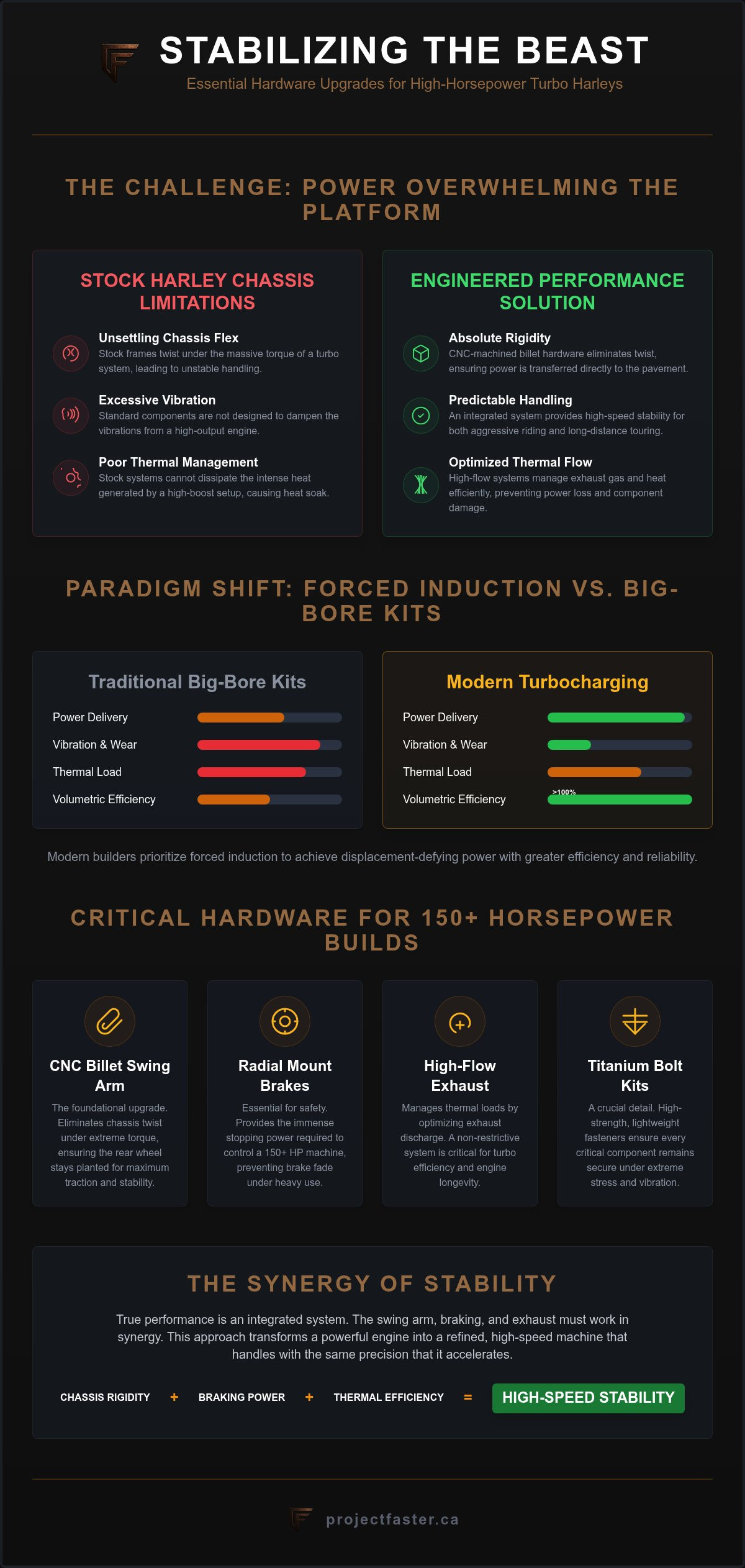
- Identify the critical supporting hardware, including radial mount brakes and titanium bolt kits, required to safely manage 150+ horsepower.
- Discover why high-flow exhaust systems are essential for managing thermal loads and optimizing discharge in a turbocharged V-Twin environment.
- Realize the importance of an integrated engineering approach where the swing arm, braking, and exhaust systems work in synergy to maintain high-speed stability.
The Evolution of Turbo Harleys: From Custom Projects to Performance Standards
Turbo Harleys represent a fundamental shift in how we extract elite power from the V-Twin platform. Historically, forced induction was reserved for drag strips and experimental custom builds; however, the landscape in 2026 has changed significantly. A modern Turbo Harley is defined as a machine that utilizes exhaust-driven forced induction to bypass the physical displacement limits of the engine block. By compressing the intake charge, builders can achieve power levels that were previously impossible without compromising the structural integrity of the crankcase or cylinders.
The industry is currently moving away from traditional big-bore kits for high-performance 2026 builds. While massive pistons can increase torque, they often introduce excessive vibration and heat, which accelerates component wear. In contrast, turbocharging allows for a smaller, more stable engine displacement to produce upwards of 150 horsepower with greater efficiency. Harley-Davidson's North American retail sales increased by 3% in the second quarter of 2026, a growth driven partly by the rising demand for "Performance Bagger" and "Performance Softail" configurations. In the Canadian performance scene, riders are prioritizing functional superiority over aesthetic chrome, favouring builds that can handle long-distance touring and aggressive canyon carving with equal competence.
Reliability is no longer the hurdle it once was for forced induction. Sophisticated electronic fuel injection (EFI) and modern tuning platforms have made turbocharging a dependable reality for daily riders. We can now precisely manage fuel maps and ignition timing to ensure the engine remains safe under boost. This evolution has transformed Turbo Harleys from temperamental garage projects into refined, high-speed machines capable of cross-country travel. To support this level of output, riders often look to our full collection of performance hardware to ensure the chassis can keep up with the drivetrain.
The Appeal of Forced Induction on V-Twin Platforms
The primary draw of a turbocharger is the linear torque curve it provides. Unlike naturally aspirated engines that may feel sluggish at certain RPMs, a turbo setup delivers a consistent surge of power as boost builds. This creates a "sleeper" factor; you get massive power output without the bone-shaking vibration of oversized pistons. It also maintains excellent rideability at low RPMs, allowing the bike to remain docile in traffic while offering explosive acceleration on the open highway. Many riders realize that this balance of fuel efficiency and peak performance is unattainable through traditional motor work alone.
Key Components of a Modern Turbo System
A successful build requires a deep understanding of How Turbochargers Work within the unique constraints of a V-Twin. The system relies on a compressor to force air into the cylinders and a turbine powered by exhaust gases to drive that compressor. Intercooling is particularly critical for the Canadian climate, as it manages intake air temperatures during hot summer rides to prevent detonation. Wastegates and blow-off valves act as the precision controllers of this system, regulating boost pressure to ensure power delivery is smooth rather than erratic. Without these high-quality components, the increased cylinder pressure would quickly find the weakest link in your mechanical assembly.
The Mechanics of Boost: How Turbocharging Transforms Harley Performance
Boost changes the fundamental physics of the V-Twin engine by forcing air into the combustion chamber at pressures higher than atmospheric levels. In a naturally aspirated engine, volumetric efficiency is limited by the vacuum created during the intake stroke. Turbo Harleys bypass this limitation, achieving volumetric efficiency levels well over 100% by using a compressor to pack more oxygen into the cylinders. This process allows a standard Milwaukee-Eight (M8) or Twin Cam engine to produce power that rivalled the output of dedicated race engines just a decade ago. It's a method of achieving displacement-defying power without the mechanical vibration of oversized pistons.
Selecting the correct compression ratio is a critical decision for any turbo build. While higher compression ratios offer better off-boost throttle response, they significantly narrow the tuning window and increase the risk of detonation under load. Most reliable high-horsepower builds utilize a static compression ratio between 9.5:1 and 10.5:1. This range provides a safe buffer for Canadian riders using pump fuel while still allowing the turbo to generate massive torque. Managing this power requires a deep understanding of thermal dynamics; turbochargers generate immense heat that must be mitigated through shielding and ceramic coatings to protect both the rider and the electrical loom.
Tuning is the final, most essential step in the forced induction process. Standard base maps are insufficient for the variables introduced by boost. High-performance builds require custom wide-band oxygen sensor setups that provide real-time data to the ECM. This ensures the air-fuel ratio remains optimal even as ambient temperatures and altitudes change. If you're planning a build and need technical advice on component compatibility, reach out to our engineering team for a consultation on your specific performance goals.
M8 vs. Twin Cam: Turbocharged Considerations
The Milwaukee-Eight platform is particularly well-suited for turbocharging due to its four-valve cylinder heads. These heads facilitate superior scavenging, allowing exhaust gases to exit more efficiently and spool the turbo faster. Twin Cam owners, however, must pay closer attention to the oiling system. The Twin Cam requires high-volume oil pumps to ensure the turbocharger bearing receives constant lubrication without starving the rest of the engine. While the M8 crankcase is structurally more robust, both platforms benefit from upgraded fasteners to prevent case stretching under high cylinder pressures.
Exhaust Flow and Turbo Efficiency
Backpressure is the primary obstacle to turbocharger performance. For the turbine to function at peak efficiency, the exhaust system must allow gases to exit with minimal resistance while maintaining high velocity. The PF Liberator High-HP Exhaust optimizes exhaust gas velocity to reduce lag and maximize boost response across the entire powerband. This efficiency ensures that the engine isn't fighting its own exhaust, which is a common failure point in poorly designed turbo kits. As we increase these speeds, we must also consider how we slow down; Modern Motorcycle Braking Technology highlights the necessity of upgrading your stopping power to match your new-found acceleration.
Overcoming Chassis Flex: Why Rigidity is Critical for Turbo Harleys
Excessive boost translates directly into lateral stress. While the engine generates the power, the chassis must manage the resulting torque loads. In many high-output Turbo Harleys, the stock swing arm becomes the weakest link, leading to a phenomenon known as the "Noodle Effect." This occurs when the thin-walled, cast aluminum or steel factory component twists under the massive torque of a turbocharged V-Twin. This torsion causes the rear wheel to track inconsistently, which creates a terrifying sensation of instability during hard acceleration or high-speed cornering.
Precision engineering is the only solution to this mechanical deficiency. There is a profound difference between a mass-produced cast part and a component CNC-machined from a solid block of billet aluminum. Castings are inherently porous and prone to microscopic stress fractures when subjected to the 150+ lb-ft of torque common in turbo builds. We utilize 7075-T6 aluminum because it is the gold standard for high-stress applications; it offers a tensile strength that rivals many steel alloys while remaining significantly lighter. By switching to a billet setup, you realize a dramatic increase in rigidity that ensures every horsepower is directed toward forward momentum rather than chassis distortion.
Weight savings also play a pivotal role in handling. Reducing unsprung weight, the mass not supported by the suspension, allows the rear shock to react faster to road imperfections. This is essential for maintaining tire contact at the high speeds these bikes reach. A lighter, stiffer rear end improves suspension response, providing a more planted feel that allows the rider to actually use the boost they have paid for. Without these upgrades, a turbo build is simply a fast engine in a slow chassis.
The Engineering of Billet Swing Arms
The PF Mako Billet Swing Arm is designed specifically to address the stability issues inherent in heavy Touring models. Its rigidity-to-weight ratio is engineered to eliminate high-speed wobbles by providing a rock-solid foundation for the rear axle. Because these designs are engineer-certified, they offer a level of safety and precision that far exceeds aftermarket aesthetic pieces. A rigid swing arm ensures that the rear end tracks perfectly behind the front wheel, even under peak boost.
Softail vs. Touring: Chassis Stabilization Strategies
The 2018+ Softail frame presents unique flex points, particularly where the swing arm connects to the monoshock pivot. For these high-torque applications, the Vector Billet Swing Arm is essential to prevent the frame from "winding up" under load. This system improves the centre of gravity through the use of precision-aligned rear axle blocks, which keep the drivetrain in perfect alignment. This level of mechanical integrity is what separates a dangerous garage build from a professional-grade performance machine.
Supporting Hardware: Brakes, Bolts, and Driveline Integration
Acceleration is only one half of the performance equation. When building Turbo Harleys, many riders focus exclusively on the intake side of the engine while neglecting the mechanical systems required to manage that velocity. A machine capable of reaching high speeds in a fraction of the stock time demands a proportional increase in stopping power and structural integrity. Without these supporting upgrades, you're essentially piloting a vehicle that has outpaced its own safety margins. High-horsepower performance requires a holistic approach where every component is rated for the increased load.
Transferring massive torque from the crankshaft to the rear tire requires more than just a stock primary drive. High-output builds often suffer from clutch slip or compensator failure because factory components are designed for a fraction of the turbo's output. Upgrading to a heavy-duty clutch pack and a reinforced primary chain is mandatory to ensure power delivery remains consistent. Similarly, high-performance suspension is required to control the aggressive squat that occurs when boost hits, keeping the chassis level and the tire planted. This synergy between the drivetrain and the suspension is what allows the bike to remain predictable under load.
Radial Mount Braking for High-Speed Control
The physics of braking change dramatically when you've doubled your engine's output. Axial-mount calipers, common on many factory models, often suffer from deflection under heavy load. This results in a spongy lever feel and reduced stopping efficiency. Radial mount systems are secured at both ends of the caliper, which significantly reduces flex and provides a more consistent, linear response. Integrating the PF Vector 108mm Radial Mount Brake Arm allows for maximum rigidity and superior heat dissipation. This setup ensures that your braking performance remains stable even during repeated high-speed decelerations where thermal energy would otherwise cause brake fade.
Titanium Fasteners and Weight Optimization
Mechanical failure points often occur at the smallest links in the chain. Replacing stock fasteners with titanium bolt kits is a strategic engineering decision rather than a cosmetic one. Grade 5 titanium offers a superior strength-to-weight ratio compared to steel, providing high tensile strength while reducing rotational mass and unsprung weight. This reduction in weight improves the bike's flickability and suspension response, allowing the motorcycle to feel more agile despite the added weight of the turbo system. Additionally, the natural corrosion resistance of titanium ensures that critical fasteners maintain their structural integrity in harsh Canadian environments.
Building a balanced, high-performance machine requires attention to every individual component. If you're ready to eliminate the mechanical weaknesses in your V-Twin platform, contact our specialists today to discuss a comprehensive hardware strategy for your build.
Building Your Turbo Harley: The Project Faster Inc. Engineering Approach
A turbocharger is a catalyst, not a complete solution. While many aftermarket providers sell kits as standalone power fixes, Project Faster Inc. realizes that a high-output engine is only as effective as the chassis supporting it. Building Turbo Harleys that survive the transition from the dyno to the street requires a holistic understanding of how increased torque affects every mechanical interface on the motorcycle. We don't just aim for high numbers; we aim for functional superiority by ensuring every component is rated for the increased load.
The true performance of a build comes from the synergy between specialized hardware. Having already discussed the role of the Mako swing arm in preventing chassis twist and the PF Liberator exhaust in managing discharge velocity, we see how these parts work in tandem. When you add the Vector braking system and titanium fasteners into this equation, you create a motorcycle that remains composed under extreme stress. This integrated strategy eliminates the mechanical bottlenecks that often plague forced induction projects, ensuring that the power delivery is predictable rather than erratic.
Engineering for the Canadian rider introduces unique challenges regarding material science and durability. The components manufactured by Project Faster Inc. are designed to maintain precision tolerances across the extreme temperature shifts found in the Canadian climate. Whether you're dealing with the high heat of a summer tour or the cooling requirements of a damp coastal ride, our hardware remains stable. When planning your next steps, we suggest consulting with engineers who understand the physics of the V-Twin platform rather than relying on marketing experts who focus only on peak horsepower figures.
Planning Your High-Performance V-Twin Build
Success begins with clearly defining your power goals. There is a significant difference between streetable reliability and a build designed for drag strip dominance. A street-focused machine requires a broader powerband and more aggressive heat management to handle traffic and long-distance travel. It's also vital to budget for the total build rather than just the turbo kit itself. You must account for the primary drive, suspension, and chassis stabilization components required to handle 150+ horsepower. Selecting an experienced builder who understands chassis dynamics is just as important as choosing the right tuner.
The Project Faster Inc. Advantage
Our commitment to engineering excellence is rooted in our use of 7075-T6 aluminum and precision CNC manufacturing. This material choice ensures that every part Project Faster Inc. produces offers maximum strength with minimal weight. Every component is tested and engineer-certified to guarantee it can withstand the mechanical stresses of a high-boost environment. We don't settle for "good enough" because we know that at high speeds, there is no room for component failure. To begin the process of stabilizing your high-output build, Shop all high-performance Harley parts to find the hardware your project requires.
Mastering the Physics of High-Boost Performance
Building a machine that produces 150+ horsepower requires more than a bolt-on kit. We've established that the chassis must be rigid enough to handle the torque, and the braking system must be powerful enough to manage the speed. True performance is found in the synergy of engineer-certified designs and superior materials science. By utilizing precision CNC machined 7075-T6 aluminum, you eliminate the mechanical flex that compromises the safety and handling of high-output Turbo Harleys. This engineering-first approach ensures that your motorcycle remains stable during aggressive acceleration.
Reliability on the road comes from addressing every potential failure point before it occurs. Whether you're upgrading your driveline or installing titanium hardware to reduce unsprung mass, every decision should be driven by technical data. Project Faster Inc. provides national Canadian shipping to ensure builders across the country have access to elite-level components. If you're ready to stabilize your build and realize its full potential, Engineered for Performance: Shop Project Faster Inc. Billet Swing Arms. Your pursuit of uncompromising performance starts with a foundation of mechanical integrity.
Frequently Asked Questions
Are turbo Harleys reliable for long-distance touring?
Yes, Turbo Harleys can be exceptionally reliable for long-distance touring provided they are engineered with a focus on thermal management and conservative boost levels. Modern electronic fuel injection (EFI) systems allow the motorcycle to maintain consistent performance across varying altitudes and temperatures by adjusting fuel maps in real-time. Ensuring the build includes high-quality supporting hardware, such as a high-flow exhaust, prevents the heat soak issues that historically plagued forced induction V-Twins.
How much horsepower can a stock Harley engine handle with a turbo?
A stock Milwaukee-Eight or Twin Cam engine typically manages between 120 and 150 horsepower reliably under boost. While the bottom end is robust, pushing past the 150-horsepower mark often necessitates internal upgrades like forged pistons and high-strength fasteners to prevent mechanical failure. The limiting factor is usually the physical strength of the stock connecting rods and the head bolts rather than the turbocharger's capacity itself.
Do I need to upgrade my swing arm if I install a turbo kit?
Upgrading to a billet swing arm is mandatory for any build exceeding 120 horsepower to ensure chassis stability and rider safety. The stock swing arm is a known flex point that can twist under the extreme torque generated by a turbocharger, causing the rear wheel to track inconsistently. A precision-engineered billet replacement provides the rigidity required to keep the motorcycle planted and predictable during high-speed acceleration on the highway.
What is the difference between a turbo and a supercharger for a Harley?
The primary difference lies in how the compressor is driven; a turbocharger utilizes waste exhaust energy while a supercharger is mechanically driven by the crankshaft. Turbo Harleys generally offer higher volumetric efficiency and greater peak power potential for V-Twin engines. However, they require more sophisticated exhaust management and plumbing to handle the increased thermal loads compared to a belt-driven supercharger system.
How does a turbo affect the sound of a Harley-Davidson?
Installing a turbocharger will significantly muffle the traditional exhaust note because the turbine acts as a physical obstruction in the exhaust stream. Riders will notice a distinct high-pitched spooling sound as boost builds, followed by the audible release of air from the blow-off valve during gear changes. It results in a more mechanical, sophisticated sound profile that emphasizes the engine's forced induction capabilities over the standard rhythmic rumble.
What maintenance is required for a turbocharged V-Twin?
Turbocharged V-Twins require more frequent oil changes and meticulous inspection of the intake and exhaust plumbing to ensure longevity. Because the turbocharger shares the engine's oil and subjects it to extreme heat, the lubricant breaks down faster than in a naturally aspirated setup. Owners should also check for boost leaks and ensure the wastegate actuator moves freely to prevent over-boost conditions that could damage the engine internals.
Will a turbo kit fit my specific Harley model (Softail vs. Touring)?
Turbo kits are available for most modern Softail and Touring models, but the specific components must be matched to your frame's geometry. Touring models often have more room for intercoolers and complex piping, whereas Softail builds require more compact packaging to maintain ground clearance and aesthetic lines. It is essential to choose a kit designed for your specific engine displacement and frame year to ensure proper mechanical integration.
Why should I choose billet aluminum over cast parts for a turbo build?
Billet 7075-T6 aluminum provides a significantly higher strength-to-weight ratio and structural density than traditional cast aluminum components. Castings are often porous and can develop stress fractures when subjected to the triple-digit torque loads common in high-output builds. Billet components are CNC-machined from a solid block, ensuring a consistent grain structure that resists distortion and provides the precision fitment required for elite performance applications.