

Most riders believe a louder pipe is a faster pipe, but noise without precise engineering is nothing more than wasted energy. You've likely felt the sluggish throttle response of a heavy OEM system or noticed a frustrating power dip caused by improper backpressure management. It's a common frustration to realize that an inferior system has blued or cracked under the stress of high-heat cycles, failing to deliver the performance it promised. Selecting a high performance exhaust for v-twin engines requires looking past the aesthetic to understand the physics of gas velocity and thermal dynamics.
This guide will show you how to identify an exhaust system engineered for maximum horsepower, superior scavenging, and rugged Canadian durability. We'll examine the mechanical advantages of weight reduction for improved flickability and explain how high-grade materials eliminate structural weaknesses found in mass-produced alternatives. From the technical specifications of the PF Liberator to the importance of precision fitment, you'll learn how to transform your bike's output and achieve a deep, authoritative note that signals true quality engineering and uncompromising performance.
Key Takeaways
- Understand the physics of exhaust pulses and scavenging to ensure your system effectively pulls fresh air into the combustion chamber.
- Evaluate the technical advantages of 304 stainless steel and titanium to eliminate mechanical weaknesses like cracking or blueing.
- Learn how to select a high performance exhaust for v-twin engines that optimizes gas velocity for significant gains in both horsepower and torque.
- Discover why 2-into-1 configurations and stepped headers are the engineering standard for maximizing the output of Milwaukee-Eight and Twin Cam platforms.
- Recognize the necessity of precision tuning and fuel mapping to ensure your hardware investments deliver real-world results rather than just a louder note.
Understanding the Engineering of High Performance Exhaust for V-Twin Engines
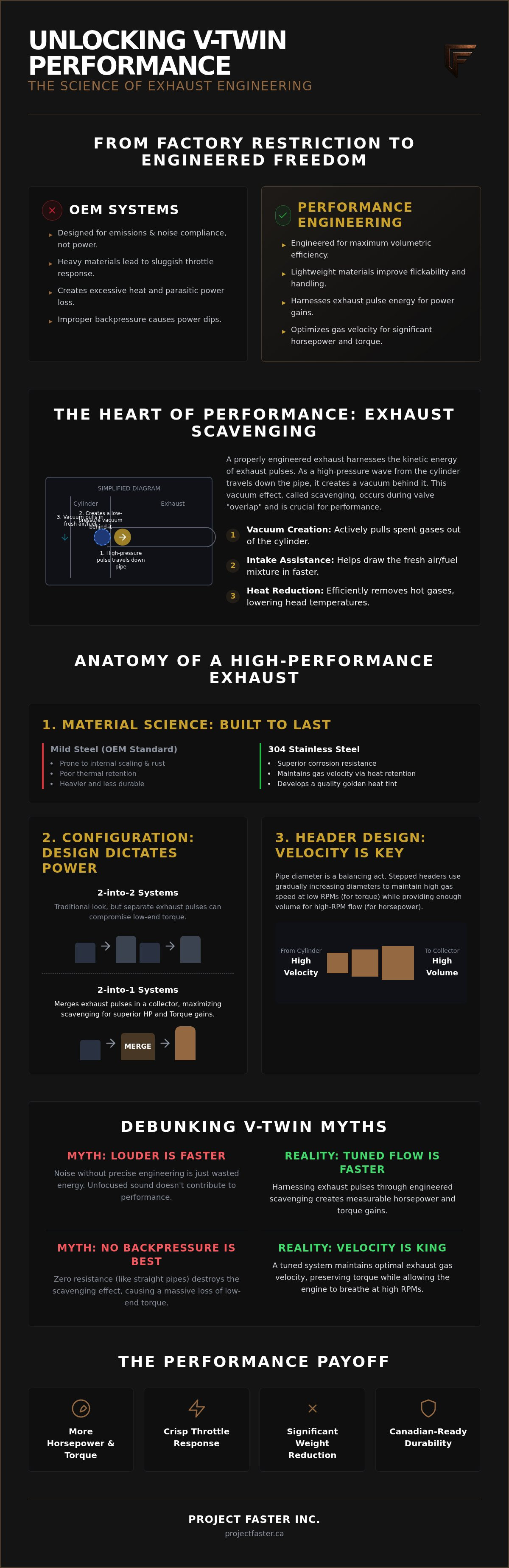
A high performance exhaust for v-twin engines is a precision instrument designed to manage fluid dynamics, not just a louder version of a factory pipe. While Original Equipment Manufacturer (OEM) systems are engineered to satisfy strict noise and emissions regulations, performance engineering focuses on volumetric efficiency. Factory pipes often suffocate the engine, creating excessive heat and parasitic power loss. Real performance comes from the science of Tuned Exhaust Systems, where the kinetic energy of the exhaust pulse is harnessed to improve engine breathing.
The primary mechanism at work here is scavenging. When an exhaust valve opens, a high-pressure pulse travels down the pipe. As this pulse moves, it creates a low-pressure area behind it. A properly designed system ensures:
- Vacuum Creation: The low-pressure wave reaches the exhaust valve during the "overlap" period.
- Intake Assistance: The vacuum pulls fresh air and fuel into the combustion chamber.
- Heat Reduction: Spent gases are removed more efficiently, lowering cylinder head temperatures.
This "overlap" period is where horsepower is either won or lost. Without this pressure management, the engine must work harder to push out spent gases, wasting energy that should be going to the rear wheel.
The Physics of Exhaust Gas Velocity
Pipe diameter is a critical balancing act in exhaust design. If the pipe is too wide, the exhaust gas expands, cools, and slows down, which destroys the scavenging effect. Conversely, if it's too narrow, it creates a physical restriction that prevents the engine from exhaling at high RPMs. Stepped headers solve this by using multiple diameters that gradually increase as the gas moves away from the cylinder head. This configuration maintains high gas speed at low RPMs to preserve torque, while providing enough volume for high-end flow. Velocity, not just volume, determines the power curve.
Backpressure vs. Flow: Finding the Sweet Spot
One of the most persistent myths in the V-Twin world is that "no backpressure is better." In reality, a total lack of resistance, such as straight pipes, often leads to a massive loss in low-end torque because it ruins the scavenging timing. A high performance exhaust for v-twin applications uses a tuned collector to balance the pulses from the front and rear cylinders. The collector acts as a junction point where the two streams merge, preventing "reversion" where exhaust gases are pushed back into the cylinder. A well-designed merge collector ensures that torque remains high in the cruising range while allowing the engine to breathe freely when you open the throttle. You can explore our range of precision-engineered components in our full performance collection.
Key Features to Compare When Shopping for V-Twin Exhausts
Selecting a high performance exhaust for v-twin motorcycles is a decision rooted in metallurgy and mechanical design. It's not merely about the external finish; it's about how the system handles extreme thermal cycles and corrosive environments. While mild steel was once the industry standard, it's prone to internal scaling and external rust, especially in the variable Canadian climate. Modern performance standards demand materials that offer both structural integrity and thermal efficiency.
Material Science: Why 304 Stainless Steel Rules
For the serious rider, 304 Stainless Steel represents the engineering sweet spot between weight, durability, and cost. It possesses superior thermal retention properties compared to mild steel, which helps maintain exhaust gas temperature and velocity. In Canada, where riders face everything from humid coastal air to salt-dusted roads, the high chromium and nickel content of 304 stainless provides essential corrosion resistance. Over time, these systems develop a distinct gold or straw-coloured heat tint. This transformation is a badge of quality, indicating the metal has successfully stabilized under the intense heat loads of a high-output engine.
2-into-1 vs. 2-into-2 Configurations
The debate between 2-into-1 and 2-into-2 systems is often a conflict between tradition and physics. If your objective is measurable horsepower and torque gains, the 2-into-1 configuration is the undisputed gold standard. By merging the pulses from both cylinders into a single collector, the system uses the scavenging effect discussed in the previous section to pull spent gases out more effectively. This creates a more consistent power curve and eliminates the "dip" often found in 2-into-2 systems. While dual pipes offer a classic symmetrical aesthetic, they lack the shared volume necessary for optimized pressure wave timing.
The internal geometry of the junction where these pipes meet is just as critical as the layout itself. Standard T-junctions create significant turbulence, which acts as a bottleneck for gas flow. High-flow merge collectors are engineered with a gradual taper to ensure a smooth transition, minimizing friction and keeping gas speed high. A deep dive into Exhaust System Fluid Dynamics reveals that even minor imperfections in collector design can lead to power-robbing reversion pulses. Precision-manufactured collectors ensure that each exhaust pulse helps the next, rather than hindering it.
Beyond raw power, weight reduction is a primary benefit of a high performance exhaust for v-twin builds. Factory systems are notoriously heavy, often utilizing thick-walled steel and restrictive internal baffling that can weigh upwards of 35 lbs. Upgrading to a professional-grade stainless system can shed 20 lbs or more. Because this weight is positioned relatively low and to one side, removing it significantly improves the motorcycle's balance and flickability in corners. If you're looking for a technical recommendation on which configuration fits your performance goals, you can reach out to our engineering team for a consultation.
Matching Your Exhaust to Your Specific V-Twin Platform
Every engine family presents unique pneumatic challenges. A high performance exhaust for v-twin builds must be tailored to the specific displacement and head design of the machine. For instance, the Twin Cam platform often suffers from excessive heat soak and restricted flow in the mid-range. Upgrading to a system with optimized header lengths helps evacuate these gases, reducing thermal stress on the rear cylinder and preventing the power fade often associated with long rides in the Canadian summer.
Optimizing the M8 Platform
The Milwaukee-Eight engine, with its four-valve head, is capable of moving significantly more air than its predecessors. To realize its full potential, the exhaust must provide a high-flow path that doesn't choke the engine as it climbs toward the redline. Using high performance Harley parts that work in synergy ensures that the increased intake volume is matched by an equally efficient exhaust exit. Without this balance, the M8's advanced head design is essentially throttled by its own backpressure.
Chassis Integration and Lean Angle
Performance is measured by more than just a dyno sheet. It's found in how the motorcycle behaves in a deep lean. A common failure in aftermarket design is a pipe that sits too low, sacrificing ground clearance for aesthetics. Engineering a high performance exhaust for v-twin applications requires a tucked profile that preserves maximum lean angle for aggressive cornering. This focus on handling is why we recommend pairing your exhaust with a PF Mako Billet Swing Arm to achieve total rear-end stability and precision. The mounting system should also be rigid enough to act as a stressed member of the chassis, minimizing vibration and potential bracket failure.
Precision fuel management is impossible without accurate data. High-end systems include dual O2 sensor bungs, allowing for the installation of wide-band sensors. This is essential for professional-grade tuning, ensuring that the air-fuel ratio is optimized across the entire RPM range for both power and engine longevity. Proper fitment also considers the difference between Softail and Touring frames. While Touring models require bag clearance, Softail builds often prioritize a more compact, aggressive line. Regardless of the platform, the goal remains the same: maximizing mechanical efficiency through superior engineering.
Standout Performance: The PF Liberator High-HP Exhaust
The PF Liberator is not a generic bolt-on upgrade; it's a purpose-built high performance exhaust for v-twin engines that require maximum throughput. Every unit is engineered by Project Faster Inc. to handle the extreme demands of high-compression builds and aggressive cam profiles. By utilizing 304 stainless steel and precision TIG welding, the team at Project Faster Inc. ensures every joint is a point of strength rather than a potential mechanical weakness. The result is a system that maintains structural integrity under thermal loads that would cause inferior materials to crack or blue excessively. It's a foundational component for any rider who views their motorcycle as a serious piece of machinery.
Why the Liberator Outperforms the Competition
Many aftermarket pipes prioritize volume over velocity, resulting in a bike that's loud but sluggish. The PF Liberator takes the opposite approach, using stepped headers to accelerate exhaust gases and a high-flow merge collector to eliminate the power-robbing effects of reversion. Project Faster Inc. relies on dyno-proven results to ensure that riders with upgraded displacement or performance cams see a tangible increase across the entire power curve. It delivers a deep, authoritative growl that signals mechanical quality at cruising speeds without the ear-splitting rasp of a straight pipe. You can shop the PF Liberator and other performance exhausts in our current collection.
Synergy with Other Project Faster Inc. Components
A high-output engine requires a chassis that can handle the increased torque without compromising stability. The PF Liberator is engineered to work in perfect harmony with the PF Vector Billet Swing Arm. While the exhaust provides the raw power, the swing arm ensures that energy is efficiently transferred to the pavement with zero lateral flex. This combination transforms the handling characteristics of the bike, making it feel more planted and responsive during aggressive acceleration.
To further refine the build, we recommend integrating titanium bolt kits into the assembly. These kits significantly reduce unsprung weight, complementing the 20-lb weight savings of the stainless exhaust for better overall flickability and suspension response. Building a comprehensive performance package means looking at the motorcycle as a single, integrated machine rather than a collection of unrelated parts. If you need assistance selecting the right technical components for your specific engine build, contact the technical specialists at Project Faster Inc. for an engineering-first consultation.
Common Mistakes to Avoid and Next Steps
Investing in a high performance exhaust for v-twin engines is a significant step toward mechanical excellence, but the installation is only half the battle. Many riders undermine their hardware by neglecting the supporting modifications required to make the system function correctly. A high-output exhaust changes the volumetric efficiency of the engine, which means the factory settings are no longer sufficient. Ignoring these technical requirements doesn't just cost you horsepower; it puts the structural integrity of your engine at risk.
The Necessity of EFI Tuning
Installing a full performance system without recalibrating the Electronic Fuel Injection (EFI) is a recipe for mechanical failure. When you increase the airflow through the engine, the factory fuel map becomes dangerously inadequate. This results in a lean condition, where the air-to-fuel ratio is too high, leading to excessive combustion chamber temperatures. Over time, this heat can cause permanent damage to valves and pistons. You must use a high-quality fuel mapper to ensure the engine receives the additional fuel it now demands. We strongly recommend consulting a professional tuner to dial in your specific configuration after the installation is complete.
Another frequent error is prioritizing a specific sound profile over the actual power curve. While a deep note is a desirable byproduct of quality engineering, selecting a pipe based solely on its volume often leads to flat spots in the RPM range. Additionally, many riders overlook the importance of heat management. In the high-stress environment of a performance build, managing radiant heat is essential to protect both the rider and sensitive electronic components. Utilizing precision-fitted heat shields helps maintain gas velocity inside the pipe while keeping external temperatures under control, ensuring your components survive the rigours of Canadian riding conditions.
Planning Your Performance Build
A successful performance build is usually executed in stages to ensure every component works in synergy. Most riders begin with the "Big Three": a high-flow intake, a high performance exhaust for v-twin engines, and a comprehensive tune. This Stage I setup provides the foundation for more advanced modifications. Once this baseline is established, you can move to Stage II, which involves upgrading the camshafts to further leverage the increased flow capacity of your exhaust system. Planning your build in this methodical way ensures that every component reinforces the next rather than fighting for efficiency. To begin your project, explore our full collection of V-Twin exhausts and select the system that matches your engineering goals.
Realizing Your V-Twin's Mechanical Potential
Selecting a high performance exhaust for v-twin engines is a commitment to mechanical integrity and measurable results. We've established that true power is a product of fluid dynamics and scavenging rather than mere volume. By choosing precision-engineered components like the PF Liberator, you're investing in TIG-welded 304 stainless steel optimized for maximum horsepower. Remember that hardware is only one part of the equation; proper EFI tuning and chassis synergy are vital to ensure your machine performs as a cohesive unit. We provide national Canadian shipping and technical support to ensure your build is backed by engineering expertise from start to finish.
If you're ready to eliminate mechanical bottlenecks and transform your riding experience, our team is here to provide the technical guidance you need. Consult with our engineering specialists today to find the perfect exhaust solution for your specific performance goals. It's time to stop settling for restrictive factory standards and start experiencing the uncompromising power your V-Twin was designed to deliver.
Frequently Asked Questions
Do I need to remap my V-Twin after installing a high-performance exhaust?
You must remap your engine control module (ECM) whenever you install a full high performance exhaust for v-twin engines. Changing the exhaust geometry alters the volumetric efficiency, meaning the factory fuel map will likely run too lean. This lean condition increases cylinder head temperatures and can lead to permanent internal damage if not corrected with a professional tune or a high-quality fuel management system.
What is the difference between a 2-into-1 and a 2-into-2 exhaust system?
A 2-into-1 system is engineered to maximize scavenging by merging exhaust pulses into a single collector, which pulls spent gases out of the combustion chamber more effectively. In contrast, a 2-into-2 system maintains separate paths for each cylinder, which often results in a dip in the torque curve. While dual pipes provide a traditional aesthetic, they cannot match the horsepower gains of a merged system.
Will a high-performance exhaust void my motorcycle’s warranty?
Installing an aftermarket exhaust does not automatically void your entire motorcycle warranty in Canada, though it may affect coverage for engine components directly impacted by the change. Manufacturers generally cannot deny a warranty claim unless they prove the aftermarket part caused the specific failure. It's advisable to speak with your local dealer to understand their specific policies regarding performance modifications and how they handle aftermarket hardware.
How much horsepower can I actually gain from a performance exhaust?
Horsepower gains typically range from 5% to 15% depending on your engine platform and the quality of the accompanying tune. For example, a Milwaukee-Eight engine responds exceptionally well to high-flow headers because of its advanced four-valve head design. These gains are most noticeable when the exhaust is paired with a high-flow intake and a Stage II cam upgrade, allowing the engine to breathe without restriction.
Why do some performance exhausts turn blue or gold over time?
The colour change on your pipes is a natural result of heat cycles affecting the chromium content in stainless steel. A straw or gold tint indicates normal operating temperatures and is a sign of high-quality material stabilizing under load. However, deep blue or purple tinting near the cylinder heads often signals an excessively lean condition that requires immediate fuel mapping adjustments to prevent the engine from overheating.
Are high-performance exhausts much louder than stock pipes?
Performance exhausts are generally louder than stock, but the focus is on the quality of the note rather than sheer volume. A well-engineered system provides a deep, authoritative growl that reflects the engine's mechanical efficiency and high-grade construction. Avoid straight pipes that prioritize noise, as they often destroy backpressure and reduce overall torque in the cruising range where most riders spend their time.
What materials are best for a durable V-Twin exhaust system?
304 Stainless Steel and Titanium are the superior choices for a high performance exhaust for v-twin motorcycles due to their exceptional strength-to-weight ratios. High-grade stainless steel offers excellent corrosion resistance in the variable Canadian climate and maintains structural integrity under extreme heat. Titanium provides even greater weight savings, which improves the bike's flickability and overall handling balance by reducing the mass hanging off the chassis.
Can I install a full exhaust system myself, or do I need a professional?
You can install a full exhaust system yourself if you possess the proper tools and mechanical aptitude, but professional installation is often recommended to ensure a leak-free seal. Precise fitment at the cylinder head is critical to prevent exhaust leaks that can skew O2 sensor readings and negatively impact performance. A professional shop can also verify that the O2 sensors are correctly positioned for accurate wide-band tuning.