

An exhaust system is a precision-engineered fluid dynamics tool, not a noise maker. While many riders prioritize the signature V-Twin rumble, focusing solely on sound ignores the physics that drive real-world performance. You likely realize that your factory pipes are a compromise of mass-production costs and restrictive emissions standards. They're heavy, they trap excessive heat, and they create backpressure that stifles your engine's potential. Understanding Harley performance exhaust benefits starts with recognizing that your exhaust functions as the lungs of your motorcycle. If it can't exhale efficiently, your high-displacement engine can't breathe in the air it needs to produce maximum power.
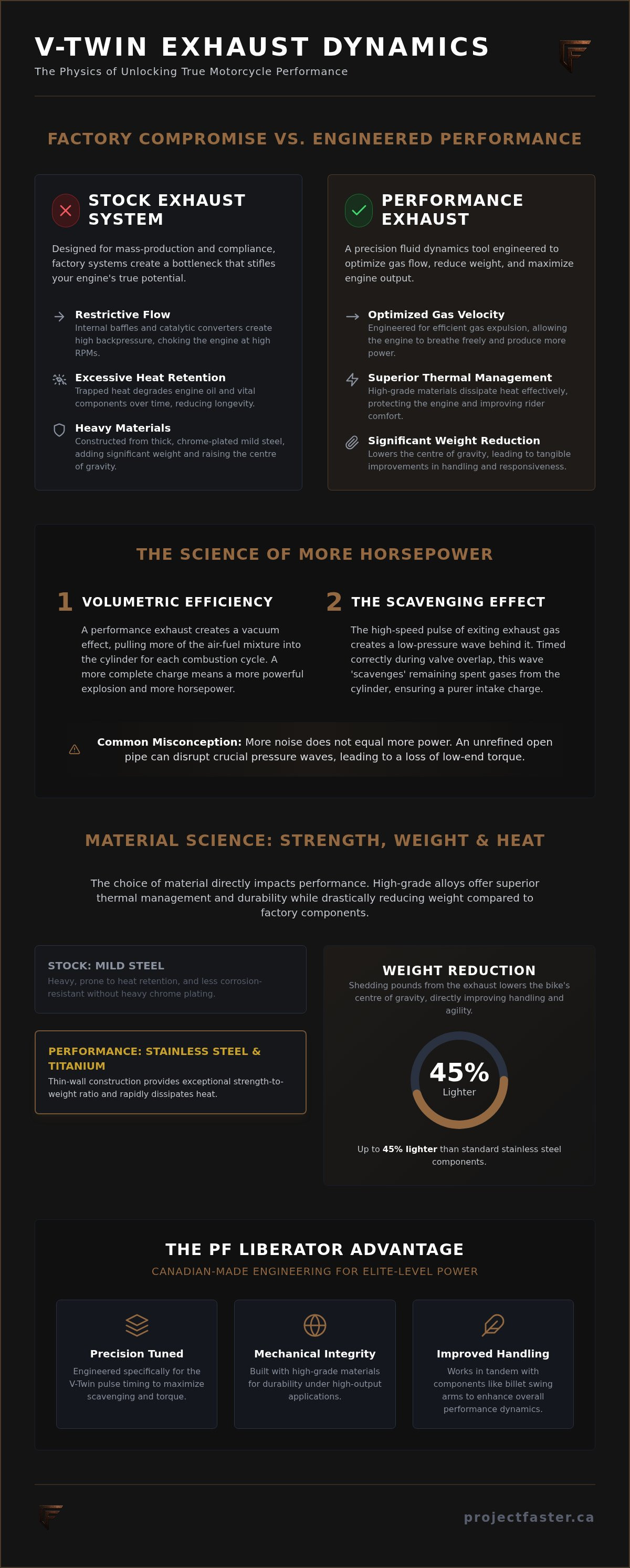
We agree that the lack of transparent performance data from generic brands makes choosing an upgrade difficult. You want more than just a louder bike; you need measurable gains in torque and a machine that handles better through reduced weight. This article explains how optimizing exhaust velocity and scavenging can unlock significant horsepower for your V-Twin. We will examine the mechanical advantages of high-grade materials and explain why a precision system is engineered to dissipate heat while shedding up to 45% of the weight compared to standard stainless steel components.
Key Takeaways
- Understand how a precision-engineered system optimizes fluid dynamics to remove combustion gases more efficiently than restrictive factory components.
- Learn how the scavenging effect uses gas velocity to increase volumetric efficiency, proving that Harley performance exhaust benefits extend far beyond just sound.
- Discover why thin-wall stainless steel and titanium offer superior thermal management and weight reduction compared to heavy, traditional chrome-plated mild steel.
- Explore how a lighter exhaust system lowers the centre of gravity and works in tandem with components like the Vector billet swing arm to improve overall handling.
- Gain insight into the Canadian-made PF Liberator High-HP Exhaust, designed specifically for elite-level power and mechanical integrity.
The Physics of Power: How Performance Exhausts Transform V-Twin Engines
A performance exhaust system functions as a critical fluid dynamics component, engineered specifically to manage the exit of combustion gases. It's not merely an aesthetic upgrade. In the context of a high-output V-Twin, the exhaust acts as a regulator for thermal energy and kinetic velocity. While stock pipes prioritize compliance and cost, a dedicated system like the PF Liberator High-HP Exhaust focuses on mechanical integrity and flow optimization. Realizing the full extent of Harley performance exhaust benefits requires looking past the chrome and examining how gas velocity directly impacts the combustion cycle. High performance is a matter of physics, not volume. A common misconception is that a louder pipe automatically generates more power. In reality, an unrefined, open pipe can disrupt the pressure waves necessary for proper engine tuning, leading to a loss of low-end torque.
Stock vs. Performance: The Flow Restriction Problem
Factory-standard Harley systems are inherently restrictive due to mass-production compromises. Internal baffles and catalytic converters are designed to dampen sound and scrub emissions, but they simultaneously create excessive backpressure. This creates a bottleneck effect. At high RPMs, the engine struggles to push spent gases out through these narrow, convoluted passages. This restriction also traps heat within the cylinder head, which can lead to thermal degradation of engine oil and components. A performance system eliminates these obstructions, ensuring the cylinder is completely cleared during the exhaust stroke. By reducing this resistance, the engine spends less energy pumping out exhaust and more energy driving the rear wheel. This efficiency is especially noticeable when the bike is pushed toward its redline.
The Engineering Goal: Optimizing Volumetric Efficiency
Volumetric efficiency is the ratio of the actual air-fuel mixture mass drawn into the cylinder compared to the mass that would fill the cylinder's static volume under atmospheric pressure. A high-flow exhaust system improves this ratio by reducing the residual gas left in the combustion chamber. This allows for a significantly denser intake charge, which is essential for increasing horsepower. For maximum gains, the exhaust flow must be precisely matched to the engine displacement and cam profile. The PF Liberator is engineered to maintain this balance, ensuring that high-HP applications aren't choked by insufficient gas velocity. When the exhaust system is tuned to the engine's requirements, it creates a vacuum effect that pulls in the next intake charge more effectively, maximizing every combustion cycle.
Maximizing Horsepower and Torque Through Scavenging and Backpressure
Harnessing fluid dynamics for a V-Twin requires more than just removing restrictions. It demands the precise timing of gas pulses to assist the engine's natural cycle. While the previous section established that an exhaust is a tool for gas exit, its most critical function is scavenging. This process uses the kinetic energy of moving exhaust gases to create a vacuum, effectively "pulling" the next intake charge into the combustion chamber. When you evaluate Harley performance exhaust benefits, the ability to manipulate these pressure waves is what separates a high-end system from a basic pipe. Achieving this balance is a matter of calculating pipe length and diameter to match the specific pulse timing of the 45-degree V-Twin architecture.
The Scavenging Process Explained
When the exhaust valve opens, a high-pressure pulse is ejected into the header. As this pulse travels at high speed toward the exit, it leaves a low-pressure zone, or vacuum, in its wake. This vacuum occurs during the "valve overlap" period, when both the intake and exhaust valves are briefly open at the same time. A well-engineered system uses this vacuum to suck residual spent gases out of the cylinder while simultaneously drawing in the fresh air-fuel mixture. This cleansing of the combustion chamber ensures a purer, more energetic explosion on the next stroke. The result is a significant increase in volumetric efficiency and the crisp, immediate throttle response that performance riders expect from a professional build.
Balancing Backpressure for Real-World Torque
A common mechanical fallacy suggests that engines "need" backpressure to maintain low-end torque. In reality, backpressure is simply resistance, and resistance is never the goal. What an engine actually requires is high gas velocity. If a pipe is too large, the gas slows down, the scavenging effect weakens, and torque disappears. The PF Liberator High-HP Exhaust solves this through a stepped-header design. By starting with a narrower diameter at the exhaust port and increasing it in specific increments, the system maintains high velocity at low RPMs while providing the necessary volume for high-RPM flow. This prevents the "torque dips" often found in generic aftermarket exhausts. For riders seeking a technical breakdown of how these pulse timings affect their specific engine configuration, you can reach out to our technical team for a consultation.
In 2-into-1 systems, the collector serves as the mechanical bridge where these pulses merge. A precision-engineered collector ensures that the pulse from the front cylinder helps scavenge the rear cylinder and vice versa. This creates a continuous, rhythmic draw that stabilizes the powerband. By balancing these pressure waves, the exhaust system allows the engine to breathe consistently across the entire rev range, maximizing both peak horsepower and usable street torque.
Material Science: Why Stainless Steel and Titanium Outperform Chrome
Material selection is the foundation of mechanical integrity in any high-output build. While factory systems typically rely on heavy, chrome-plated mild steel for aesthetic appeal and cost-efficiency, performance engineering demands industrial-grade alloys. The transition from decorative plating to materials like 304 stainless steel or titanium represents one of the most significant Harley performance exhaust benefits. These alloys are not chosen for their shine, but for their specific thermal properties and superior strength-to-weight ratios. In a high-performance application, every gram of unnecessary mass and every degree of trapped heat works against the engine's efficiency.
Thermal Management and Heat Dissipation
High-grade stainless steel, particularly thin-wall tubing, dissipates heat far more effectively than traditional mild steel. Thick factory pipes act as thermal insulators, trapping heat within the exhaust tract and radiating it back toward the engine cases and the rider. By contrast, specialized alloys allow heat to escape the system quickly. This rapid dissipation helps maintain lower oil temperatures and protects sensitive engine components from thermal degradation. In the Canadian climate, where temperature fluctuations can be extreme, the corrosion resistance of these alloys is equally vital. Unlike chrome, which can flake or "blue" unevenly when subjected to road salt and moisture, stainless steel and titanium develop a consistent, durable patina that reflects the system's heat cycles without compromising structural thickness.
Weight Reduction and the Power-to-Weight Ratio
Removing a stock exhaust system often sheds between 10 and 15 lbs of dead weight from the motorcycle's profile. According to industry data, a titanium exhaust system can be 40% to 45% lighter than a comparable stainless steel unit. This reduction in mass directly improves the power-to-weight ratio, allowing the engine's torque to move the bike with less effort. More importantly, this weight loss occurs away from the motorcycle's centre of gravity, which has a profound impact on handling. Reducing this "sprung weight" allows the suspension to react more precisely to road imperfections, as there is less inertia for the shocks to manage. The PF Liberator is engineered to minimize this mass, providing a streamlined profile that enhances agility during aggressive cornering.
The engineering of a truly elite-level bike involves looking at the machine as a cohesive unit. To further optimize your build, many riders pair these systems with titanium bolt kits to eliminate excess weight from every mounting point. Over time, the material choice also dictates the visual character of the bike. While stainless steel matures into a deep gold or straw colour, titanium develops a distinctive blue and purple hue at the headers. These changes are not defects; they are the visible markers of an exhaust system that is successfully managing the intense thermal energy of a high-HP V-Twin.
Beyond the Dyno: Handling, Centre of Gravity, and Heat
Performance is not measured solely on a dynamometer. While peak power figures are impressive, the physical architecture of an exhaust system fundamentally alters the motorcycle's chassis dynamics. One of the most overlooked Harley performance exhaust benefits is the redistribution of mass. Stock systems are frequently bulky and positioned low and wide, which creates a high polar moment of inertia. By replacing these heavy factory components with a streamlined, high-clearance system, you move the weight closer to the machine's longitudinal axis. This mass centralization makes the bike feel lighter and more responsive during rapid transitions. A motorcycle that is easier to lean is a motorcycle that can carry more speed through a technical section.
Optimizing the Centre of Gravity
Moving mass toward the bike's centre improves what engineers call flickability. A tucked-in, high-performance pipe provides the necessary ground clearance for aggressive lean angles, ensuring that the exhaust isn't the limiting factor in a corner. This reduction in outboard weight complements other high-performance chassis upgrades. For instance, the reduced mass of a Vector billet swing arm works in synergy with a lighter exhaust to stabilize the rear end under heavy acceleration. When you remove significant weight from the side of the bike, you're not just gaining speed; you're refining the balance of the entire machine. This allows the suspension to work more efficiently, as there is less lateral weight pulling the bike off its line during mid-corner bumps.
Rider Comfort and Component Protection
Heat management is a critical factor in maintaining mechanical integrity. V-Twin engines are prone to heat soak, particularly in the rear cylinder which receives less direct airflow. Restrictive stock pipes exacerbate this by trapping hot gases near the cylinder head. A precision-engineered exhaust system facilitates rapid gas exit, which significantly reduces the radiant heat felt on the rider's leg. This is not just about comfort. Lower operating temperatures protect sensitive electronics, gaskets, and wiring harnesses from premature failure. By mitigating thermal stress, you're ensuring the long-term reliability of your build. A cooler-running engine maintains more consistent power delivery, as it's less likely to retard ignition timing due to excessive cylinder head temperatures. If you're planning a high-output build and need a technical assessment of your chassis balance, contact our engineering team for specific recommendations.
The PF Liberator Advantage: Engineering Excellence for Your Harley
The PF Liberator High-HP Exhaust is the culmination of rigorous fluid dynamics testing and Canadian manufacturing expertise. While many aftermarket options prioritize a specific look or a generic sound profile, we engineer our systems for riders who demand elite-level power. This system isn't just an accessory. It's a specialized component designed to maximize Harley performance exhaust benefits by utilizing stepped-header geometry and high-velocity collectors. Every weld and every bend is calculated to eliminate the mechanical weaknesses found in factory pipes. By focusing on the physics of gas flow, we provide a foundation for engines producing high horsepower and torque figures that generic systems simply cannot support. We realize that performance is a matter of precision, not just volume.
Precision Manufacturing and Fitment
The structural integrity of the PF Liberator begins with CNC-machined flanges. These components ensure a perfectly flat mating surface for a leak-free seal at the exhaust port, preventing the turbulence that often plagues lower-quality systems. Our philosophy prioritizes uncompromising performance over aesthetic trends. This engineering-first perspective ensures that the exhaust works in total harmony with other specialized parts. For instance, the high-clearance design of the Liberator creates the necessary space to showcase and support the Mako Billet Swing Arm. This combination transforms the rear of the motorcycle into a rigid, high-performance assembly capable of handling extreme power delivery without chassis flex.
Next Steps for Your Performance Build
Installing a high-flow system like the PF Liberator changes the volumetric efficiency of your engine. Because the engine is now breathing more effectively, an ECU re-tune is mandatory to optimize the air-fuel ratio and ignition timing. Running a performance exhaust without a proper tune can lead to lean conditions and excessive heat. We advocate for a holistic approach to every build. Power is only useful if you can control it. This means balancing your new-found horsepower with upgrades to your handling and braking systems. If you're building a specialized high-horsepower machine and require technical guidance on fitment or performance projections, contact the Project Faster engineering team for a professional consultation. We specialize in components for riders who value mechanical excellence and real-world results.
Elevating Your V-Twin Build Through Precision Engineering
A high-performance build requires more than just a collection of parts. It demands a cohesive strategy where every component works in harmony to maximize efficiency. We have explored how a precision-engineered system optimizes fluid dynamics and scavenging to clear combustion gases effectively. By transitioning to industrial-grade alloys like stainless steel and titanium, you significantly reduce weight and improve thermal management. Realizing the full spectrum of Harley performance exhaust benefits means moving beyond aesthetic upgrades and focusing on the physics of gas velocity and chassis balance. This engineering-first approach ensures that your motorcycle handles with the same intensity that it accelerates.
Project Faster specializes in high-HP V-Twin applications, providing engineer-certified components that are manufactured in Canada for uncompromising durability. Whether you're looking to shed mass or unlock peak torque, our team is ready to assist with technical insights tailored to your specific goals. Ready to optimize your V-Twin's performance? Contact Project Faster for expert advice on the PF Liberator exhaust. Your machine is capable of elite-level power; it simply needs the right engineering to reach its potential.
Frequently Asked Questions
How much horsepower can I realistically gain with a Harley performance exhaust?
You can realistically gain up to 25 horsepower on a Milwaukee-Eight Softail when pairing a full exhaust system with a high-flow intake and proper tuning. These gains are achieved by reducing the backpressure inherent in stock systems and optimizing the engine's volumetric efficiency. The specific increase depends on your engine displacement and cam profile, but a high-HP system ensures the exhaust doesn't become the bottleneck in your performance build.
Does a performance exhaust require a new fuel map or tuner?
Yes, a new fuel map or electronic tuner is essential to realize the full Harley performance exhaust benefits and protect your engine. Installing a high-flow system increases the amount of air moving through the cylinder, which requires a corresponding increase in fuel delivery to maintain a safe air-fuel ratio. Without a re-tune, your engine will likely run lean, leading to excessive heat and potential long-term mechanical damage.
What is the difference between a 2-into-1 and a 2-into-2 exhaust system?
A 2-into-1 system is engineered for maximum performance by using a collector to merge exhaust pulses, which creates a scavenging effect that pulls spent gases from the cylinders. In contrast, 2-into-2 systems are typically chosen for their traditional aesthetic and symmetrical look but often lack the pulse-timing advantages of a merged system. For riders prioritizing peak horsepower and a broad torque curve, the 2-into-1 configuration is the superior technical choice.
Will a performance exhaust make my Harley engine run hotter or cooler?
A performance exhaust helps your engine run cooler by facilitating the rapid exit of high-temperature combustion gases. Stock systems, often equipped with dense baffles and catalytic converters, trap heat near the cylinder heads and radiate it back toward the engine cases. By utilizing thin-wall stainless steel or titanium, a high-performance system dissipates this thermal energy more efficiently, protecting your oil integrity and increasing rider comfort during extended operation.
How does reducing exhaust weight affect the handling of my motorcycle?
Reducing exhaust weight by 10 to 15 lbs significantly lowers the motorcycle's polar moment of inertia, making the bike more responsive to rider input. Removing this mass from the side of the machine centralizes weight and allows the suspension to react more precisely to road imperfections. This reduction in sprung weight improves the flickability of the chassis, allowing you to maximize Harley performance exhaust benefits by carrying more speed through technical corners.
Is stainless steel or titanium better for a high-performance Harley exhaust?
Titanium is the superior choice for elite builds where weight reduction is the primary objective, as it is approximately 45% lighter than stainless steel. However, high-quality 304 stainless steel remains the industry standard for most performance applications due to its excellent durability, corrosion resistance, and thermal management properties. While titanium offers a unique blue patina and maximum weight savings, both materials outperform traditional chrome-plated mild steel in every technical metric.
Can a performance exhaust damage my V-Twin engine if not tuned properly?
An untuned performance exhaust can damage your V-Twin engine by causing it to run in a dangerously lean state. When the exhaust flow is increased without adjusting the fuel map, the combustion temperature rises significantly, which can lead to burnt valves, damaged spark plugs, or even piston failure. Ensuring your ECU is recalibrated to match the new flow characteristics is a critical step in maintaining mechanical integrity and engine longevity.
Why is the PF Liberator considered a high-HP exhaust compared to slip-ons?
The PF Liberator is a full, high-performance system designed with stepped headers and a tuned collector, whereas slip-ons only replace the mufflers and retain the restrictive factory head pipes. Slip-ons are primarily aesthetic and sound-focused upgrades that offer minimal performance gains. The Liberator is engineered as a complete fluid dynamics tool, optimizing gas velocity from the exhaust port to the exit for maximum horsepower and torque in high-output applications.